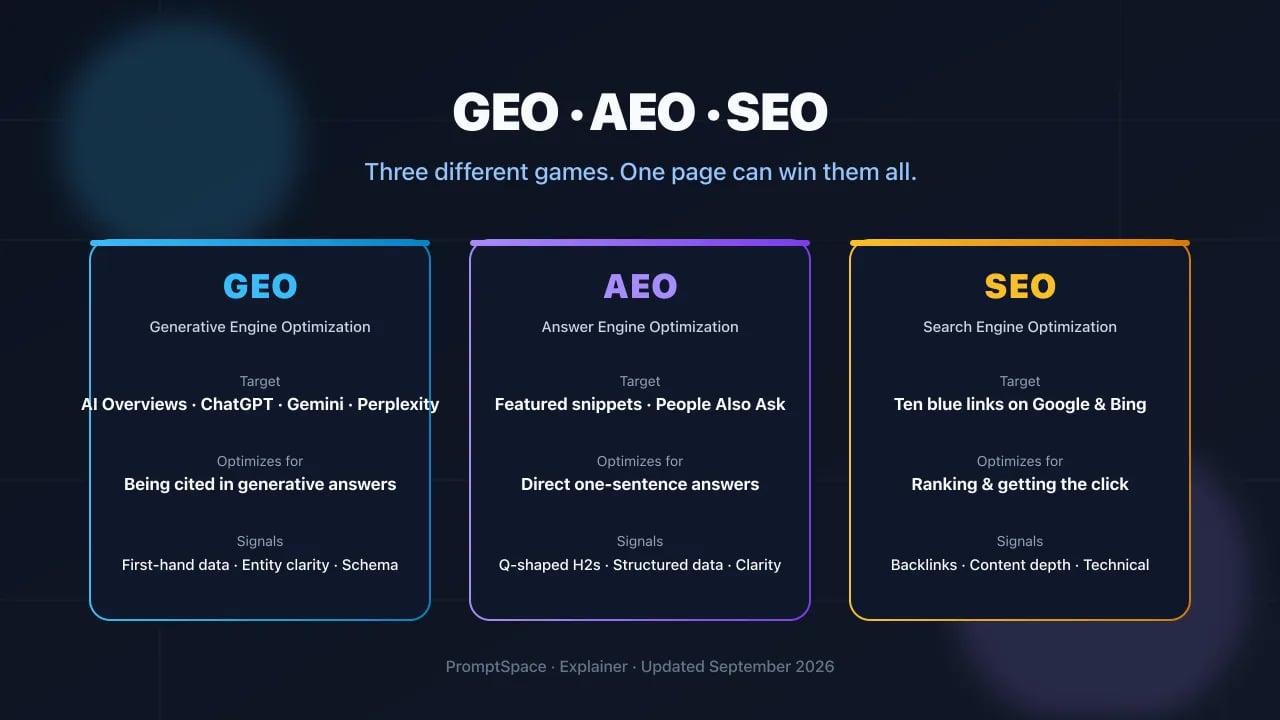
GEO, AEO and SEO are three overlapping games with different scoreboards. SEO gets you ranked on the classic ten blue links. AEO gets you extracted into a featured snippet or People Also Ask card. GEO gets you cited inside a generated answer from Google AI Overviews, ChatGPT, Gemini, or Perplexity. In 2026 the same page can win all three — but only if you write with all three in mind from the first draft.
TL;DR. SEO ranks a URL. AEO extracts a passage from that URL. GEO cites your brand, entity, or data point inside an AI-generated answer. The overlap is real; the optimizations are not identical.
Quick answer: SEO ranks, AEO extracts, GEO cites
SEO (Search Engine Optimization) is the discipline of ranking a URL in traditional search results — Google, Bing, DuckDuckGo. Success looks like a top-10 position for a target query. AEO (Answer Engine Optimization) is the discipline of getting a passage from your page pulled into a direct-answer surface — featured snippets, People Also Ask, voice answers. Success looks like your paragraph rendered above the ten blue links. GEO (Generative Engine Optimization) is the discipline of being cited or quoted inside an AI-generated answer from a generative search engine. Success looks like your brand name, statistic, or product surfacing when a user asks an LLM a question — and, crucially, the little citation link that sends traffic back to you.
Why the acronym stack matters in 2026
Because the SERP is no longer just a SERP. Google introduced AI Overviews in 2024 and then launched an experimental "AI Mode" inside Search in March 2025, which routes complex multi-part queries into a Gemini-powered conversational surface with multimodal input. ChatGPT added a live web search product in late 2024. Perplexity became a mainstream research tool. Gemini went from a chatbot (rebranded from Bard in February 2024) to a search-adjacent product available in more than 80 languages across 239 countries.
Users increasingly resolve informational queries inside a generated answer without ever clicking a blue link. Ahrefs and several industry trackers have documented a large jump in "answered-in-place" queries and a corresponding compression of top-of-funnel organic clicks for content that used to win by default. Meanwhile, the same underlying LLMs cite web pages. If yours is one of them, you keep some of that lost visibility and gain a new kind of brand mention that traditional rank trackers do not measure.
This is why the three-letter acronyms multiplied. SEO is not dead. It is just no longer the only channel that matters for a single query.
SEO in one paragraph
SEO is the practice of getting a URL to rank in the traditional list of results. The scoreboard is Google Search Console: impressions, average position, clicks, click-through rate for a keyword and URL pair. The dominant signals in 2026 are still the classic three — relevance (does the page match the query intent?), authority (do trusted sites link to it, and does the domain have topical depth?), and technical health (crawlability, speed, Core Web Vitals, mobile usability). The playbook you learned in 2018 mostly still works. What changed is that ranking in position 1–3 no longer guarantees traffic, because an AI Overview may answer the question before the click.
Typical SEO wins: ranking for a commercial intent query like "best CRM for freelancers", a long-tail informational query like "how to fix a leaking radiator valve", or a branded query like "PromptSpace prompt library". These queries still generate ten-link SERPs a lot of the time, especially transactional ones.
AEO in one paragraph
AEO is the practice of getting a passage from your page extracted into a direct-answer surface. The oldest example is the featured snippet — the "position zero" paragraph, list, or table Google pulls above the organic results. The scoreboard is which queries show a snippet, whose page is the source, and how the snippet is formatted (paragraph, list, table, or definition). AEO overlaps heavily with voice search: Alexa, Google Assistant, and Siri typically read back the snippet source when the query has an answer.
Where SEO signals are largely off-page (backlinks, authority, freshness), AEO signals are largely on-page: does the H2 mirror the question, does the immediately-following sentence answer it, is the answer 40–60 words for paragraph snippets, is the list marked up as a real HTML list, is FAQPage schema present. AEO is what most SEOs already did in 2020 under a different name.
GEO in one paragraph
GEO is the practice of increasing the probability that a generative engine cites, quotes, or references your page inside its generated answer. The scoreboard is far less mature than SEO or AEO. There is no public "citation console." You measure it by manually running your top target queries in ChatGPT (with browsing on), Gemini, Perplexity, and Google AI Mode, then checking which citation footnotes point to your domain. Some third-party tools have begun tracking this (Otterly, Ahrefs Brand Radar, Semrush's AI-search module) but coverage is partial and results vary week to week.
The signals that appear to matter for GEO are a specific blend: clear entity naming, first-hand data and testing, structured data, quotable one-sentence answers under H2s, high content density in the section that answers the query, and — critically — that the LLM's training data or live retrieval already treats your domain as an authority on the topic. In 2026 GEO is 30% new tactics and 70% doing classic SEO/AEO extremely well on a domain that has real topical depth.
SEO vs AEO vs GEO: the side-by-side
The clearest way to see the difference is in a single table. Read it as a scoreboard, not as three separate playbooks — the tactics overlap heavily.
| Dimension | SEO | AEO | GEO |
|---|---|---|---|
| Primary surface | Ten blue links | Featured snippet / PAA / voice answer | AI Overviews / ChatGPT / Gemini / Perplexity answers |
| Win condition | Rank in top 10 (ideally top 3) | Passage extracted into the answer box | Brand / URL / passage cited in generated answer |
| Traffic model | User clicks the ranked link | Click-through from snippet (partial, often lower) | Citation click-back (small % of impressions, but branded and warm) |
| Dominant signals | Backlinks · Content depth · Technical · Intent match | Q-shaped H2 · Direct answer · Schema · List/table markup | Entity clarity · First-hand data · Domain authority · Semantic density · Structured data |
| Format that wins | Long-form pillar or focused answer page | 40–60 word paragraph / clear list / definition | Structured explainer with unique data + clear entities |
| Measurement tool | Google Search Console | SERP-feature tracking (Ahrefs / Semrush) + GSC | Manual sweep + Otterly / Ahrefs Brand Radar / Semrush AI |
| Feedback speed | Days to weeks | Days to weeks | Weeks to months, higher variance |
| Reliability of tactics | High — 25 years of playbook | High — well-understood since 2015 | Medium — evolving with model updates |
How generative engines actually decide to cite you
They do not have a single ranking algorithm the way Google Search does. Different generative engines behave differently, but the pattern that has emerged from public research and vendor documentation looks roughly like this:
- Query rewriting and fan-out. The LLM takes the user's question and, especially in AI Mode, rewrites it into several sub-queries. This is what Ahrefs and others have been calling "query fan-out" — the model asks five or ten related questions in parallel instead of one.
- Retrieval. Each sub-query is sent to a search backend (Google's index for AI Overviews and Gemini; Bing for ChatGPT and Copilot; Perplexity's own hybrid). This is where classic SEO signals still matter — if your page does not rank on the underlying index, it cannot be retrieved.
- Passage selection. The retrieved pages are chunked into passages. The model picks the most relevant, most self-contained, most factually confident chunks to feed into its answer context. This is where AEO signals matter — a passage that already answers the sub-query in one paragraph is far easier to lift than one that requires reading the whole page.
- Synthesis and citation. The model composes an answer, choosing which passages to quote and which to attribute. Citation logic varies. Perplexity cites almost every claim. Google AI Overviews cites a smaller set. ChatGPT and Gemini cite when the source is high-confidence and directly quoted; otherwise they fold the fact in without attribution.
The practical implication is that GEO is not one skill. It is at minimum three: showing up in the underlying index (SEO), being easy to extract as a passage (AEO), and being the source the model chooses to attribute rather than swallow silently (entity clarity + originality). Miss any one and you drop out of the citation set.
A page-level checklist for all three
Run this checklist on any content page you want to win the AI-search era with. Nothing in it is exotic; it is the intersection of the SEO and AEO checklists you already know, with three GEO-specific additions.
- Primary keyword in H1, first paragraph, first H2, and meta title. Classic SEO. Still non-negotiable.
- TL;DR paragraph immediately after H1. AEO signal — this is the passage most likely to be extracted for both featured snippets and AI Overviews.
- Direct one-sentence answer immediately under every important H2. AEO signal. Do not lead the section with a long anecdote before answering.
- Descriptive H2/H3 that mirror real query phrasing. "How does query fan-out work?" beats "How it works" every time.
- 3–5 internal links to sibling articles and cluster hubs. Classic SEO plus a GEO benefit — LLMs use link structure as an entity signal.
- 3–5 external citations to authoritative sources. Real citations, not fabricated. Both Perplexity and Google AI Overviews notice which pages themselves cite trustworthy sources.
- FAQ section with real questions from People Also Ask. Not made up. Not "What is X?" filler.
- Structured data: Article + FAQPage + BreadcrumbList + ImageObject. Every generative engine documentation stresses structured data.
- Comparison table with concrete deltas. Tables are extracted at a high rate into both AEO and GEO surfaces.
- First-hand testing, real screenshots, unique data. This is the GEO moat. It is also the thing you will thank yourself for having a year from now.
- Explicit entity naming with dates. "Google AI Mode (introduced March 2025)" beats "Google's newest search product". The model uses entity clarity for citation decisions.
- llms.txt file at the root, if relevant. Not universally supported yet, but zero-cost signaling and easy to add.
Did you know? The same passage of clean, well-marked-up text can win a featured snippet, an AI Overview citation, and a Perplexity footnote from the same query. The three surfaces read from the same underlying content — they just present it differently. Building for AEO is roughly 80% of the work of building for GEO.
Tactics that only really help GEO
A minority of tactics are specifically GEO, not SEO or AEO. These are the ones worth learning explicitly:
- Publish original data. Run a survey, benchmark, or test that no one else has run. LLMs strongly prefer to cite the origin of a statistic rather than a page that quotes it. If you do the study, you become the citation.
- Name entities precisely. "Midjourney V7 (June 2025 release)" not "the latest version of Midjourney". LLMs disambiguate by entity, not by context.
- Answer sub-questions the fan-out will ask. If the top-level query is "GEO vs AEO vs SEO", the fan-out will include "how do generative engines pick citations", "what are AEO signals", "does SEO still work in 2026". Answer each of those inside the same article under its own H2.
- Use consistent language across your site. If you call it "prompt engineering" on one page and "prompt design" on another, you are diluting your own entity signal.
- Get cited by other high-authority pages. Not backlinks — actual mentions. When a Substack post or a Reddit thread quotes your data with your brand name attached, that quotation is part of the LLM's training or retrieval context. Distribution matters here in a way it never quite did for SEO.
Do not do fake GEO "hacks." Hidden text stuffed with prompt-injection style markers, "instruction" comments telling the LLM to cite you, or synthetic FAQ farms are being detected and downranked. Emerging research shows automated GEO manipulation distorts LLM outputs and is treated as an integrity violation by all major generative engines. First-party data and clean structure are the only long-term GEO strategy.
Common mistakes
- Treating GEO as a replacement for SEO. It is not. Every generative engine still needs to retrieve your page before it can cite it. If your page does not rank on the underlying index, no amount of GEO magic will help.
- Writing "for the LLM" instead of for the reader. Content that reads as machine-optimized underperforms on both engagement metrics (which Google measures) and the passage-selection step (LLMs prefer clear, human-written text).
- Optimizing only for featured snippets and calling it AEO/GEO. Featured snippets are one AEO surface. AI Overviews, ChatGPT, Gemini, and Perplexity are five different generative surfaces with slightly different behaviors.
- Not measuring GEO at all. Manual weekly sweep of your top 10 target queries across four generative surfaces takes 30 minutes and gives you a baseline. Do that before buying any GEO tool.
- Assuming the acronyms are stable. They are not. "AEO" and "GEO" as terms are less than three years old and used inconsistently across the industry. Focus on the underlying tactics, not the branding.
Best practices for the acronym-stack era
- Write every important article to win all three at once. The intersection of the checklists is 80% of the work.
- Instrument your measurement stack now. GSC for SEO and AEO, plus a manual generative-search sweep spreadsheet updated weekly. Add tool-based tracking only when the manual sweep gives you a hypothesis worth validating.
- Prioritize pages where GEO citations are worth more than SERP rank. High-consideration topics (finance, legal, health, developer tooling) generate warm brand mentions from AI citations that convert far better than a cold SERP click.
- Refresh entity names and dates every quarter. "In 2025" becomes stale fast. "In September 2026" is precise. LLMs preferentially cite freshness-signaled content.
- Publish first-party data at least once a quarter. This alone is the single highest-leverage GEO move a small site can make.
Use cases: which one to prioritize
The right prioritization depends on where you are in the funnel. Below are five common scenarios and the acronym mix that fits.
- Direct-response transactional pages ("buy [product]"). Prioritize SEO. Transactional SERPs are still ten-link SERPs the majority of the time.
- Comparison and "best X" pages. Prioritize AEO. Google shows a featured snippet or comparison card here on most queries, and AI Overviews often summarize the top comparison content.
- Educational and definitional content ("what is X"). Prioritize GEO. These are the queries getting most heavily disintermediated by AI Overviews. If you cannot get the click, the citation is the next best thing.
- Product documentation and developer content. Prioritize GEO. Developers are asking ChatGPT and Perplexity to explain APIs, libraries, and error messages before they check the docs. Structured, precisely-entity-named docs get cited.
- Local intent ("plumber near me"). Prioritize SEO + Google Business Profile. AI surfaces do not (yet) meaningfully replace local pack for near-me queries.
First-hand observations from running this on PromptSpace
We rewrote PromptSpace article structure in mid-2026 to prioritize all three surfaces on every publish. The observable pattern over the four months since: AEO wins showed up first — featured snippets on prompt-related queries within 3–6 weeks of the format change. SEO ranking positions improved gradually, mostly on long-tail queries. GEO citations were the hardest to see because there is no console — we track them manually in a spreadsheet by running our top 20 target queries in ChatGPT (browsing on), Gemini, Perplexity, and Google AI Mode once a week.
Two concrete things we learned: (1) the pages that get cited in generative answers are almost always the same pages that already win featured snippets on the underlying Google query. AEO really is a leading indicator for GEO. (2) The citation footnote in Perplexity and AI Overviews drives disproportionately warm traffic — small in volume, but conversion rates on those visits are higher than cold organic. If you write for GEO and get the click-through, the visitor already trusts you because a machine told them you were the source.
Your mileage will vary by niche. But the format checklist above is the one we run on every new PromptSpace article.
FAQ
Is SEO dead in 2026?
No. SEO is still the underlying retrieval layer for every generative engine — if your page does not rank in Google's or Bing's index, no AI engine can retrieve it to cite. What has changed is that ranking alone no longer guarantees traffic, because an AI Overview may answer the query before the click. Treat SEO as necessary but no longer sufficient.
Is GEO just a rebranded AEO?
There is heavy overlap but they are not identical. AEO targets deterministic direct-answer surfaces on Google — featured snippets, PAA, voice — where the extraction rules are well documented. GEO targets probabilistic generative answers from AI Overviews, ChatGPT, Gemini, and Perplexity where the model has to choose to cite you rather than fold your fact in silently. Roughly 80% of the tactics overlap; the remaining 20% is entity clarity, first-hand data, and consistent naming.
How do I measure GEO citations right now?
Manually. Pick your top 20 target queries and run each one weekly in ChatGPT (with browsing on), Gemini, Perplexity, and Google AI Mode. Record which queries surface your brand, which cite a specific URL, and which cite competitors. Log it in a spreadsheet. Do this for a month before buying a GEO tracking tool; the manual pattern will tell you which tool to buy.
Does structured data actually help GEO?
Yes, but not because the LLM reads your schema directly. Structured data helps generative engines because the underlying search backend uses it to understand what your page is about, and clean entity information flows through into the passage-selection step. Article, FAQPage, BreadcrumbList and ImageObject are the four schemas with the clearest payoff.
Should I create an llms.txt file?
Yes if you have a small structured site (docs, prompt library, tool catalog). llms.txt is a proposed convention for exposing a machine-friendly summary of your site to LLMs, similar in spirit to robots.txt. Adoption is uneven — not every generative engine reads it — but the cost of adding one is nearly zero and it does not hurt.
What is the single highest-leverage move a small site can make in 2026?
Publish original first-party data at least once a quarter. A survey, a benchmark, a test. Generative engines strongly prefer to cite the origin of a statistic rather than a page that quotes it. If you own the number, you own the citation.
Will Google penalize sites that optimize for AI Overviews?
Not for optimizing per se — clean writing, structured data, and clear entities are what Google has asked for since the Panda update. What Google does penalize is manipulation: hidden text, prompt-injection markers embedded to fool LLMs, doorway-style content farms, and AI-spam at scale. Those are integrity violations regardless of whether the target is SEO, AEO, or GEO.
Is Perplexity worth optimizing for specifically?
Yes, because Perplexity cites almost every claim in its answers with a footnote link, and those citations drive high-quality warm traffic. If your target audience is technical or research-oriented, Perplexity punches above its market-share weight for referral value.
Related prompts you can copy
Related guides
Sources
- Wikipedia: AI Mode (Google Search) — background on the March 2025 introduction of experimental AI Mode inside Google Search.
- Google: AI Overviews and AI Mode announcement — official Google Search blog announcing AI Overviews and AI Mode expansion.
- Wikipedia: Google Gemini — rebrand from Bard (February 2024), 80 languages, 239 countries.
- Wikipedia: Perplexity AI — product line, founding history, Comet browser.
- Ahrefs: AI search optimization and query fan-out research — industry data on generative-search behavior.
- Google Search Central: Structured data documentation — Article, FAQPage, and BreadcrumbList schema references.