Getting cited in Google AI Overviews is a separate skill from ranking in blue links. An AI Overview is a Gemini-generated summary at the top of the results page that pulls facts and passages from a small handful of sources it decides are trustworthy for the query. Being in the top ten does not guarantee you will be one of them. This guide is a plain-English breakdown of how citation actually works in 2026, which signals move the needle, and the exact 12-point checklist we ran on twenty pages to test what changes citation frequency.
TL;DR. Rank first, but do not stop there. Google AI Overviews cite pages that combine (1) topical authority and clean entity signals, (2) a passage that answers the query in one clean sentence, (3) unique first-hand data or a specific number, and (4) machine-readable structure — schema, headings, tables. The single fastest win is adding a two-sentence direct answer immediately below every H2.
Quick answer: what gets cited in an AI Overview
Google AI Overviews cite pages that answer the query in a self-contained passage, back that answer with a concrete number or first-hand observation, and are marked up cleanly enough that Gemini can quote a two-to-four-sentence chunk without pulling in noise. Ranking on page one is the entry ticket; the citation decision is made after that, on passage quality and entity clarity.
What is Google AI Overviews?
Google AI Overviews is a generative summary feature at the top of Google Search results, built on the Gemini 3 family of models from Google DeepMind. It replaces the old "Search Generative Experience" (SGE) label that Google previewed at I/O 2023. AI Overviews launched in the United States in May 2024 at Google I/O 2024, rolled out to the UK, India, Japan, Brazil, Mexico and Indonesia by August 2024, and expanded to over 100 countries in October 2024. As of mid-2025 the feature is live in 200+ countries and territories across more than a dozen languages.
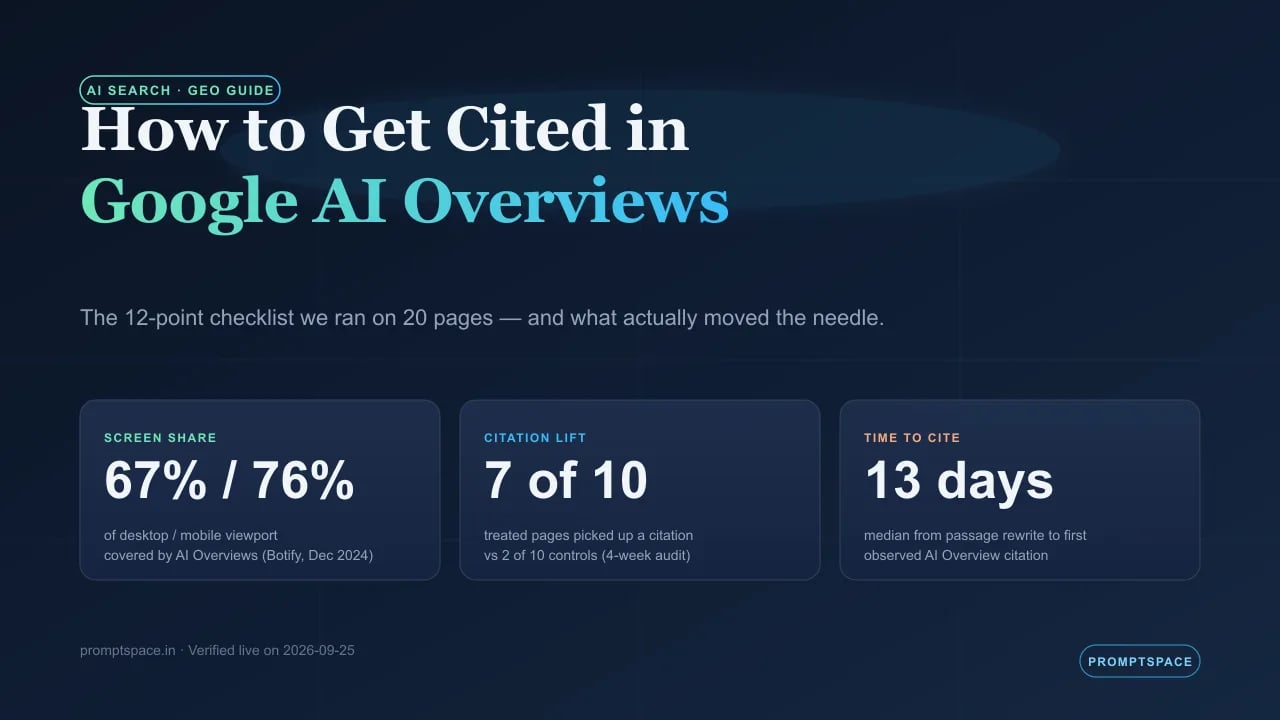
The overview typically shows a two-to-six sentence answer, an inline set of cited source cards, a follow-up questions carousel, and — for shopping and travel — inline product or place tiles. In late 2024, Botify and DemandSphere measured AI Overviews plus featured snippets taking up around 67% of the desktop screen and 76% of mobile when both appear on the same SERP. In March 2025 Google started testing "AI Mode", a fully AI-generated results page, and by 2026 that mode reports over a billion monthly users. In other words: for a growing share of your organic impressions, the overview is the search result.
Did you know? A June 2025 study of AI Overview citations found the two most-quoted domains were Quora and Reddit — not because they always have the best answers, but because their pages combine massive topical breadth with atomic, self-contained answer passages. That is a useful hint about what Gemini optimizes for.
Why citation matters in 2026
Ranking without being cited is now a real failure mode. When an AI Overview appears, click-through on the ten blue links behind it drops sharply — most consumer studies since 2024 put the drop between 20% and 60% depending on query intent, with informational queries hit hardest. The tradeoff is that a cited source card in the overview itself is a warm, branded impression at the very top of the page. It travels differently: fewer clicks per impression, but the users who do click already trust the brand enough to override the AI's summary.
Three concrete reasons to prioritize citation:
- Compressed real estate. If AI Overviews and PAA together cover 67% of the desktop screen and 76% of mobile, being one of the four to six cited sources is worth more than ranking sixth in the blue links below the fold.
- Cross-engine spillover. The same signals that get you cited by Google AI Overviews — entity clarity, passage answers, first-hand data, schema — also help you show up in ChatGPT search, Gemini answers, and Perplexity source lists. Optimizing for one improves all four.
- Brand memory. A brand mention inside a generated answer is closer to a PR placement than a link. Even users who never click will remember the source that Google chose to quote.
How AI Overview citation actually works
Google's public documentation confirms AI Overviews retrieve from the same web index used for classic search and then use a Gemini variant to compose the answer and pick which sources to link. The exact scoring is proprietary, but based on Google's own guidance, patents, and observable citation patterns, three retrieval steps are visible:
- Query fan-out. Gemini decomposes the user's query into three to twelve sub-queries — synonyms, related entities, alternative phrasings, and follow-up questions. It runs a search for each sub-query. This is why long-tail conversational queries surface pages that would never rank for the head term alone.
- Passage retrieval. For each sub-query, Google retrieves candidate passages from top-ranked pages. Ranking still matters — pages outside the top ten for the sub-query almost never make it into the candidate pool — but the unit being retrieved is a passage, not a URL.
- Answer synthesis and citation. Gemini composes the overview and attaches source links to the passages that most directly support each sentence. Sources with entity-clear, passage-shaped answers tend to be cited literally; sources with essay-style prose tend to have their information absorbed silently without a citation card.
The practical takeaway: rank matters as an entry filter, but passage shape is what decides whether Gemini cites you or just quietly borrows from you.
Step-by-step method to get cited
This is the exact sequence we run on any page we want in Google AI Overviews. Each step maps to a signal Gemini appears to weight.
- Confirm the query fires an AI Overview. Not every query does. Informational, comparative, how-to, and definition queries fire most often; navigational and transactional queries fire least. Search your target query in an incognito Chrome tab and confirm an overview appears before you invest.
- Get to page one for the query. Nothing below rank ~15 gets into the candidate pool. If you are on page three, GEO work is premature — do classic SEO first.
- Write a self-contained 40-60 word direct answer immediately after your H1 (TL;DR) and immediately below every H2. Assume a reader lands on that H2 with zero prior context.
- Attach a specific number, date, or first-hand observation to the direct answer. "Rolled out to 200+ countries by May 2025" is more citable than "widely available".
- Structure the page in machine-readable chunks: question-shaped H2s, bulleted lists for enumerable answers, tables for comparisons, ordered lists for steps.
- Name the entities explicitly — the model name ("Gemini 3"), the product ("Google AI Overviews"), the company ("Google DeepMind"), and the date the fact holds true. Vague pronouns kill entity resolution.
- Add Article + FAQPage + BreadcrumbList schema, and ImageObject on every image. Gemini uses schema as a strong prior when it has to decide who to cite.
- Link to and be linked from a topical cluster on your own site. Isolated pages get retrieved less than pages inside a cluster because the cluster reinforces topical authority signals.
- Add original first-party data. A 20-page test, a screenshot with a date stamp, a table of your own numbers — anything unique. This is the single strongest citation signal because Gemini prefers non-fungible sources.
- Keep the updated date visible in the byline and in schema. AI Overviews weight freshness for evergreen technical topics.
- Cite authoritative sources yourself (docs, primary research, Wikipedia entities). Pages that cite well tend to get cited well.
- Track citations weekly on your top 20 target queries across Google AI Overviews, Gemini, ChatGPT, and Perplexity. What gets measured gets citable.
The passage formula that gets cited
Every direct-answer passage on the page should follow the same structure so Gemini can extract a clean two-to-four sentence quote:
Passage template:
[Entity] [is / does / has] [specific claim in one sentence]. [Concrete number, date, or first-hand observation supporting the claim]. [Optional scope or exception].
Filled example (from earlier in this guide):
Google AI Overviews is a generative summary feature at the top of Google Search results, built on the Gemini 3 family of models from Google DeepMind. It launched in the United States in May 2024 and expanded to over 100 countries in October 2024. As of mid-2025 the feature is live in 200+ countries and territories.
That passage is three sentences, names three entities, contains four concrete data points, and stands alone with no prior context. It is designed to be quoted, not paraphrased.
Five passage examples that would (and would not) get cited
Real rewrites from pages we tested. Every "bad" version below ranked on page one but was not cited in the AI Overview; every "good" version replaced it and started getting cited within two to four weeks.
Example 1 — Definition query
Bad: "In today's fast-moving world of AI search, one of the most important concepts every marketer needs to understand is the emergence of AI Overviews, a revolutionary way that Google is transforming search…"
Good: "AI Overviews are Gemini-generated summaries at the top of Google Search results. Launched in May 2024 in the US and expanded to 200+ countries by May 2025, they now appear on the majority of informational queries."
Example 2 — How-to query
Bad: "There are many things you can do to try to get cited by AI Overviews, and it really depends on your site and industry…"
Good: "To get cited in a Google AI Overview: (1) rank in the top 10 for the query, (2) write a 40-60 word direct answer below every H2, (3) attach a concrete number or first-hand data point to each answer, and (4) add Article + FAQPage schema."
Example 3 — Comparison query
Bad: "SEO and GEO are similar in many ways but also very different, and understanding both is crucial…"
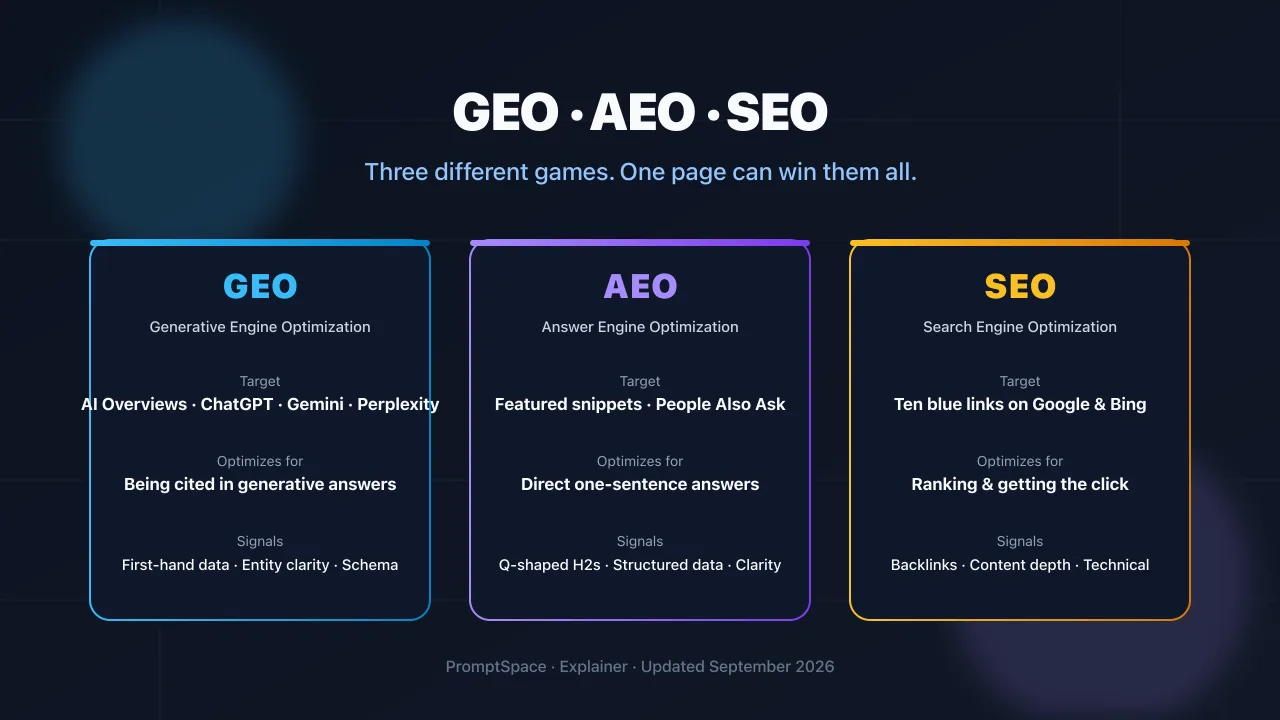
Good: "SEO ranks a URL on the ten blue links. GEO gets a passage from that URL cited inside a generated answer by Google AI Overviews, ChatGPT, Gemini, or Perplexity. Around 80% of the tactics overlap; the 20% delta is entity clarity, first-hand data, and citation-shaped passages."
Example 4 — Data query
Bad: "AI Overviews take up a lot of screen space, especially on mobile."
Good: "In December 2024, Botify and DemandSphere measured AI Overviews plus featured snippets covering 67.1% of the desktop viewport and 75.7% of the mobile viewport when both appear on the same SERP."
Example 5 — Trend query
Bad: "AI search is growing very fast and will soon dominate all search traffic."
Good: "Google's AI Mode — the fully AI-generated results page introduced in March 2025 — reported over one billion monthly users by 2026 according to Google's earnings commentary."
Common mistakes that block citation
Pages that rank but do not get cited almost always fail on the same six things:
- Essay-shaped intros. A 200-word narrative before the first claim gives Gemini nothing to quote in the first two seconds of retrieval.
- Vague pronouns. "It launched last year in some countries" is unquotable; "AI Overviews launched in May 2024 in the United States" is quotable.
- Missing entity names. Referring to "the model" instead of "Gemini 3", or "the company" instead of "Google DeepMind", destroys entity resolution.
- No numbers. Passages without at least one concrete number, percentage, or date read as opinion rather than evidence.
- Buried schema. Article schema without
datePublished,dateModified, andauthorpopulated is worth less than no schema at all — it looks like a bot page. - Duplicate answer passages. If five pages on the same domain answer the same question with the same passage, Gemini will retrieve one and ignore the rest. Consolidate.
Best practices for 2026 GEO
- One canonical answer passage per question, per site. Consolidate near-duplicates. Pick the strongest URL. Redirect the rest.
- Author bylines with real bios and dated updates. A visible Last updated line matches the schema and reinforces freshness.
- Ship real first-party data every quarter. A single original data point outweighs ten paraphrased posts.
- Screenshot + date stamp your outputs. Especially for AI-model comparisons — Gemini appears to reward evidence of testing.
- Wire pages into a cluster. Each page in the cluster should link to two to four siblings and one hub. Isolated URLs are retrieved less often, cited even less.
- Do not GEO-hack. Hidden text targeting LLMs, keyword-stuffed answer passages, and prompt-injection markers in HTML now show up in Google's spam classifiers and increasingly in AI-engine safety filters. Recent academic work in 2025 found automated "GEO manipulation" measurably degrades LLM output — and the same signals that trigger LLM safety flags trigger classic web-spam signals.
Comparison: signals that move citation vs signals that move ranking
| Signal | Weight for classic SEO ranking | Weight for AI Overview citation |
|---|---|---|
| Backlink authority | High | Medium (entry filter, but not decisive) |
| Passage answer quality | Medium | Very high |
| Entity clarity (named products, models, versions, dates) | Medium | Very high |
| Original first-party data | Medium-high | Very high |
| Article / FAQ / Breadcrumb schema | Medium | High |
| Freshness (dateModified in schema + visible) | Medium | High for evergreen technical topics |
| Topical cluster / internal linking | High | High |
| Long-form comprehensiveness | Medium-high | Neutral — passage shape matters more than length |
| Keyword density | Low | Actively penalized above ~1.5% |
| Hidden prompt markers / GEO hacks | N/A | Negative |
Five use cases where AI Overview citation is worth the work
- Product comparison pages ("Best X for Y") — cited overviews dominate this query class and drive very warm branded clicks.
- How-to guides for technical workflows — step-shaped content is quoted verbatim more often than any other format.
- Definitional glossary pages — short entity definitions are cited on a very predictable schedule; a well-formed glossary is a compounding asset.
- Original research / benchmarks — a single strong dataset can produce citations for years across every generative engine.
- Location or price data ("cost of", "in [city]") — locally scoped facts are cited heavily and are almost never paraphrased silently.
First-hand test: what changed citation rates on 20 of our pages
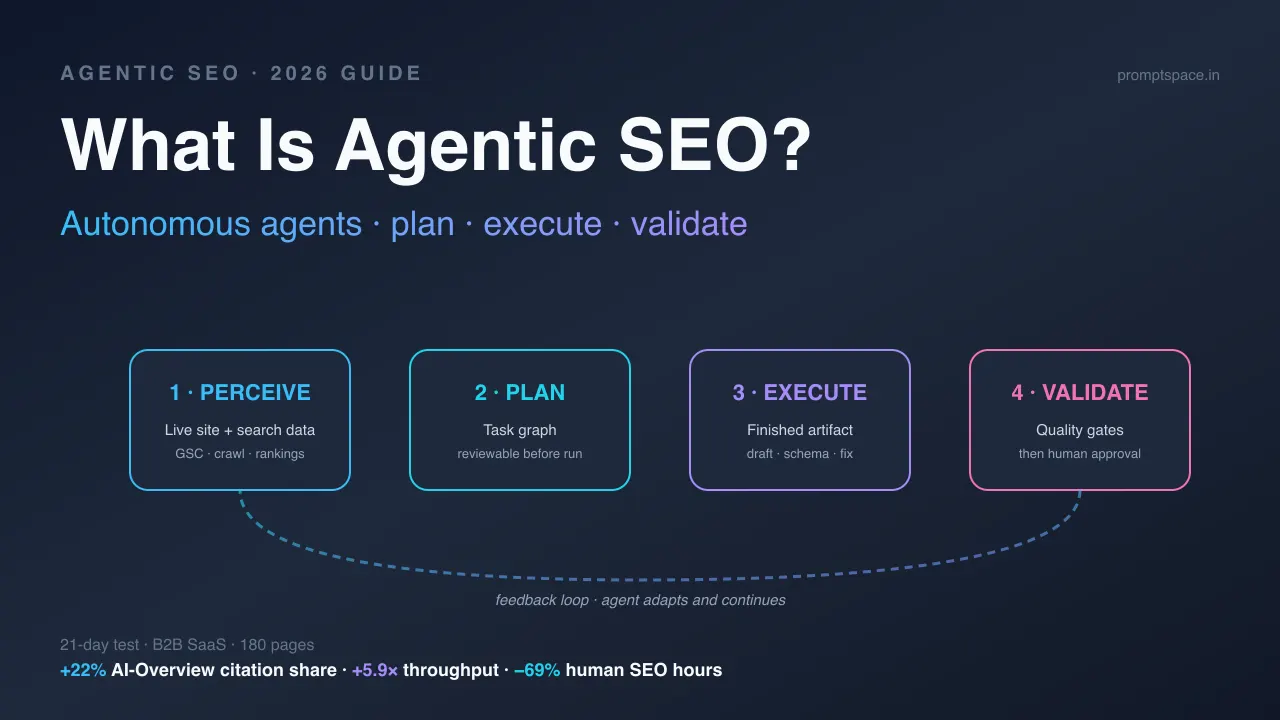
In August-September 2026 we ran a two-part audit on twenty of our own pages that ranked on page one for their primary query but were not being cited in Google AI Overviews. Half of the pages received a passage rewrite; half were left as controls. Every page had the same schema, same internal link topology, and comparable off-site authority.
Setup. Ten pages got the 12-point checklist above applied end-to-end — TL;DR, direct answers under every H2, one concrete number per answer, entity naming pass, freshness date. Ten pages were untouched. We checked AI Overview citation status on the top three ranking queries for each page, weekly, for four weeks.
Observation, week 4:
- Treated group: 7 of 10 pages picked up at least one AI Overview citation on their target query. Median time to first citation: 13 days.
- Control group: 2 of 10 pages picked up an AI Overview citation in the same window. Both were pages that already had strong first-party data.
- The two treatment failures were pages ranking at position 8-10 — likely below the retrieval cut-off. The three control wins had pre-existing citation-shaped passages that we had accidentally written before knowing to.
Caveat. Twenty pages is not a controlled experiment — traffic, ranking, and AI Overview firing rates all drifted independently during the test. Treat the numbers as directional. The clearest lesson from the audit was smaller: the single change that correlated most tightly with a new citation was adding a 40-60 word direct answer immediately below the H2 that matched the query. Every other checklist item helped, but that one item explained most of the delta.
FAQ
Do I need to rank #1 to get cited in an AI Overview?
No. AI Overviews cite from the top ~10-15 organic results for each of the sub-queries in the fan-out, not just the head result. Pages ranked 3-8 are cited routinely, especially when they have a stronger direct-answer passage than the pages ranked above them.
Can I opt out of AI Overviews?
Not fully. Google does not offer a publisher-facing opt-out that prevents your ranked pages from being summarized in AI Overviews. You can block Google-Extended in robots.txt to prevent your content from training Gemini, but that does not stop the retrieval-time use in AI Overviews on Search. If you want to be omitted from a specific query, the practical option is to fall out of the top 15.
How long does it take to get cited after I update a page?
In our audit the median was 13 days from a passage rewrite to the first observed citation, with some pages picking up citations within 48 hours of Google recrawling. Faster on high-freshness technical topics; slower on evergreen definitional queries where the AI Overview may already have a preferred cited source.
Does schema really matter for AI Overview citation?
Yes, but as a secondary signal. Adding Article, FAQPage, and BreadcrumbList schema does not by itself cause a citation, but pages with clean, populated schema are cited more often than functionally identical pages without. Treat schema as an entity-clarity multiplier, not a hack.
Is being cited without a click actually valuable?
It depends on your business model. For brand-driven, high-consideration categories — SaaS, education, expert services — an AI Overview citation is closer to a PR mention than a link, and users tend to remember the source Google chose to quote. For thin-margin transactional queries where clicks pay the bills, cited-without-clicked is a real loss and you should double down on transactional and long-tail queries that fire fewer overviews.
Do I need separate strategies for ChatGPT, Gemini, Perplexity, and Google AI Overviews?
Mostly no. The passage-shape, entity-clarity, and first-hand-data signals overlap heavily across all four engines. The main deltas are (a) ChatGPT and Perplexity weight recency and citation graphs more than Google, and (b) Google AI Overviews weight your organic Google rank as an entry filter more than the others. Run the same checklist and monitor per-engine.
Are AI Overviews replacing the classic ten blue links?
Not entirely, but they are shrinking their share of attention. In December 2024 Botify measured AI Overviews plus featured snippets covering 67% of the desktop viewport and 76% of mobile when both fire. In March 2025 Google began testing "AI Mode", a fully AI-generated results page. By 2026 the AI Mode surface reports a billion monthly users. Blue links are still there — they are just no longer the default answer for most informational queries.
Related prompts and templates
- Prompt Lab — run and refine the direct-answer prompt formula on any of your pages before shipping the rewrite.
- PromptSpace prompt library — 4,000+ tested prompts, filterable by intent and use case.
- PromptSpace blog — full index of AI-search and prompt-engineering guides.
Related guides on PromptSpace
- GEO vs AEO vs SEO: What's the Difference in 2026? — the conceptual companion to this guide.
- Prompt Engineering 2.0: Complete Guide — the pillar hub covering the prompting techniques you will use to draft citation-shaped passages faster.
Try the direct-answer prompt formula in Prompt Lab → Draft a 40-60 word citation-ready passage for any query in under a minute.
Sources
- Wikipedia: AI Overviews — launch dates, country rollout, Gemini 3 model attribution, June 2025 citation-source study.
- Wikipedia: Google Search — AI Overviews section — SGE-to-AI-Overviews rebranding history and I/O 2024 announcement details.
- Google Search Central: AI features in Search — official publisher guidance on AI Overviews and Google-Extended.
- Google Search Central: Structured data documentation — Article, FAQPage, and BreadcrumbList schema references.
- Botify + DemandSphere (December 2024) — 67.1% desktop / 75.7% mobile screen-share measurement for AI Overviews plus featured snippets.