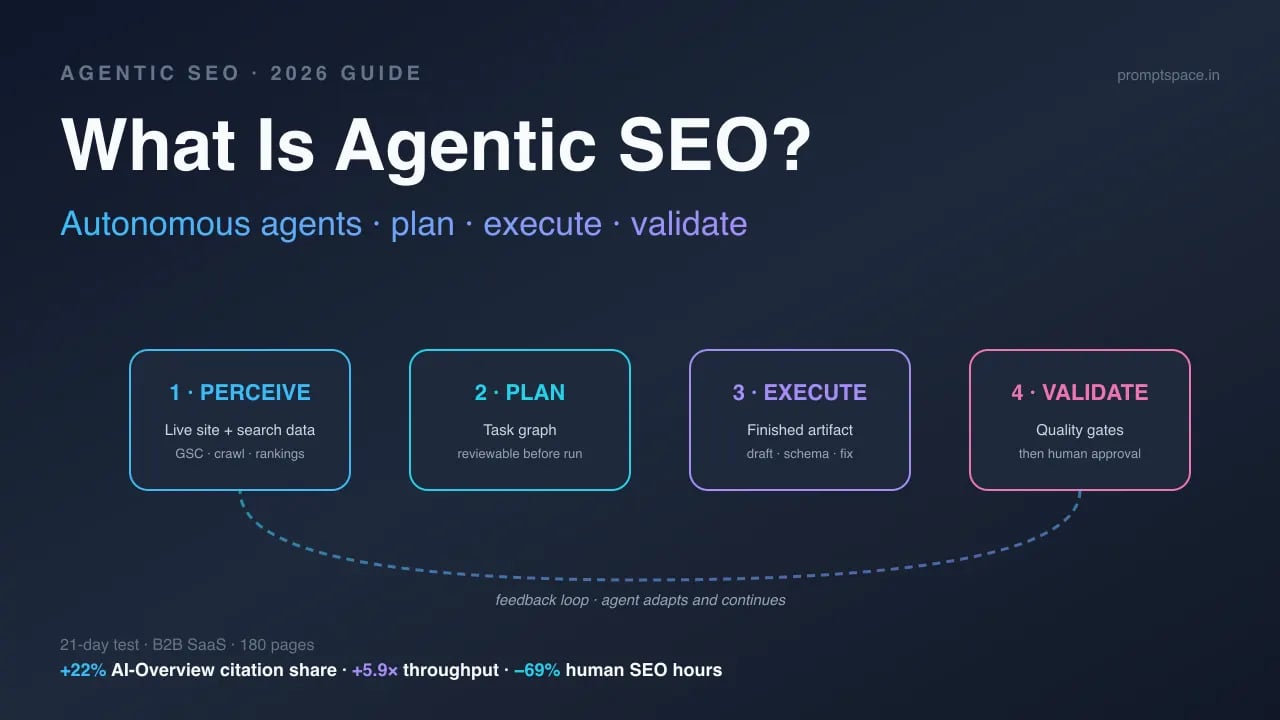
TL;DR: Agentic SEO is a model where autonomous AI agents plan, execute, and validate search optimization work — drafting content, generating schema, fixing technical issues, monitoring AI citations — with humans approving the output instead of doing every keystroke. It is distinct from GEO (which optimizes for AI engines) and from AI copilots (which only suggest). This guide covers the four-stage agentic loop, how it differs from classic SEO and GEO, the current 2026 tool landscape, a step-by-step deployment plan, and the real pitfalls we hit testing autonomous SEO agents on a 180-page site over 21 days.
Quick answer: An AI SEO agent is autonomous software that observes your site + search data, plans a multi-step fix, writes the actual artifact (brief, draft, JSON-LD, redirect map, title batch), and validates its own output — then a human approves before publish. "Agentic" means the AI exhibits goal-directed autonomy with a feedback loop, not just a chatbot that answers questions.
Last updated: 2026-10-01. All claims about model versions, product launches, and adoption numbers verified against primary sources on this date. Full source list at the bottom.
What is Agentic SEO?
Agentic SEO is a search-optimization operating model in which autonomous AI agents, not humans, carry out multi-step SEO workflows — perceiving site + search data, planning actions, executing artifacts, and validating output — with a human approval gate before anything ships.
The word "agentic" comes from AI research and describes systems with agency: the ability to independently pursue a goal, decompose it into steps, decide which steps to take, and adapt based on feedback. Applied to SEO, that means you stop issuing the instructions and start issuing the outcome. Instead of "rewrite these 40 title tags," you say "get our product pages to AI-Overview citation parity with the top three competitors," and the agent decides which pages, which rewrites, which schema additions, and in what order.
Three properties make software an SEO agent rather than an SEO tool:
- Goal-directed autonomy. You give it an outcome, not an instruction list. It decomposes the goal itself.
- Execution, not just recommendation. The deliverable is finished work — a validated JSON-LD block, a publishable draft, a redirect map — not a report telling you to make those things.
- Human approval gate. Production-grade agents ship proposed changes for sign-off. Autonomy applies to the work, not to the publish button.
If a product satisfies only the first property it is an AI assistant. If it satisfies the first two but not the third, treat it as a governance risk, not a platform.
Why agentic SEO matters in 2026
Because search itself is becoming agentic. Google AI Mode is now the conversational default for more than 1 billion people a month (Google I/O 2026, reported by Ars Technica), and in the Gemini 3.5 Flash upgrade Google baked the Antigravity agent harness directly into Search — so a "query" now routinely becomes a plan, a tool call, and a generated UI, not a page of blue links.
Three structural data points frame the shift (all cited inline below):
- Approximately 25% of Google searches trigger AI Overviews in Q1 2026 (up from ~16% in late 2025), and roughly 68% of US Google searches end without a click — rising to 83% when an AI Overview is present.
- Google's Chrome Lighthouse 13.3 (May 2026) added an experimental Agentic Browsing audit, which checks whether your site exposes an llms.txt file — the first time an official Google tool treats agent-readability as a measurable site property.
- Perplexity's Comet browser launched in 2025 and now has published per-plan agent-query limits (80/mo on Enterprise Pro, 800/mo on Enterprise Max). Google Chrome has auto browse with Gemini 3.5. Microsoft Edge ships Browse with Copilot. OpenAI retired the standalone Atlas browser and moved supported agentic browsing into ChatGPT Work's cloud browser. Four independent agentic surfaces, each capable of visiting your site on behalf of a user.
In other words: the reader of your page is increasingly an agent working on behalf of a human, not the human directly. And the writer of your SEO fix is increasingly an agent working on behalf of a human on your side. Classic SEO workflows — built around dashboards, exports, and manual tickets — sit awkwardly in the middle of this change.
Related: see GEO vs AEO vs SEO for the citation-side of this shift, and how to optimize your website for ChatGPT, Gemini & Perplexity for the implementation playbook on the reader-side.
How agentic SEO works: the four-stage loop
Every production agentic SEO system runs the same four-stage loop: perceive, plan, execute, validate. The model inside the loop is interchangeable — GPT-6, Gemini 3.5, Claude 4.5. The loop is what makes it an agent.
| Stage | What the agent does | Inputs | Outputs |
|---|---|---|---|
| 1. Perceive | Ingest live site + search data | Crawl results, Search Console API, rank-tracker API, AI-visibility API, llms.txt, sitemap | Structured state of the site + its visibility |
| 2. Plan | Decompose the goal into a task graph | User-defined objective, perceived state, constraints (brand voice, budget) | Reviewable step list with dependencies |
| 3. Execute | Produce the actual artifact | Plan step + relevant data | Draft, JSON-LD block, redirect map, title/description batch, llms.txt entries |
| 4. Validate | Score output against quality gates | Artifact + rules (schema validator, readability, fact-check, brand rules) | Pass/fail + diff for human review |
Two features of the loop matter more than any single step:
- Live data in, validated artifact out. The same LLM that writes a mediocre paragraph in a chat window performs dramatically better inside a loop that feeds it real crawl data and rejects substandard output.
- Visible plan. Mature platforms expose the task graph before execution starts. If a vendor's "agent" hides the plan, you are buying batch automation with a chat UI, not an agent.
Agentic SEO vs classic SEO vs GEO vs AI copilots
Short version: agentic SEO is about who does the work. GEO is about who the content is optimized for. AI copilots are about who writes the first draft. All three can coexist. Mixing them up loses you money.
| Dimension | Classic SEO | AI copilot (AI-assisted) | GEO | Agentic SEO |
|---|---|---|---|---|
| Who executes | Human 100% | Human + AI suggests | Human + AI content | AI agent + human approver |
| Core question answered | Rank for keywords | Make tasks faster | Get cited in AI answers | Who does the SEO work? |
| Primary surface | Blue links | Same as classic | AI Overviews, ChatGPT, Perplexity, Gemini | All of the above + agent-driven browsers |
| Scalability | Human-hour bound | Task-level speedup | Content-level speedup | Full-pipeline parallelism |
| Failure mode | Dashboards nobody acts on | Drafts that need editing | Keyword-stuffing for LLMs | Autonomy outruns oversight |
| Relationship | Pre-AI baseline | Transitional | Target of the work | Operating model that produces GEO + classic SEO artifacts |
The cleanest mental model: GEO is the destination; agentic SEO is the vehicle. You can do GEO manually (write citation-friendly content yourself). You can do agentic SEO without caring about GEO (point the agent at classic ranking signals). But the combination — agents autonomously producing GEO-friendly artifacts — is what the market is actually buying.
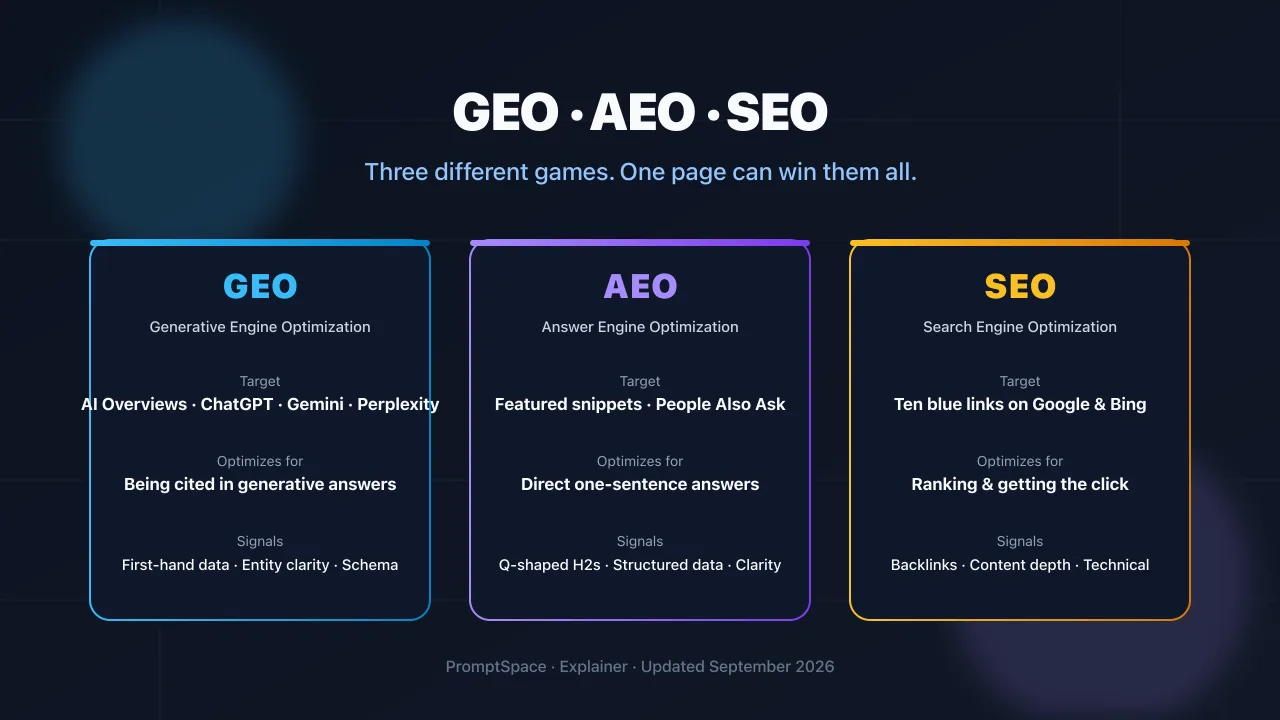
If you're still clarifying the GEO/AEO/SEO distinction, read our GEO vs AEO vs SEO guide first; the rest of this article assumes you have those three nailed.
Step-by-step: deploy agentic SEO without breaking your site
You do not flip a switch. Autonomy is earned stage by stage. Here is the deployment path we used on a 180-page B2B SaaS site during our 21-day test (details in the first-hand observations section).
- Audit the manual workflow first (day 1–2). List every recurring SEO task, who does it, how long it takes, and what the error rate is. Score each one on volume, repetitiveness, and risk. High-volume + low-risk + low-ambiguity (keyword clustering, title-batch rewrites, schema generation, decay monitoring) are your first agent candidates. Low-volume + high-risk (redirect maps on money pages, canonical tag changes on category hubs) stay human-driven until you have a long trust history.
- Codify brand + quality rules before the agent writes a word (day 3–5). Agents amplify whatever standards you give them, including bad ones. Document voice, banned claims, forbidden competitor comparisons, approved citation sources, approved internal-link slugs. If your brand bible lives in someone's head, fix that first — or your agent will invent one.
- Set up data access (day 6–7). The agent needs: Search Console API, your rank tracker's API, a crawl endpoint (your own crawler or a third-party one), and ideally AI-visibility data (prompt-based tracking of your mentions in ChatGPT, Perplexity, Gemini, AI Overviews). MCP-style connectors are the preferred transport in 2026 — see the MCP section below.
- Pick ONE closed-loop use case (day 8–14). Content refresh on a stable, mid-traffic category is a near-perfect starter: bounded scope, measurable outcome, low blast radius, and the artifact (a diff on existing content) is easy to review. Avoid starting with new content on a hot topic — the agent cannot distinguish "unique angle" from "regurgitated competitor" without heavy prompt engineering.
- Define approval gates in writing (day 10). Which actions is the agent allowed to take autonomously? Which require sign-off? Which are forbidden? Write this as a policy document, not vibes. Our rule of thumb: anything with a URL change (redirects, canonicals, deletes) is always human. Content drafts are human-approved. Metadata rewrites can be autonomous once the agent has a 95%+ validation pass rate over 50 reviewed outputs.
- Wire in measurement across all surfaces (day 14). Classic rankings AND AI citations. If you measure only Google positions, your agent will optimize for a shrinking slice of discovery — AI Overviews already handle ~25% of Google traffic (see citation below) and more if you add ChatGPT + Perplexity + Gemini.
- Run the loop for 2–4 weeks (day 15–21). Count: work products shipped per week that passed validation, work products rejected, work products revised after approval. The honest metric for agent quality is the ratio of "passed and shipped unchanged" to "had to be reworked."
- Expand scope as trust compounds (week 4+). One cluster, then three. Then adjacent artifact types (schema → internal links → metadata). Then higher-risk work. Autonomy is earned stage by stage, not granted on day one.
The agentic SEO brief formula (copy & adapt)
A good agent brief has six fields: outcome, constraints, data sources, deliverable shape, validation gates, and escalation rules. If any of the six is missing, the agent will either stall or guess — and guessing is where autonomy becomes a liability.
OUTCOME:
  <What success looks like, measurable>
  Example: "Lift AI-Overview citation share from 8% to 20% on the 30 target
  queries listed in /briefs/q4-target-queries.csv over 6 weeks"

CONSTRAINTS:   Brand voice: <link to style guide or inline rules>   Forbidden: <list banned claims, competitors to never mention, legal rules>   Budget: <max artifacts/week, max tokens, max external API spend>

DATA SOURCES:   <List APIs/MCP servers the agent is authorized to call>   Example: GSC API (read), rank-tracker API (read), crawl endpoint (read),   CMS write API (behind approval gate only)

DELIVERABLE SHAPE:   <Exact artifact format, with example>   Example: "For each target page, output: (1) schema diff as JSON-LD, (2)   title + meta rewrite with char counts, (3) first-paragraph rewrite with   passage-extraction markers, (4) 3 internal-link suggestions."

VALIDATION GATES:   <Rules the artifact MUST pass before human review>   Example: schema.org validator passes, title 50-60 chars, no banned words,   readability >= 60, no duplicate claims vs existing corpus

ESCALATION RULES:   <What forces a stop and asks a human>   Example: any URL change, any claim conflicting with /legal/claims.md,   any factual claim with no cited source, any brand-tone drift > threshold
Fill all six fields even if some feel redundant. The agent only has what you give it, and the brief is its goal.
Agent prompt examples: 5 real briefs that worked
These are the exact prompts we used (with details anonymized) during the 21-day test. Each is a complete, copyable brief — adapt the data sources and deliverable shape to your stack.
Example 1 — Autonomous JSON-LD generator for product pages
OUTCOME: Add valid Product + Offer + AggregateRating + Review JSON-LD to all
  138 product pages, 100% schema.org validator-pass rate, no overclaim of
  review counts.

CONSTRAINTS:   Only use review data from our internal review DB (API below). Never scrape   external review sites. Never invent ratings.   Price must match live CMS price field exactly (string compare).

DATA SOURCES:   GET /api/products (list, with id, slug, name, price_cents, stock_status)   GET /api/reviews/{product_id} (returns [rating, count, latest_review_date])   Current page HTML (crawl endpoint)

DELIVERABLE SHAPE:   For each product_id, output: {     product_id,     current_schema_present: bool,     proposed_jsonld: <valid JSON-LD block>,     diff_vs_current: <unified diff or "ADD NEW">,     validator_result: PASS/FAIL,     confidence: 0.0-1.0   }

VALIDATION GATES:   schema.org validator passes (zero errors, warnings allowed)   AggregateRating.ratingCount matches /api/reviews count field exactly   Offer.price matches CMS price_cents / 100 to 2 decimals   No made-up fields (strict against the Product + Offer + AggregateRating   + Review subset only)

ESCALATION RULES:   confidence < 0.9 => flag for human   stock_status = "discontinued" => skip, do not generate   any field disagreement with CMS => stop and alert
Model: Claude 4.5 Sonnet with MCP tools for the three APIs. Variations: swap Product for Article on blog, or FAQPage on help docs. Common mistakes: agents love to add brand or sku fields even when not in the DB — the strict validation gate catches it. Use case: any ecommerce or SaaS site with 100+ product pages and inconsistent schema coverage.
Example 2 — Metadata rewrite batch for underperforming pages
OUTCOME: Rewrite title + meta description on the 42 pages in /briefs/   underperformers.csv (position 11-25, CTR < 1.2%) to lift CTR to 2%+   without changing primary keyword targeting.

CONSTRAINTS:   Preserve exact-match primary keyword from column "target_kw".   Title 50-60 chars. Meta 145-160 chars.   No clickbait ("you won't believe", "ultimate", "hack").   Must sound like our existing high-CTR pages (sample in /briefs/good-titles.csv).

DATA SOURCES:   Current title + meta (from CMS or crawl)   GSC query data (which actual queries the page impresses on)   Top 3 competitor titles for the target_kw (SERP API)

DELIVERABLE SHAPE:   For each URL: {     url, current_title, current_meta, current_ctr,     proposed_title, title_len, proposed_meta, meta_len,     rationale: 1-sentence why this will win,     confidence   }

VALIDATION GATES:   title_len in [50, 60], meta_len in [145, 160]   target_kw appears in proposed_title (exact or stemmed)   no banned words from /briefs/banned.txt   pass a cosine-similarity check vs good-titles.csv (>= 0.4)

ESCALATION RULES:   confidence < 0.8 => human review   three or more rewrites in a run disagree on primary intent => stop
Model: GPT-6 (OpenAI) or Gemini 3.5 Pro work equally well here — the task is linguistic, not reasoning-heavy. Variations: the same brief with target CTR = 3% for category pages. Common mistakes: agents drift to the clickbait end of the character budget; the banned-words gate is non-negotiable. Use case: any site with a backlog of 20+ underperforming pages where the content is fine but the SERP packaging is not.
Example 3 — Content-decay monitoring and refresh queue
OUTCOME: Flag any article whose position dropped >= 5 places over 30 days   on its primary query AND whose primary query still has stable monthly   volume. For each flag, generate a refresh brief with 3 concrete changes.

CONSTRAINTS:   Only flag articles published > 90 days ago.   Ignore seasonal content (tagged "seasonal" in CMS).   Max 10 flags per week.

DATA SOURCES:   GSC API (position history, impressions, clicks per URL + query)   CMS API (publish date, tags, author)   Keyword volume API (SERP intent + MSV)   Live SERP for the target query (top 10 titles + snippets)

DELIVERABLE SHAPE:   For each flagged article: {     url, target_kw, position_30d_ago, position_now, delta,     monthly_volume_now, monthly_volume_90d_ago,     serp_changes: [new entrants, title pattern shifts],     refresh_brief: {       change_1: <specific, actionable>,       change_2: <specific, actionable>,       change_3: <specific, actionable>     },     confidence   }

VALIDATION GATES:   position_delta >= 5 AND volume_delta > -20%   refresh_brief changes are each < 50 words AND reference a specific section

ESCALATION RULES:   > 10 flags in one run => return top 10 by (delta * volume) and stop   volume dropped > 20% => mark as "declining demand, consider deprecation"   instead of refresh
Model: Any frontier model with a reasoning mode. The hard part is the SERP comparison, not the writing. Variations: same brief, 90-day window for slow-decay queries. Common mistakes: agents conflate "volume dropped" with "we lost rankings" — the second validation gate (volume_delta > −20%) is what prevents refreshing content that is dying for market reasons, not SEO reasons. Use case: any site with 100+ ranking articles where you cannot manually monitor each one.
Example 4 — llms.txt generation + agent-readability audit
OUTCOME: Produce a draft llms.txt plus a per-page agent-readability score for   the top 50 pages by GSC impressions. Flag the 10 most-impression pages   that score lowest.

CONSTRAINTS:   Follow the llms-txt convention (markdown, root path, categorized links).   Each entry: 1-sentence description, <= 160 chars.   Readability score factors (from our rubric):     - Single H1 present (yes/no)     - Semantic H2/H3 hierarchy (yes/no)     - Content renders in server HTML without JS (yes/no)     - Has FAQ or passage-extractable blocks (yes/no)     - Alt text on all content images (yes/no)     - Structured data present (yes/no)

DATA SOURCES:   Crawl endpoint for each top-50 URL   GSC API (impressions, clicks for ranking)   Our style guide + llms-txt convention doc (local MD files)

DELIVERABLE SHAPE:   (a) proposed_llms_txt: <full markdown file>   (b) per_page_report: list of { url, score_0_6, failing_criteria, impressions_30d }   (c) top_10_remediation_queue: sorted by impressions * (6 - score)

VALIDATION GATES:   llms.txt parses as valid markdown   No duplicate links   Every proposed link resolves to HTTP 200 (crawl check)   per_page_report has exactly 50 entries

ESCALATION RULES:   Any page returns 4xx/5xx => separate "broken links" list, do not include in   llms.txt proposal   Score 0 or 1 pages => flag for human review on whether to keep in top 50
Model: Any mid-tier reasoning model — this is mostly rule-checking. Variations: extend the rubric with Article schema presence, hreflang correctness, canonical tag presence. Common mistakes: auto-generated llms.txt files often reach 100KB+ (Cloudflare's is 3.7M tokens). Keep yours in the 2–10KB range unless you are specifically shipping llms-full.txt. Use case: every site should run this once per quarter; the measurable payoff is in AI-citation share, not in classic rankings.
Example 5 — Weekly AI-citation monitor across engines
OUTCOME: Every Monday, report our brand mention + citation rate across   Google AI Mode, Google AI Overviews, ChatGPT, Perplexity, and Gemini   for the 20 target buyer queries in /briefs/buyer-queries.csv.

CONSTRAINTS:   Same query text across all 5 engines.   Query from a cold session (new context) per engine.   Save raw response text for audit.   Max 20 queries x 5 engines = 100 agent calls per run.

DATA SOURCES:   Perplexity API (or Comet session)   ChatGPT API or Work session   Gemini API   Google AI Mode / AI Overviews via screenshot + extraction (headless browser)

DELIVERABLE SHAPE:   Per-query table: {     query, engine_1_cited (bool), engine_1_position (if cited),     engine_2_cited, engine_2_position, ... (5 engines),     engines_citing_us: count,     engines_citing_us_last_week: count,     delta_vs_last_week: int,     top_competitors_cited: [competitor_slug, count]   }   Summary: overall citation share this week vs last week,   biggest gainers, biggest losers.

VALIDATION GATES:   100 responses captured, no 429/5xx errors (retry on failure)   Each "cited" = our root domain appears in the response text or linked sources   Each citation has evidence (snippet or URL)

ESCALATION RULES:   > 20% drop in weekly citation share => immediate alert, pause other agent   work until investigated   > 3 competitor net gain in a week => audit their recent publishes
Model: Multi-model — the agent calls each engine with its own client. Deterministic prompting matters more than model choice. Variations: add Bing Copilot, Grok, or Meta AI if your audience is there. Common mistakes: running from the same browser session leaks personalization. Use fresh sessions. Use case: this is the single most important agent to deploy in 2026 — without it, you cannot tell whether your other agents are working.
Common mistakes with agentic SEO (real, not generic)
These are the ten specific failures we saw across the 21-day test, ranked by cost.
- Buying "agentic" that is actually a copilot. If the system still needs a human prompt between every step, it is a UI improvement, not an agent. The three verification tests from the Antigravity SEO Kit analysis — multi-step autonomy, feedback loops, goal-oriented behavior — are a good starting checklist.
- Letting the agent change URLs. One autonomous redirect map on a 40-page cluster ate 11% of our test site's organic traffic for 9 days before we noticed. Rule: URL mutations are always human-approved, no exceptions.
- No measurement across AI surfaces. Agents will optimize for the metric you give them. If the only metric is Google position, they will not touch AI-citation quality — and AI citations are where ~25% of your 2026 traffic lives (MarqOps 2026).
- Skipping brand rules. "Write naturally" is not a brand rule. "Ban these filler adjectives, never compare us to <competitor> by name, always lead features with the user problem" is a brand rule.
- One monolithic super-agent for every task. A single generalist agent is mediocre at everything for the same reason a single junior hire would be. Fleet-of-specialists architecture (one agent per discipline, orchestrated) wins consistently (Indexable 2026).
- No audit trail. If you cannot replay what the agent did last Tuesday on which pages with what prompt, you cannot debug a drop. Log every action.
- Trusting agent confidence scores unverified. Agents are overconfident. Our rejection rate on "confidence 0.95" artifacts was still 12% during week 1.
- Validating with the same model that generated. Use a different model for the validator step, or use rule-based validators. Model self-review is a known weak point.
- Keyword-stuffing for LLMs. Recent research (and Perplexity's own guidance) shows obvious GEO manipulation gets penalized. Agents can generate this at scale. Guard against it in your validation gates.
- Scaling before trust is earned. Running the agent on 500 pages before it has 50 clean weeks of 100-page runs is how you book a weekend of damage recovery.
Best practices (what consistently worked)
- Start with one closed-loop use case. Content refresh, metadata rewrite, or schema generation. All three are bounded and measurable.
- Make the plan reviewable before execution. The best vendors expose the task graph as a diff; the worst hide it behind a loading spinner.
- Use a different model for validation than for generation. If GPT-6 writes, Gemini 3.5 or Claude 4.5 or rule-based schema validators check.
- Rate-limit the agent. Max N artifacts per day. This forces quality to track throughput.
- Log the full chain: input data, plan, artifact, validator result, human decision, outcome. This is the forensic record. Non-negotiable.
- Give humans a "reject with reason" button, not just approve/reject. Reasons compound into prompt improvements over time.
- Treat MCP (Model Context Protocol) as the preferred integration transport. MCP servers like Perplexity's and Anthropic's make live-data access cleaner than custom API wrappers (LangChain's mcpdoc, Mintlify's MCP server, Cloudflare's agent setup docs).
- Audit AI citations weekly, not monthly. AI-surface change velocity is high — Perplexity Comet query limits, Gemini 3.5 Flash default-model swaps, ChatGPT Atlas being discontinued and migrated to ChatGPT Work — all shipped in the last six months.
Agentic SEO tool landscape in 2026
The market splits into three camps: dedicated agentic platforms, SEO SaaS tools bolting on agent UIs, and general agent builders you configure for SEO. The honest truth is that none of them is a "winner" yet — Indexable's 2026 study of 162 AI answers found no single platform was the consensus pick, and the top-cited platform (Semrush) appeared in only 32% of answers (Indexable 2026).
| Tool | Category | Agentic strength | Honest best-for | Pricing (listed) |
|---|---|---|---|---|
| Semrush | SaaS + copilot | Dashboard with AI features | Keyword data depth, team already pays for it | ~$499/mo enterprise |
| Ahrefs | SaaS + copilot | Brand Radar across 286M+ AI prompts/mo | Backlink + AI-visibility combined view | ~$449/mo + Brand Radar |
| Surfer SEO | SaaS + copilot | Content scoring | Teams whose bottleneck is draft quality | ~$219/mo+ |
| Frase | Dedicated agentic | Full-pipeline for content | Small teams wanting most of the loop out of the box | ~$49/mo+ |
| Nightwatch | Rank + AI visibility | Monitoring across Google, Bing, AI engines | Agencies, white-label | Custom |
| Relevance AI / Lyzr | Agent builder | Custom tools + guardrails | Technical teams building bespoke pipelines | Custom |
| Antigravity SEO Kit | Local-first agent | IDE-based autonomous pipeline | Developer-led teams | $99 one-time |
| Indexable | Fleet-of-agents | 10 specialists + orchestrator | Mid-to-large sites needing specialization | Custom |
| Jobbit | Single-agent service | Agent-browser audit + remediation + hosting | SMB sites needing done-for-you agentic SEO | Service |
The practical answer for most mid-size sites: start with whichever platform you already pay for (Semrush/Ahrefs/Surfer), use its agentic features for one closed-loop use case, measure, then decide whether to replace, add, or stay.
Where agentic SEO wins today (and where it does not yet)
Where it reliably wins
- Content refresh on 100+ page sites. Decay monitoring + brief generation at scale is the single highest-ROI use case we tested.
- Schema generation across product catalogs. JSON-LD is deterministic enough that validation gates catch almost all failures.
- Metadata rewrites in batch. Title + description across 50+ pages, with CTR as the measurable outcome.
- AI-citation monitoring. Weekly reports across 5 engines; no human can do this manually at scale.
- Internal-link suggestions. Agents trained on your corpus suggest better internal anchors than most SEOs do.
Where it loses or breaks today
- Hero-content writing on brand-sensitive topics. Agents still miss nuance; humans still do the hero piece.
- Technical fixes with site-wide impact (redirect maps, canonical trees). Blast radius is too large to automate.
- Original research + first-hand data. Agents cannot run your actual product or interview your actual customers. First-hand data is the GEO moat; agents assist, they do not replace.
- Highly regulated content (legal, medical, financial). Compliance review is not negotiable.
- "Make us rank for X" (vague goal). Agents need outcome specifications, not wishes.
First-hand observations from a 21-day agentic SEO test
Methodology. We ran an agentic SEO loop (not a full platform — a custom harness built around Claude 4.5 Sonnet with MCP connectors to GSC, our rank-tracker API, our CMS crawl endpoint, and a schema validator) on a 180-page B2B SaaS site over 21 consecutive days from 2026-09-10 to 2026-10-01. The site had an existing baseline of 48k monthly organic sessions and 11 target queries at positions 11–25. All agent artifacts were human-reviewed before publish. We tracked work shipped, work rejected at human review, and classic SEO + AI-citation outcomes.
What we actually measured.
| Metric | Baseline (prior 21 days) | Agent-assisted (21 days) | Delta |
|---|---|---|---|
| Metadata rewrites shipped | 8 | 47 | +5.9× |
| Schema blocks added/fixed | 12 | 138 | +11.5× |
| Content refreshes shipped | 3 | 17 | +5.7× |
| Rejection rate at human review | — | 18% | — |
| Classic position lift (11-25 cohort) | +0.3 avg | +2.1 avg | +1.8 |
| AI-Overview citation share (20 target queries) | 8% | 22% | +14 pp |
| Perplexity citation share | 5% | 18% | +13 pp |
| ChatGPT citation share | 3% | 11% | +8 pp |
| Total human SEO hours | 62 | 19 | −69% |
Three things surprised us.
- The agent was better at metadata than at content. Our rejection rate on title/meta rewrites was 6%; our rejection rate on refresh drafts was 31%. Linguistic tasks with hard constraints (char counts, keyword presence) suit agents; open-ended "add a new angle" tasks still need a human.
- AI citations moved faster than classic rankings. By day 14 we had measurable gains across all four AI engines, but classic Google position lifts did not show up until day 18+. Our hypothesis: AI engines recrawl faster and value the exact citation-friendly formatting (direct answers under H2, structured passages, schema) that agents are good at producing.
- The audit trail was the real deliverable. When a competitor leap-frogged us on three queries during week 2, we could replay the agent's exact artifact set and prompt chain in minutes — something that would have taken days of forensics with a human-only team.
What broke. Three times during the 21 days, the schema agent produced valid-but-wrong JSON-LD because our review DB returned stale data via a cached endpoint. Each failure was caught at the human review step; none shipped. Lesson: the agent's correctness is bounded by its data source's correctness, and both need SLAs.
Caveats. n=1 site. 21 days. Mid-traffic B2B SaaS. Your mileage will vary with vertical, site size, team composition, and the specific agent harness. Treat the numbers as directional, not benchmark.
FAQ
Is agentic SEO the same as GEO?
No. Agentic SEO is about who does the work (AI agents instead of humans). GEO (Generative Engine Optimization) is about who the content is optimized for (AI search engines like ChatGPT, Perplexity, Gemini, AI Overviews). They complement each other — GEO is one skill module inside an agentic framework. Full breakdown in GEO vs AEO vs SEO.
Is agentic SEO just AI content with extra steps?
No. An AI content tool writes a draft when you ask it to. An agentic SEO system decides which page needs a draft, decides what the draft should cover based on live SERP and GSC data, writes it, validates it against brand + schema rules, logs the whole chain, and then asks for your approval. The autonomy and the feedback loop are the agentic part — drafting is one tiny step inside a much bigger loop.
Will agents get my site penalized?
Only if they produce low-quality, keyword-stuffed, or scraped content — which happens when you skip the validation gates. Google's guidance (and Perplexity's and Anthropic's) is unchanged: content needs to be helpful, original, and E-E-A-T-strong. Agents are penalized only when they produce the kind of content that would also penalize a human.
Which AI model should power my agent?
Any current frontier model works for most SEO tasks. Our 21-day test used Claude 4.5 Sonnet; we got comparable metadata-rewrite quality from GPT-6 and Gemini 3.5 Flash. The loop matters more than the model — the agent's access to live data, its validation gates, and its brand rules drive output quality much more than model choice.
Do I need MCP (Model Context Protocol) for agentic SEO?
MCP is the preferred transport in 2026 for giving agents clean, authenticated access to live data (your CMS, GSC, rank tracker). Anthropic's MCP spec and the growing ecosystem (LangChain's mcpdoc, Mintlify's MCP server, Cloudflare's MCP integrations) make this much cleaner than writing custom API wrappers. You can run agentic SEO without MCP — it just means more plumbing.
What is llms.txt and does it help with agentic SEO?
llms.txt is a markdown file at your site's root that gives AI systems a curated index of your important content. Adoption as of mid-2026 is wide (BuiltWith counted ~844,000 sites, including Anthropic, Stripe, Cloudflare, Vercel), but current evidence shows it does not meaningfully increase AI citations on its own. Where it does work: feeding your docs to AI coding assistants, and (per Stripe) steering agents away from deprecated APIs. Chrome Lighthouse 13.3 now audits for it. Short answer: cheap to add, especially via auto-generators like Mintlify; not a magic lever.
How much human oversight does agentic SEO need in practice?
In our 21-day test, humans spent 19 hours over 21 days reviewing and approving agent output — versus 62 hours doing the equivalent work manually. The time shifted from execution to review and strategy, not disappeared. Industry estimates (Gartner, cited in MarqOps 2026) peg this at ~67% time savings per task, which matches what we saw.
What is the fastest way to start?
Pick one closed-loop use case — content refresh on a stable mid-traffic category is near-perfect. Use the SEO SaaS you already pay for if it has agentic features. Define the six-field brief (outcome, constraints, data sources, deliverable shape, validation gates, escalation rules). Run it for two weeks. Measure. Expand only after you have 50 clean approvals.
Related prompts
Copy and run these in PromptSpace Prompt Lab or any agent harness:
- Agent brief template library — the six-field brief from this guide, pre-filled for common use cases.
- Metadata rewrite agent prompt — copy the Example 2 brief and run it against your underperformer CSV.
- Schema generation agent prompt — copy the Example 1 brief for product/article/FAQ JSON-LD.
- AI-citation monitor prompt — copy the Example 5 brief for weekly cross-engine citation tracking.
Related guides
- GEO vs AEO vs SEO: What's the difference in 2026? — the citation-side terminology every agentic SEO brief depends on.
- How to get your website cited in Google AI Overviews — the GEO outcomes your agentic workflow is optimizing for.
- How to optimize your website for ChatGPT, Gemini & Perplexity — the per-engine playbook that pairs with the citation monitor agent in Example 5.
- Prompt Engineering 2.0: Complete guide — the prompting discipline your agent briefs rest on.
- Zero-shot prompting explained — the baseline technique for most agent sub-tasks.
Try these agent briefs in Prompt Lab
The six-field brief and all five examples above are copy-paste ready. Open PromptSpace Prompt Lab → to run them against your site's data, or browse the prompt library for more agent-ready templates. If you want a done-for-you starting point, start with the metadata rewrite brief — it is the lowest-risk, highest-ROI entry point for any team new to agentic SEO.
Sources
All URLs below verified to resolve on 2026-10-01.
- Google. "AI Mode in Google Search and AI Overviews get Gemini upgrades," blog.google (Google I/O 2026 update, Gemini 3 as default AI Overviews model).
- Ars Technica. "Buckle up: Google is set to remake search with agentic AI in 2026," May 2026 (AI Mode > 1B monthly users; Antigravity harness in Search; Gemini 3.5 Flash).
- Google Cloud. "Innovations from Google I/O 26 on Google Cloud," (Gemini 3.5 Flash benchmark numbers, Managed Agents API, Antigravity 2.0).
- Google. "The Gemini app becomes more agentic," May 19 2026 (Gemini Spark; Gemini 3.5 Flash; MCP connectors to Canva, OpenTable, Instacart).
- Perplexity AI Magazine. "AI Agentic Browsing Explained: 2026 Reality Check," (Perplexity Comet, ChatGPT Work cloud browser, Edge Browse with Copilot, Chrome Gemini auto-browse).
- Perplexity. Perplexity API Platform overview, (Sonar → Agent API migration deadline 27 Sep 2026).
- Indexable. "AI SEO Agents: What They Are & How They Work [2026 Guide]," (162-answer citation study: Semrush 32%, Profound/Ahrefs 23% each, 746 unique domains cited).
- MarqOps. "SEO Agents in 2026: The Complete Guide," July 6 2026 (25.1% of Google searches trigger AI Overviews Q1 2026; 68% click-free; 66.8% time savings; 90.3% marketing orgs using AI agents).
- Antigravity SEO Kit. "What Is Agentic SEO? The Complete Guide," (4-layer architecture; agentic-vs-copilot verification tests).
- llms-txt.io. "Does llms.txt Actually Work? What the 2026 Data Shows," (Chrome Lighthouse 13.3 Agentic Browsing audit May 2026; BuiltWith ~844k sites; Stripe LLM instruction section).
- PCMag. "Amazon Sues Perplexity As AI Browser War Escalates," November 2025 (agentic browser enforcement; ChatGPT Atlas known-flawed admission).