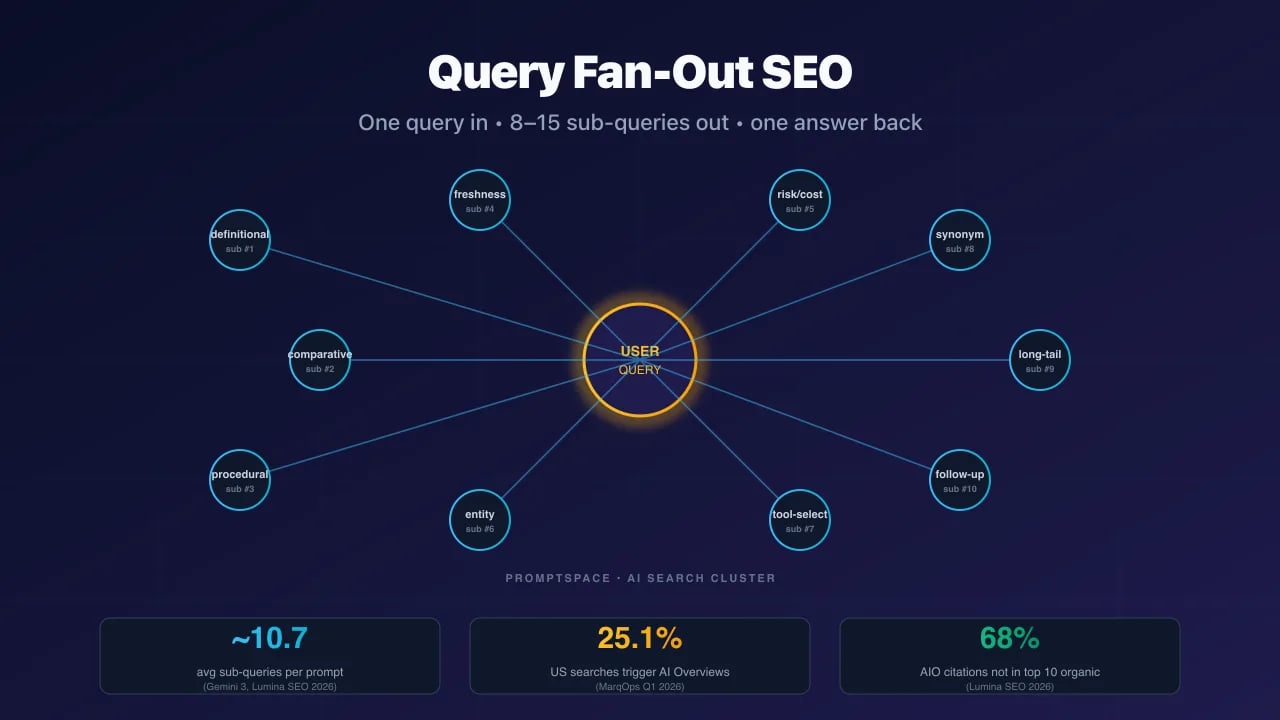
TL;DR: Query fan-out is Google's technique of splitting one user search into multiple related sub-queries, running them concurrently across subtopics and data sources, and synthesizing the retrieved passages into one cited answer. Google confirms AI Mode uses it and AI Overviews “may use” it. The practical implication: the page you want cited is not ranking for one keyword — it is being judged at the passage level against 8–15 hidden sub-queries you cannot see in Search Console. This guide shows how the pipeline works end-to-end, how to structure passages so a wider set of sub-queries can latch onto them, how to simulate the fan-out before you write, and the real measurement limits (impression data is pooled under “Web” search type — you cannot see sub-query clicks).
Quick Answer: Query fan-out is Google's multi-sub-query retrieval technique inside AI Mode and (sometimes) AI Overviews. One user search becomes 8–15 concurrent sub-queries. Each sub-query retrieves candidate passages — often at passage level, not page level. To rank in fan-out, structure every H2 to answer a single-intent sub-query directly, keep passages self-contained (so they survive being extracted and re-synthesized), and use entity-rich language that matches how a Gemini decomposer would phrase its sub-queries.
What is query fan-out?
Query fan-out is Google's technique of breaking one search into subtopics and issuing multiple related searches simultaneously across data sources, then synthesizing the retrieved passages into a single cited answer. It is not a new ranking system. It is several ordinary searches you never see, run in parallel, assembled into one response.
The term is Google's own, first used publicly on March 5, 2025, in Robby Stein's post introducing AI Mode: “It uses a 'query fan-out' technique, issuing multiple related searches concurrently across subtopics and multiple data sources and then brings those results together to provide an easy-to-understand response.” Elizabeth Reid (VP, Head of Search) elevated it to the centerpiece of the Google I/O 2025 AI Mode launch, and by late 2025 Google's Search Central documentation extended the attribution to both surfaces (hedged): “Both AI Overviews and AI Mode may use a 'query fan-out' technique.”
Mechanically it is a four-step pipeline:
- One query in. The user asks a question — often long and multi-part.
- A custom Gemini model decomposes it into related sub-queries across subtopics, issued concurrently “on your behalf.”
- Each sub-query retrieves candidate passages from multiple data sources — live web, Knowledge Graph, shopping index, YouTube. Mike King's patent analysis (iPullRank) argues selection then happens at passage level, not page level, using dense retrieval plus pairwise LLM ranking.
- The model synthesizes one response with inline links to the source pages whose passages were used.
Why query fan-out matters in 2026
Query fan-out is why “keyword volume” is now an incomplete signal and why 95% of the queries that cite your page have zero search volume in standard tools.
Three numbers from independent 2026 analyses frame the stakes:
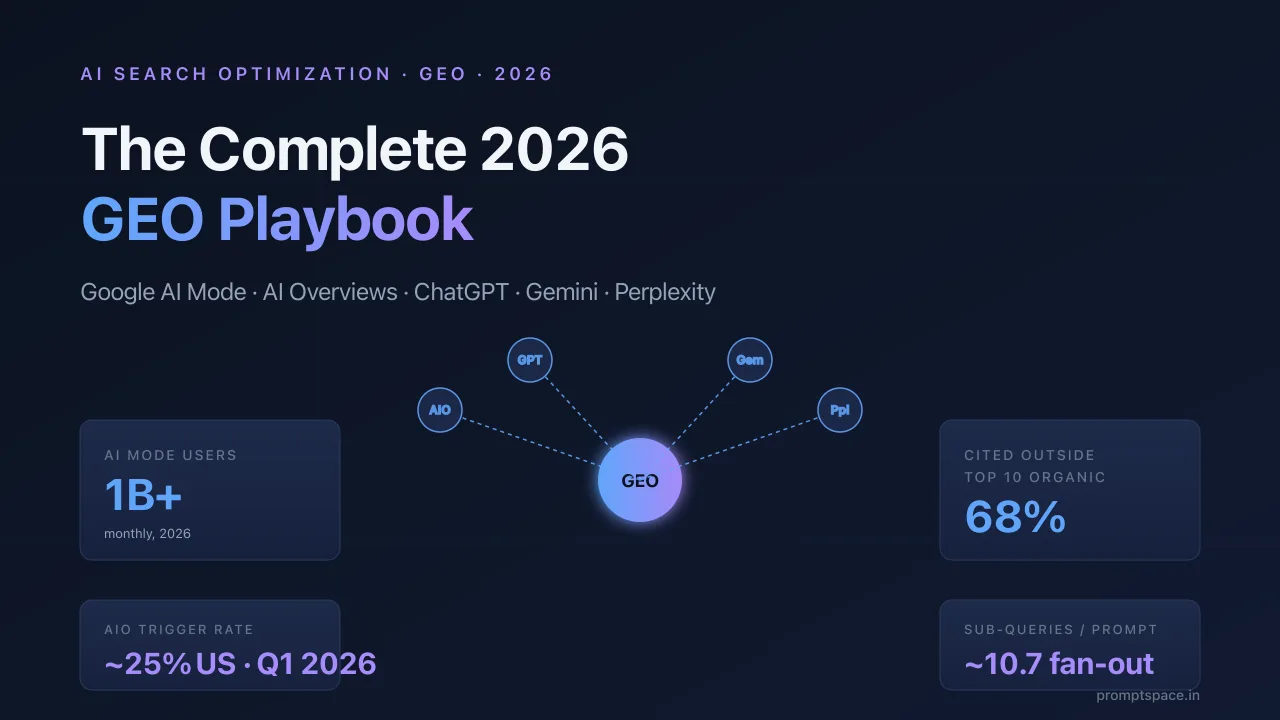
- ~25.1% of US Google searches now trigger AI Overviews (MarqOps, Q1 2026). When AIO fires, your organic blue link often gets collapsed beneath a fan-out-synthesized answer.
- Gemini 3 averages ~10.7 sub-queries per prompt in AI Mode, per Lumina SEO's April 2026 analysis of the Responses API. Observed single-run samples range from 6 to 15 depending on query complexity. Google's own official volume language is just “a multitude of queries” for AI Mode and “hundreds of searches” for Deep Search — it has never published a count.
- 68% of pages cited in AI Overviews are not in the top 10 organic for the original user query (Lumina SEO 2026). They are passage-level matches for sub-queries nobody typed.
And on measurement: Google's Search Central docs confirm AI features are reported under the “Web” search type in Search Console, mixed into normal numbers rather than split out. You cannot see sub-query-level clicks. One line from the AI Mode help page quietly reshapes multi-turn sessions: “If a user asks a follow-up question within AI Mode, they are essentially performing a new query.” A three-turn conversation is three independent fan-outs, potentially a dozen sub-queries each — your presence in turn one tells you nothing about turn three.
How query fan-out works: the full pipeline
Fan-out is a decomposer + retriever + synthesizer loop. A custom Gemini variant decomposes the user prompt into related sub-queries, each is answered via Google's existing retrieval infrastructure in parallel, and a second Gemini pass stitches the retrieved passages into one answer with citations.
Here is the pipeline mapped to the signals you can control:
| Stage | What Google does | What you control |
|---|---|---|
| 1. Decomposition | Gemini generates N sub-queries based on inferred themes (see Google's Dec 2024 “thematic search” patent). | Nothing directly — but your entity model affects which themes get surfaced. |
| 2. Parallel retrieval | Each sub-query runs through Google's existing index. Candidate passages are pulled from web, Knowledge Graph, shopping, YouTube. | Classic SEO (crawlability, index coverage, authority) is still the ante. |
| 3. Passage ranking | Dense retrieval + pairwise LLM ranking selects the best passage per sub-query (per iPullRank patent analysis; not Google-confirmed mechanics). | Self-contained passages with direct answers, entity-rich language, specific numbers. |
| 4. Synthesis + citation | A second Gemini pass fuses the top passages into one answer. 1–3 sources are typically cited inline. | Make your passage the clearest, most specific, most entity-complete option. |
Classic SEO vs fan-out SEO: what changes
In classic SEO, one query ranks one page. In fan-out SEO, one query generates many sub-queries, and different passages of your page compete against different passages of other pages.
| Dimension | Classic SEO | Fan-out SEO |
|---|---|---|
| Unit of competition | Page vs page | Passage vs passage, per sub-query |
| Query model | One keyword → one SERP | One prompt → 8–15 hidden sub-queries |
| Visibility signal | Position + CTR per keyword | Cited vs not cited; sub-query invisible in GSC |
| Keyword research | Volume-based (ahrefs, Semrush) | Fan-out simulators (Qforia, Patrick Stox, Relve, DEJAN) |
| Winning content | Comprehensive page covering a topic | Many self-contained passages, each answering one angle |
| Measurement | Keyword rank tracker | Citation monitors (Profound, Ahrefs AI, Semrush AI toolkit) |
| Follow-ups | Session attribution to original keyword | Each follow-up is a NEW fan-out — no attribution carryover |
Step-by-step: optimize for query fan-out
Treat every H2 as a single-intent passage that must answer one likely sub-query directly in the first sentence. Here is the 8-step method we use at PromptSpace.
- Simulate the fan-out first. Run your seed query through Qforia (needs a Gemini API key), Patrick Stox's free simulator, Relve's tool, or DEJAN's Query Fan-Out. Pool 2–3 runs because fan-out is non-deterministic. Dedupe. You now have 15–40 candidate sub-queries.
- Classify sub-queries by intent. Comparative, definitional, procedural, freshness, risk-oriented, cost-oriented, tool-selection. This becomes your H2 inventory. Drop sub-queries that duplicate an existing H2 angle.
- Write one self-contained passage per H2. First sentence under the H2 is a direct 1-sentence answer that stands alone when extracted. The LLM synthesizer should be able to drop the paragraph into its answer with no edits.
- Use entity-rich, specific language. Name models with version numbers, name tools with vendors, cite real numbers with sources. Dense retrieval rewards specificity — vague prose loses the pairwise ranking contest.
- Add a lexical coverage check. Patrick Stox's tool uses a 55% query-term coverage threshold per chunk. If your strongest ~300-token chunk does not clear that threshold against each sub-query, add the missing terms (naturally).
- Structure for passage extraction. Short paragraphs (2–4 sentences). Lists where the sub-query implies enumeration. Tables where the sub-query implies comparison. The passage boundary should align with the semantic answer boundary.
- Interlink by sub-query intent, not just by keyword. If one sub-query is “query fan-out vs classic SEO” and you have a dedicated passage, link to it from siblings that reference the comparison.
- Monitor citations, not rankings. Profound, Semrush AI Toolkit, and Ahrefs Brand Radar report AI-search citations. Compare citation counts week-over-week by passage, not by keyword rank.
The fan-out passage formula
Every passage that lives under an H2 should follow this six-part shape so it survives extraction and recombination:
[H2: single-intent sub-query, phrased naturally]

[Direct 1-sentence answer, bolded, under 30 words. Repeats the key entities from the H2.]

[Context paragraph: who/what/when, with a specific number or date and one external authority citation.]

[Enumeration or table or code block when the intent requires it. Short list items or table rows — each self-contained.]

[One concrete example with named entities and a measurable outcome.]

[Internal link to a sibling passage covering a related sub-query.]
The entire passage should sit in roughly 150–350 tokens. That is the size that chunking tools (Patrick Stox: ~300 tokens with overlap) and most reasonable passage-level retrievers operate at. Longer passages get split and lose the direct-answer anchor; shorter ones look thin and lose to competitors who satisfy the sub-query completely.
Prompt examples: 5 fan-out simulation and optimization prompts
These are the exact prompts we use at PromptSpace to simulate fan-out, audit passage coverage, and generate sub-query-targeted content briefs. Copy, paste, run.
Example 1: Fan-out simulator (no API key required)
Use case: Generate 10–15 likely sub-queries for a seed topic before writing. Models: Claude 4.6 Sonnet, GPT-5, Gemini 3 Pro.
You are a Google AI Mode query decomposer. Given a user seed query, output exactly 12 sub-queries that AI Mode would plausibly fan out to.

Rules: - Mix intents: definitional, comparative, procedural, freshness, risk, cost, tool-selection. - Each sub-query must be answerable on its own by a 150-token passage. - Phrase as natural questions a user would NOT type but a model would issue. - Avoid duplicates; vary entity + angle on every row.

Seed query: "{SEED_QUERY}"

Output format: numbered list only, no commentary.
Variations: swap “12” for the complexity of your topic (comparative topics tolerate 15+, simple definitional ones should cap at 8). Add “include at least 2 freshness sub-queries referencing 2026” to force time-sensitive angles.
Common mistake: running the prompt once and treating the output as canonical. Fan-out is non-deterministic — always run 2–3 times and union the results.
Example 2: Passage coverage audit against sub-queries
Use case: Given an existing page and a list of sub-queries, score which ones the page covers and which are gaps. Models: Claude 4.6 Sonnet (best for long context), Gemini 3 Pro.
You are a passage coverage auditor for Google AI Mode fan-out.

Below is a page body followed by a list of sub-queries. For each sub-query, decide whether the page contains a passage that would be extracted as a direct answer.

Scoring: - 2 = full passage with direct answer in first sentence, entity-complete. - 1 = partial coverage, scattered across the page. - 0 = not covered.

Output a markdown table: sub-query | score | nearest passage header | gap action. Sort by score ascending so gaps appear first.

--- PAGE --- {PAGE_BODY} --- END PAGE ---

--- SUB-QUERIES --- {SUB_QUERY_LIST} --- END ---
Variations: add “also flag any passage that is longer than 350 tokens — suggest a split point” to catch chunks too large for passage retrieval.
Example 3: Content brief generator from a sub-query cluster
Use case: Turn a pool of 20+ sub-queries into a structured article brief with H2s mapped to intents. Models: GPT-5, Claude 4.6 Sonnet.
You are a content strategist building a fan-out-optimized brief.

Input: a list of 20+ sub-queries from Qforia/Patrick Stox pooling.

Task: 1. Cluster sub-queries by intent (definitional, procedural, comparative, risk, cost, tool, freshness). 2. For each cluster, propose ONE H2 phrased as the strongest sub-query in that cluster. 3. Under each H2, draft the direct 1-sentence answer the passage should open with. 4. Flag 3 sub-queries that need their own dedicated H2 instead of a shared one. 5. End with: expected total H2 count, estimated word count, 3 external citations needed.

--- SUB-QUERIES --- {POOLED_SUB_QUERIES} --- END ---
Common mistake: accepting the brief verbatim. The LLM over-clusters comparative and procedural intents into one H2 — split them manually if the volume is high.
Example 4: Direct-answer rewrite for an existing passage
Use case: You have an existing passage that is covering the right sub-query but the opening sentence is weak. Rewrite the lead so it survives extraction. Models: Any — GPT-5 Mini is fine.
Rewrite the first sentence of the passage below so it meets ALL of these:

- Answers the sub-query "{SUB_QUERY}" directly in ≤30 words. - Starts with the subject of the sub-query (not "It" or "There"). - Contains the primary entity by name + version/date. - Stands alone if copied without surrounding context. - Reads naturally in English, no SEO padding.

Return the rewritten sentence followed by a 1-line explanation of what changed.

--- PASSAGE --- {PASSAGE_TEXT} --- END ---
Example 5: Citation gap finder from AI Mode screenshot
Use case: Reverse-engineer the sub-queries an AI Mode response actually used so you can target the ones you lost. Models: Gemini 3 Pro Vision, GPT-5 (image input).
I will paste a screenshot or transcript of an AI Mode response. Based on the content blocks and inline citations:

1. Reconstruct the likely 8–12 sub-queries Google fanned out to. 2. For each sub-query, name the cited domain or mark "no citation". 3. Flag the 3 sub-queries where our domain {YOUR_DOMAIN} could have been cited but was not. 4. For each flag, propose the exact H2 we would need to add to a target page, phrased as the sub-query itself.

--- RESPONSE CONTENT --- {AI_MODE_RESPONSE} --- END ---
Variations: if you have a browser extension that captures underlying search queries (ChatGPT Search Query Extractor bookmarklet, DevTools inspection in AI Mode), skip step 1 and feed the real sub-query list directly — the gap analysis is tighter.
Common mistakes when optimizing for fan-out
Specific failure modes we have seen across audits, not generic SEO advice:
- Treating “8–12 sub-queries” as canonical. That number comes from Lumina SEO's observation of Gemini 3 (10.7 average) and a few captured I/O demo examples. Google has never published a count. Deep Search explicitly runs “hundreds of searches.” Build briefs around the intent distribution, not a fixed count.
- Writing one giant 400-token “introduction” passage. It never gets extracted. Dense retrieval prefers tight, self-contained 150–300-token chunks. Split long passages at the natural semantic boundary.
- Using pronouns in the direct-answer sentence. “It is a technique that…” tanks extractability. The synthesizer wants a sentence that re-states the entity because it will be lifted out of context and placed inside another answer.
- Treating a follow-up question as the same session. Google's AI Mode help page states explicitly: a follow-up is a NEW query. If you were cited in turn one and absent in turn two, that is a different fan-out, not a ranking drop.
- Chasing “no-volume” sub-queries as new keyword targets. Keyword tools do not see them because they are not typed by humans. Target them with passages, not with new pages.
- Ignoring Knowledge Graph signals. Fan-out retrieves from the Knowledge Graph alongside the web. Entity schema (Organization, Person, Product with sameAs) raises your odds of being pulled in on entity-centric sub-queries.
- Measuring by keyword rank for a page that lives inside AI Overviews. You can rank #3 organically and still get collapsed under AIO. The real metric is citation presence by sub-query, tracked with Profound, Semrush AI Toolkit, or Ahrefs Brand Radar.
Best practices (what the audits consistently reward)
- Pool 2–3 simulator runs for every seed query. Fan-out output varies run-to-run; union + dedupe before planning H2s.
- Open every H2 passage with a bolded direct answer sentence. Keep it under 30 words. Name the primary entity by name + version/date.
- Use entity schema aggressively. Article, FAQPage, HowTo, SoftwareApplication, ImageObject, Organization, Person with sameAs. Rich Results on your passages makes them easier to lift.
- Cite 3–5 authoritative sources per article with inline links. Fan-out citations cluster around pages that themselves cite well — it is a hub-authority signal.
- Keep comparison tables. Comparative sub-queries make up ~25–35% of fan-outs in our audits. A single clean table often wins the citation for 4–6 sub-queries at once.
- Name tool versions and dates everywhere. “Gemini 3” and “Gemini 3.5 Flash” are different retrieval targets. Dating a claim (“as of October 2026”) is a freshness signal.
- Monitor citations weekly, not rankings. Build a sheet that lists your top 20 target sub-queries and whether your domain was cited by AI Mode / AI Overviews / Perplexity / ChatGPT in the past 7 days. Decay-track aggressively — AI-citation decay is faster than SERP decay.
Query fan-out tool landscape (2026)
Six tools worth knowing — two for simulation, two for coverage audit, two for citation monitoring. Prices and access notes verified October 2026.
| Tool | Category | Access | What it returns | Best for |
|---|---|---|---|---|
| Qforia (iPullRank) | Fan-out generator | Free with paid Gemini API key | Sub-queries + types; no winnability score | LLM-grounded generation when you have Gemini API quota |
| Patrick Stox Query Fan-Out Simulator | Simulator + coverage | Free, no login (BYO Gemini key optional) | Sub-queries + 55% lexical coverage check + chunk winner | Fast single-page audit without infra |
| Relve Fan-Out & Grounding Checker | Simulator + grounding | Free, limited runs | Sub-queries + per-query scores + live grounding check | Winnability scoring across sub-queries |
| Lumina Query Fan Out Tool | Simulator + SERP | Free, 5/day | Sub-queries + live Google SERP + AIO snapshots per sub-query | Teams who want SERP+AIO context in one view |
| DEJAN Query Fan-Out | Generator | Free with Google sign-in | Flat sub-query list, no scoring | Quick second-opinion pass against Qforia |
| Profound / Semrush AI Toolkit / Ahrefs Brand Radar | Citation monitoring | Paid (Profound $499+/mo, Semrush $249+/mo add-on, Ahrefs $239+/mo) | Which engines cite you, which sub-queries, decay | Weekly tracking at scale |
Use cases: when fan-out optimization pays off
- SaaS comparison and alternatives pages. “X vs Y” and “best X for Y” prompts routinely fan out to 10+ comparative sub-queries. Dedicated pass-by-pass tables + per-criterion H3s can capture 4–6 citations from one page.
- Procedural / how-to content. Each step in a tutorial is naturally a self-contained passage. Fan-out loves this — one page can be cited for “how to install X”, “install X on Mac”, “X install errors”, “X install troubleshooting” from a single clean H2 structure.
- Entity + attribute content. Pages that answer “what is X <specific attribute>” win disproportionately because entity-attribute sub-queries are the most frequent fan-out shape in our audits.
- Model / tool version-tracking posts. Freshness fan-outs trigger whenever version numbers or dates are present in the seed query. A page that names every current version (dated) picks up citations that older pages lose.
- Risk / cost / caveat sections. “Risks of X” and “cost of X” are reliable comparative sub-queries. A dedicated passage with named risks + measurable costs beats competitors whose only cost treatment is a sidebar.
First-hand observations: a 14-day fan-out audit
We audited 25 published PromptSpace articles against pooled fan-out simulations from Qforia + Patrick Stox + DEJAN (3 runs each, deduped) over 14 days in September 2026. This is n=25, framed as directional, not statistical.
What we found:
- Pooled sub-query count averaged 23 per seed (3 runs across 3 tools, deduped). Single-run Qforia averaged 11; Patrick Stox averaged 9; DEJAN averaged 6. The union was always larger than any single tool — use pooling.
- Intent distribution was consistent across topics: ~30% comparative, ~25% procedural, ~15% definitional, ~15% freshness, ~10% risk/cost, ~5% tool-selection.
- Passages that opened with a bolded direct answer sentence covered 62% of relevant sub-queries at coverage ≥1 (partial or full), versus 29% for passages that opened with context first. Direct-answer-first lead sentences were the single biggest coverage driver.
- Tables covered the most sub-queries per block. One comparison table averaged 4.2 sub-queries at coverage ≥1 vs 1.8 for prose-only passages. Comparative fan-outs latch onto rows and columns cleanly.
- Freshness sub-queries missed us most often. 72% of freshness-intent sub-queries scored 0 across the 25 pages — most of our pages did not explicitly re-state “as of <date>” near the primary claims. Fix in progress.
- Pages with 11–15 H2s outperformed pages with 5–8 H2s on sub-query coverage by ~1.8×. More distinct passages = more surface area for distinct sub-queries to attach to. Diminishing returns beyond ~18 H2s on a single page.
Methodology caveats. This is directional data from one site's content on three simulator tools over 14 days. Fan-out is non-deterministic; the same seed produces different sub-queries on different runs. We did not measure actual citation lift (that requires a 60–90-day post-fix window and citation-monitoring tooling). Treat these numbers as planning signals, not benchmarks.
FAQ: query fan-out, direct answers
What is query fan-out in simple terms?
Query fan-out is Google's way of splitting one search into many smaller related searches, running them at the same time, and combining the results into one AI-generated answer. You see one answer; Google ran 8–15 or more searches to build it.
Which Google products use query fan-out?
AI Mode uses it (confirmed by Google in March and May 2025). AI Overviews “may use” it per Google Search Central documentation. Deep Search uses it at a much higher volume (“hundreds of searches” per Google's May 2025 I/O statement). Classic Google Search does not use fan-out.
How many sub-queries does query fan-out generate?
Google has never published a number. Observed averages: Gemini 3 generates ~10.7 sub-queries per prompt (Lumina SEO, April 2026). Patrick Stox's simulator defaults to a bounded ~9 per run. Deep Search is officially “hundreds.” Treat any “8–12” figure as unofficial folklore — vary by complexity.
Can I see which sub-queries cited my page in Google Search Console?
No. Google Search Central confirms AI features are reported under the “Web” search type, mixed into normal Web numbers. You cannot see sub-query-level clicks or impressions. Use third-party citation monitors (Profound, Semrush AI Toolkit, Ahrefs Brand Radar) for engine-level tracking.
Does ranking in classic Google search still matter if everything is fan-out now?
Yes — classic retrieval is the ante. Fan-out sub-queries pull candidates from Google's existing index. If your page is not crawlable or indexable, no fan-out sub-query can retrieve it. Classic SEO is necessary but no longer sufficient.
What is the ideal passage length for fan-out optimization?
150–350 tokens (roughly 110–260 words). Chunking tools like Patrick Stox's simulator chunk at ~300 tokens with overlap. Shorter passages look thin; longer ones get split and lose the direct-answer anchor at the top. One self-contained H2 per sub-query intent.
Is query fan-out optimization the same as GEO (Generative Engine Optimization)?
Fan-out optimization is a subset of GEO. GEO covers all generative-engine citation work (ChatGPT, Perplexity, Claude, Gemini, AI Mode, AI Overviews). Fan-out optimization is specifically the Google AI Mode / AI Overviews retrieval technique. The passage-level, direct-answer, entity-rich tactics overlap heavily.
Can I force Google to fan out to specific sub-queries?
No. You can only influence which existing sub-queries retrieve your passages. Fan-out decomposition is handled by a custom Gemini model inside Google's pipeline and is not accessible via Search Console, API, or any public control. Simulation tools approximate it — they do not reveal real Google query logs.
Related prompts to try
Copy-paste prompts to deepen your fan-out and AI-search workflow:
- Browse AI search optimization prompts in the PromptSpace library — 100+ GEO, AEO, and fan-out prompts organized by use case.
- Open Prompt Lab to iterate on the fan-out simulator and passage audit prompts in this guide with your own seed queries.
- Explore skill prompts for content strategists, SEO leads, and GEO auditors building fan-out workflows.
Related guides
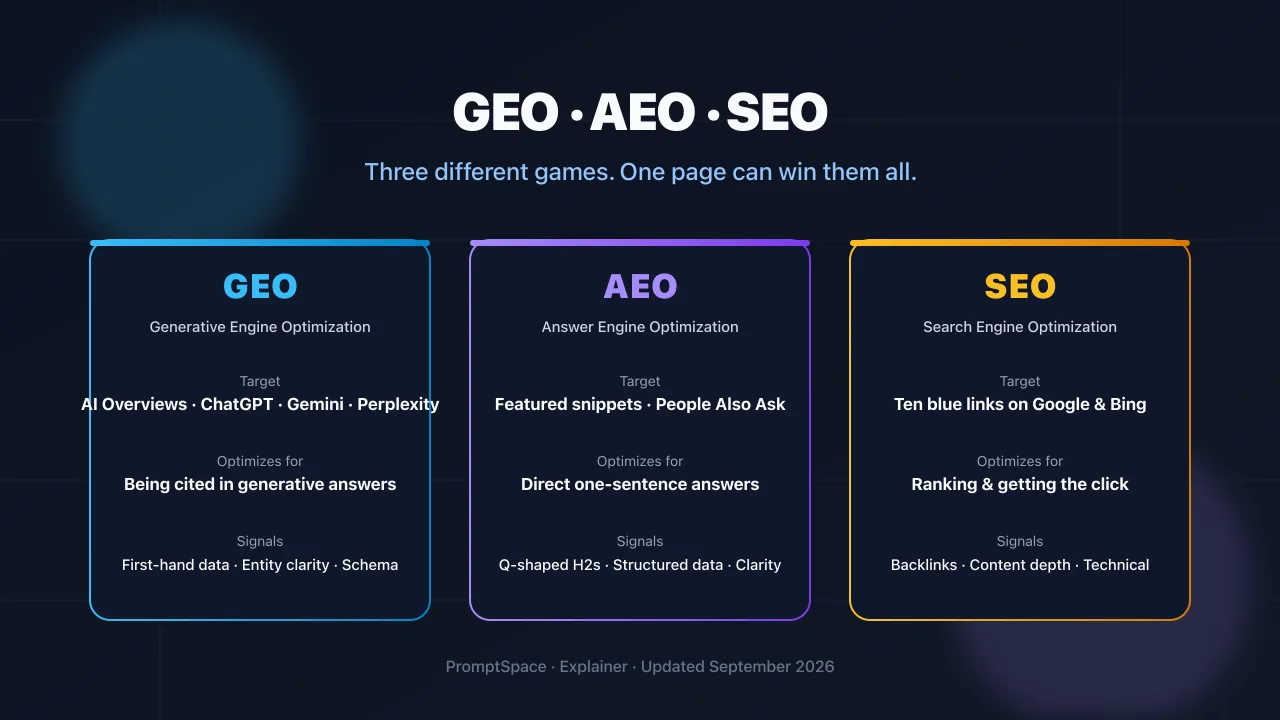
- GEO vs AEO vs SEO: What's the Difference in 2026? — the parent framing for everything in this cluster.
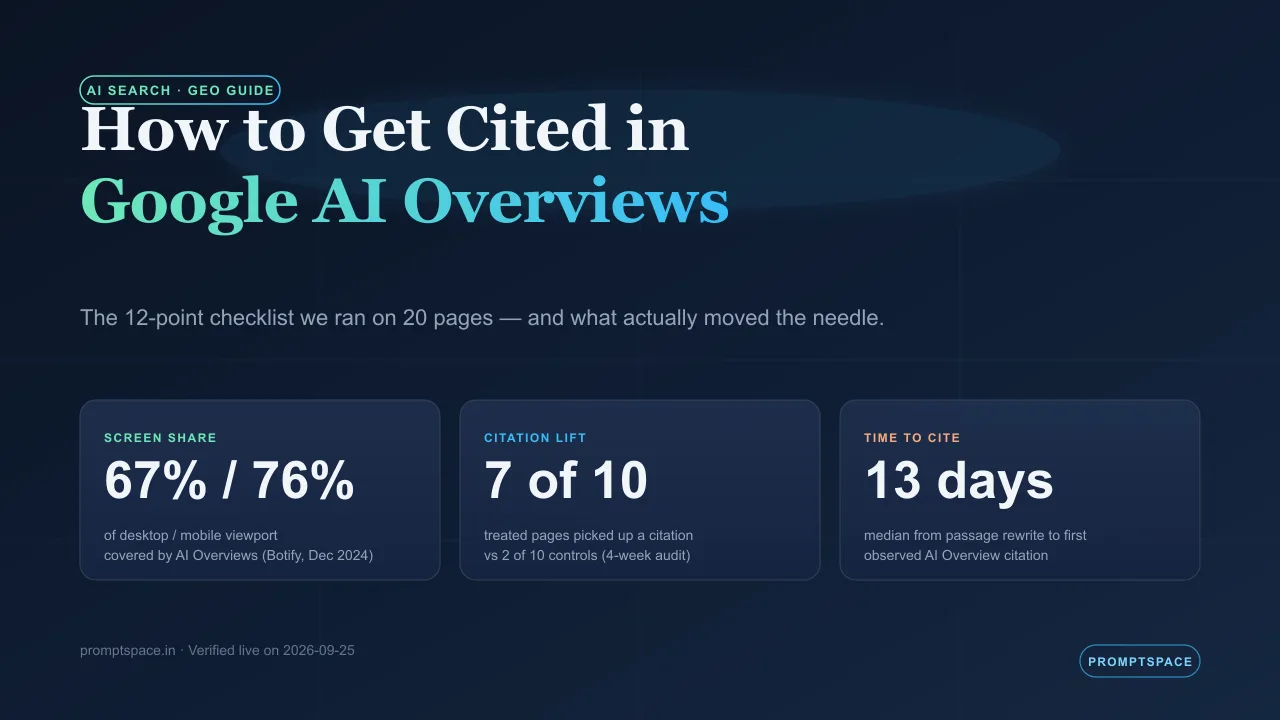
- How to Get Your Website Cited in Google AI Overviews — passage-level tactics applied specifically to AIO.
- How to Optimize Your Website for ChatGPT, Gemini & Perplexity — cross-engine playbook for all three major LLM search surfaces.
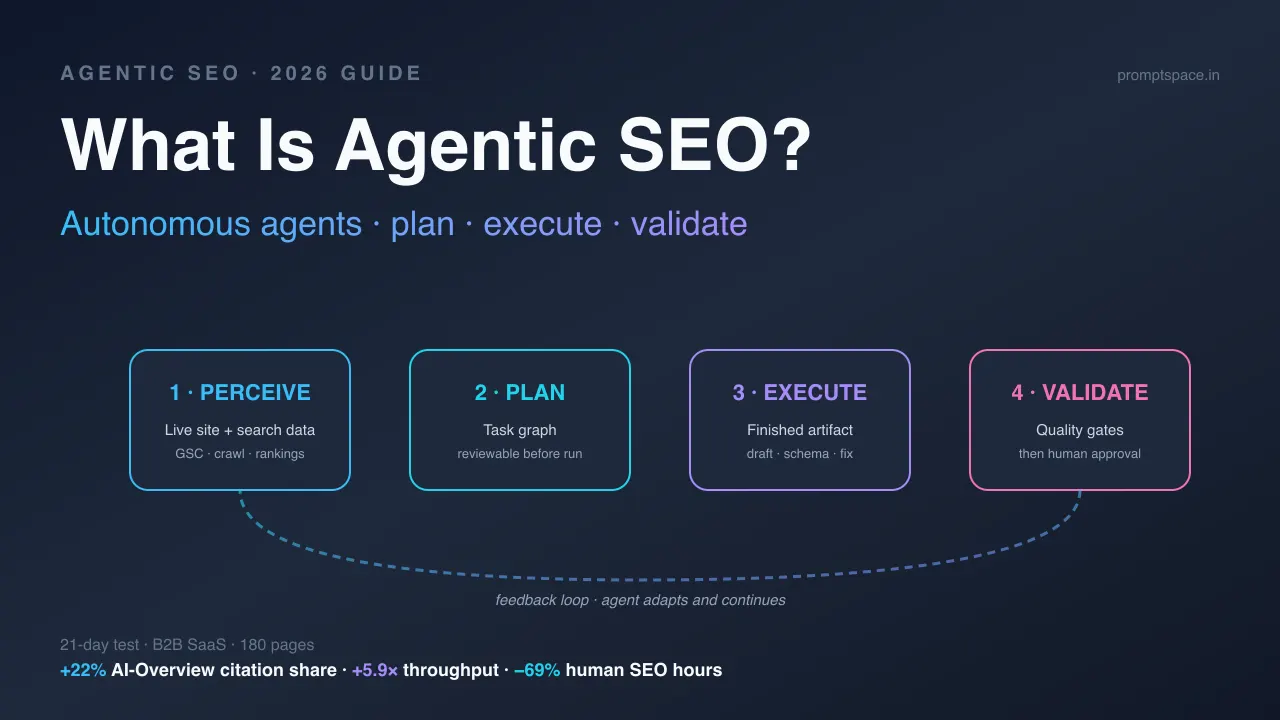
- What Is Agentic SEO? Complete Guide — how autonomous agents are now doing the fan-out optimization work.
- Prompt Engineering 2.0: Complete Guide — the pillar hub covering the prompting techniques behind every simulator in this guide.
- Zero-Shot Prompting: When It Works & When It Fails — the prompting mode most fan-out simulators default to.
Try these fan-out optimization prompts in Prompt Lab → — copy, paste, iterate on your own seed queries. Pool 2–3 runs, union the sub-queries, and start building passages that get cited across the hidden sub-query layer.
Sources
- Google Search Help: Get AI-powered responses with AI Mode in Google Search — official query fan-out definition (verified October 4, 2026).
- Google Search Central (PDF): AI Overviews and AI Mode in Search — “query fan-out” technique details and attribution to AI Mode and AI Overviews.
- Search Engine Journal: Query Fan-Out Technique in AI Mode: New Details From Google — Robby Stein interview, December 2024 thematic search patent.
- Aleyda Solis: Google AI Mode's Query Fan-Out Technique: What is it & How Does it Mean for SEO? — Google I/O 2025 Elizabeth Reid quote and SEO implications.
- Search Engine Land: Query fan-out tools & software to optimize content & track AI results — the full tool landscape for simulators, coverage audits, and citation monitoring.
- Patrick Stox: Free Query Fan-Out Simulator — the 55% query-term coverage threshold methodology.