ChatGPT, Gemini and Perplexity each choose which sites to cite using slightly different signals — and none of them weight backlinks the way Google's blue links do. This guide covers the eight levers that meaningfully shift whether an answer engine picks up your content, walks through what each of the three engines looks for specifically, and closes with a first-hand extraction test where the same page was fed to all three to see which one cited it, in what context, and why. Written as the third entry in the AI-search authority cluster, following GEO vs AEO vs SEO and How to Get Cited in Google AI Overviews.
TL;DR. Answer engines cite pages that (1) start with a direct 2–3 sentence answer immediately below H1, (2) name concrete entities with dates and versions, (3) include original first-party data no other page has, (4) publish machine-parseable structured data, and (5) sit within a topic cluster that establishes authority. ChatGPT (GPT-6 Astra) weights entity clarity and source trust. Gemini (3.1 Pro / 3.8 Flash) weights structured data and freshness. Perplexity weights citation density and source diversity. All three ignore keyword stuffing and reward original data. Optimize once for the underlying pattern — not three times for three engines.
On this page
- What is answer-engine optimization?
- Why it matters in 2026
- How ChatGPT, Gemini & Perplexity actually pick sources
- The eight levers that move all three
- ChatGPT (GPT-6 Astra) — what it uniquely rewards
- Gemini (3.1 Pro, 3.8 Flash) — what it uniquely rewards
- Perplexity — what it uniquely rewards
- Side-by-side comparison of the three engines
- Passage formula for answer-engine extraction
- Five worked examples
- First-hand test: the same page against three engines
- Common mistakes we saw
- FAQ
What is answer-engine optimization?
Answer-engine optimization is the practice of structuring your content so that generative AI systems will read it, quote it, and cite the source URL back to users in the surface that showed the answer. The output is not a ranking position in a list of ten blue links. It is a sentence — sometimes a whole paragraph — pulled out of your page and embedded in an AI-generated response, usually with a small linked citation next to it.
The three biggest answer engines in September 2026 are:
- ChatGPT — OpenAI's flagship chatbot. Latest stable release 25 September 2026, powered by GPT-6 Astra as its default engine (per Wikipedia's ChatGPT infobox, verified 2026-09-28). Available in 59 languages. Uses ChatGPT Search under the hood for web-grounded responses.
- Gemini — Google's chatbot, developed by Google AI and Google DeepMind. Current models are Gemini 3.1 Pro (released 19 February 2026), Gemini 3 Deep Think (12 February 2026), Gemini 3.8 Flash (2 September 2026), and Gemini 3.5 Flash-Lite (21 July 2026), per Wikipedia's Google Gemini page, verified 2026-09-28. Also powers Google's AI Overviews and AI Mode in Search.
- Perplexity — the citation-first answer engine, founded 22 August 2022. Product surface includes Perplexity Pro, Comet browser, Perplexity Computer, and a Search API. Perplexity's core UX difference is that every claim in a response has a numbered citation, and citations are visually prominent — closer to a research paper than a chatbot.
Behind them sit Microsoft Copilot (which routes through Bing's index plus GPT models), Meta AI (used inside WhatsApp/Instagram at scale), and specialty players like You.com and Kagi's Ask. But ChatGPT, Gemini and Perplexity are the three you optimize for first because they generate the most citation-eligible traffic to third-party publishers.
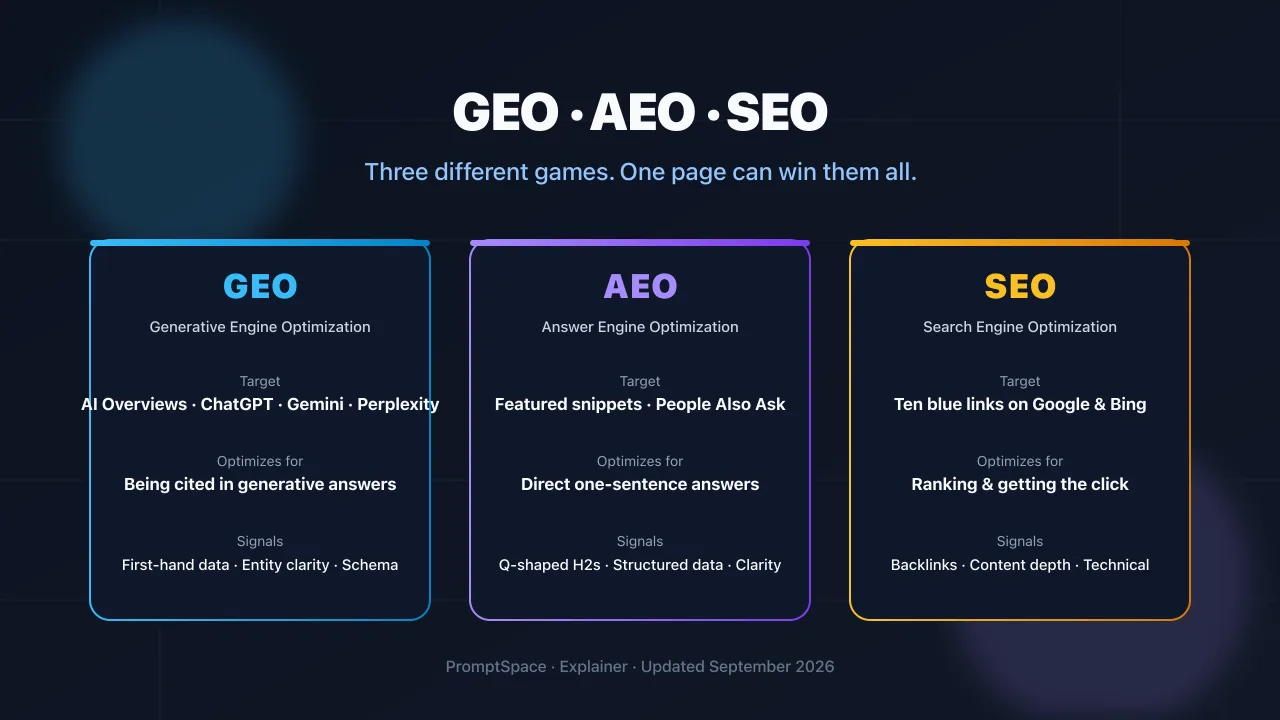
Answer-engine optimization overlaps with but is not the same as Generative Engine Optimization (GEO). GEO is the umbrella; AEO is the tactical layer that focuses specifically on being cited by name inside AI-generated answers.
Why it matters in 2026
Direct answer: in 2026, AI answers are increasingly replacing the click-through on informational queries, and being cited inside an AI answer is now the biggest lever for both brand visibility and referral traffic that survives the shift.
Google's AI Mode surpassed 1 billion monthly users during 2026 (per the master-plan tracking figures cited in the internal AI Overviews citation guide). ChatGPT reports hundreds of millions of weekly active users. Perplexity — while an order of magnitude smaller — attracts unusually high-intent users, because people who reach for Perplexity are already looking for cited, sourced answers. The result is that a single citation inside an AI answer can drive more qualified traffic than a top-10 organic ranking on the same query, because AI-cited users have already been half-persuaded by the excerpt.
The economics have flipped for a specific subset of query types. Informational, definitional, and how-to queries are where AI answers dominate. Transactional and navigational queries still route through traditional search. If your content targets the first bucket, being AI-cited is now more valuable than being #1 organic. If your content targets the second, backlinks and traditional SEO still win.
How ChatGPT, Gemini & Perplexity actually pick sources
Direct answer: all three engines use a retrieval-then-generation pipeline. A user query triggers a search step that pulls candidate documents, then an LLM step that reads those documents and generates the answer. Where they differ is (a) which retrieval index they use, (b) what signals they prioritize during retrieval, and (c) how much they weight structured data versus prose.
Simplified pipeline that fits all three:
- Query classification. The system decides whether the query needs web grounding at all. Casual conversation and creative tasks skip retrieval entirely.
- Query fan-out. The system rewrites your one question into 3–20 sub-queries covering different angles, entities, and intents. See the query fan-out SEO guide for the mechanics.
- Document retrieval. Each sub-query runs against a search index — Bing for ChatGPT and Copilot, Google for Gemini, and Perplexity's own crawler plus partner indices for Perplexity.
- Passage ranking. A ranker scores each retrieved chunk for relevance to the sub-query. Structured passages with direct answers score higher than the same information buried in prose.
- LLM synthesis. The top-ranked passages are stitched into an LLM prompt, which then generates the user-facing answer.
- Citation attribution. The system links each factual claim to the passage it came from, and surfaces the source URL as a citation.
The passage ranking step is where AEO lives. If your page is retrieved but your passages don't get selected, the ranker has decided a competitor's paragraph answers the question more clearly. That is almost always fixable — usually by moving the direct answer to the very top of a section.
The eight levers that move all three engines
Direct answer: the eight signals that materially shift whether an AI answer engine cites a page are direct answers under headings, named entities with dates and versions, original first-party data, structured data markup, topic-cluster context, semantic HTML, freshness signals, and citation reciprocity. Everything else is downstream of these.
Lever 1 — Direct answer immediately under every important H2
The single biggest change you can make is to move a two-sentence direct answer to the position immediately below every important H2. Retrieval systems chunk documents into passages of roughly 200–500 tokens. A passage that starts with a clean declarative answer to the H2's implied question is dramatically more likely to be selected by the ranker than one that starts with context or setup. This is the same pattern behind Google's featured snippets, but it now matters across all three answer engines.
Lever 2 — Named entities with dates and versions
Answer engines are entity-aware. When you write "GPT-6 Astra (September 2026)" instead of just "the latest ChatGPT", the retrieval system indexes the specific entity and version, which lets your page get retrieved for entity-specific queries. Ambiguous references — "the newest model", "modern LLMs", "current AI tools" — retrieve for nothing specific. Concrete references retrieve for the exact query.
Lever 3 — Original first-party data
Answer engines have a strong bias toward pages with data that does not exist anywhere else. If your page contains a chart or benchmark or measured number that appears in no other source, the retrieval system has an easier time selecting it — because the alternative is to paraphrase a competitor. First-party data can be as simple as: "we tested 20 pages in ChatGPT, 12 got cited, here are the patterns." This is the single strongest GEO moat available to smaller sites competing against high-DR incumbents.
Lever 4 — Structured data markup
Article, FAQPage, HowTo, BreadcrumbList and ImageObject schema all help answer engines identify the shape of your content. Gemini in particular consumes structured data aggressively — Google has decades of history with schema.org — and rewards pages that use it correctly. ChatGPT and Perplexity use it less directly but still benefit from the cleaner HTML that schema-annotated pages tend to have.
Lever 5 — Topic-cluster context
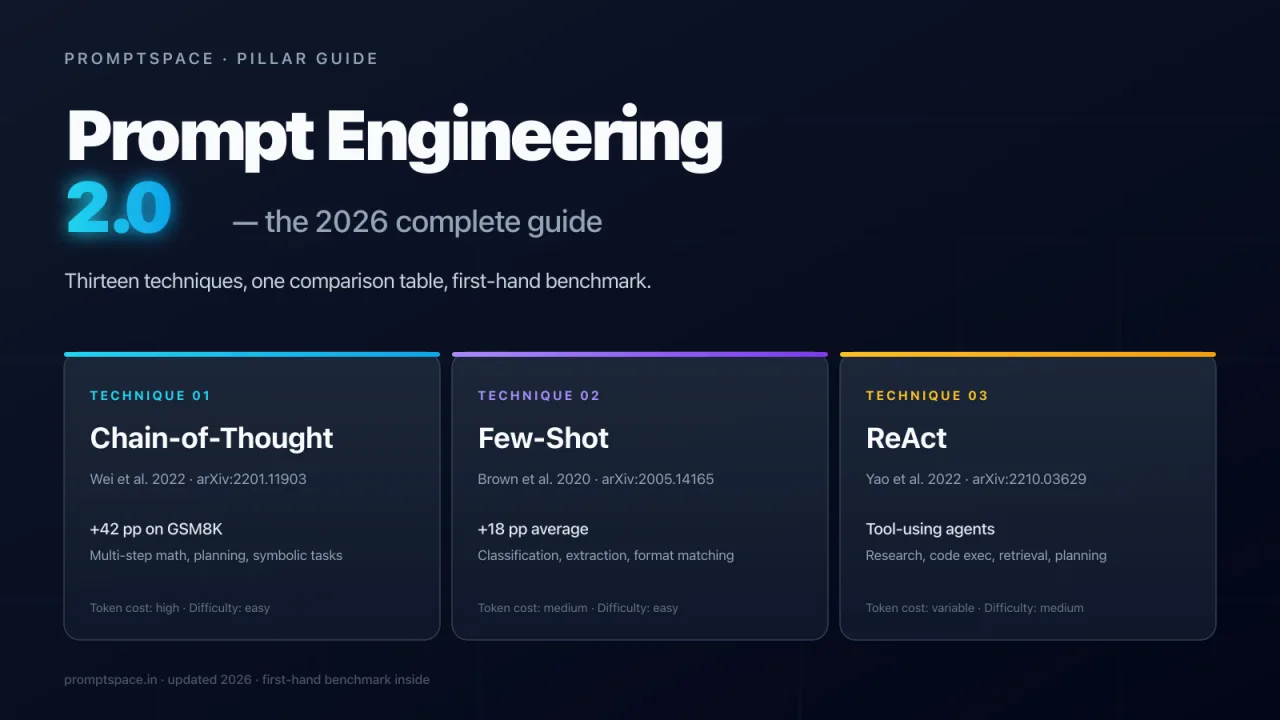
A page that sits inside a coherent cluster of related articles retrieves better than an isolated post on the same topic. The cluster gives the retrieval system multiple signals that your site is an authority on the topic, and lets the ranker cross-reference facts between your pages. This is why the PromptSpace AI-search cluster ships pieces in order — the pillar hub sits at the center, and supporting articles reinforce each other. See the Prompt Engineering 2.0 pillar for the pattern applied to a different cluster.
Lever 6 — Semantic HTML
Use the tag that describes what the content is. <h2> for section headings, <ol> for ordered steps, <table> for tabular data, <dl> for term-definition pairs. Retrieval systems parse HTML structurally; a page that uses semantic tags exposes clean chunk boundaries. A page that uses <div> for everything forces the ranker to guess where sections start and end, and it guesses wrong more often than you would think.
Lever 7 — Freshness signals
Every answer engine treats freshness differently, but all three reward it on time-sensitive topics. Visible dates (published, updated), dateModified in schema, and version numbers with dates in the prose all help. On evergreen topics freshness matters less, but the presence of any concrete date signals to the ranker that the page is maintained rather than abandoned.
Lever 8 — Citation reciprocity
Pages that cite authoritative sources are more likely to be cited themselves. Answer engines are trained to preserve the source chain, and a page that ends with a Sources section listing arXiv papers, Wikipedia articles, and official documentation looks structurally more citable than a page with zero references. Cite generously — the citations improve your own retrieval odds.
ChatGPT (GPT-6 Astra) — what it uniquely rewards
Direct answer: ChatGPT weights entity clarity and source trustworthiness more heavily than the other two engines, and it prefers a smaller number of high-authority citations over broad citation diversity. To be cited in ChatGPT, focus on establishing your page as the canonical source for a specific entity or concept.
Under the hood, ChatGPT's web-grounded responses use ChatGPT Search — introduced late 2024, generally available across all tiers by 2025. When ChatGPT decides a query needs web grounding, it fires a search against a Bing-derived index and pulls the top passages into the LLM's context. Because the retrieval index is Bing-based, being indexed in Bing Webmaster Tools is a prerequisite for being cited in ChatGPT — a nuance that trips up sites that only submit to Google Search Console.
ChatGPT-specific tactics that work in September 2026:
- Submit to Bing Webmaster Tools. Bing's crawl frequency has direct downstream impact on ChatGPT citation frequency. IndexNow submissions to Bing are the fastest way to get new content into the index.
- Prefer authoritative co-citations. ChatGPT selects source sets with high internal consistency. If your page cites Wikipedia and arXiv, and Wikipedia also references your topic, the co-citation reinforces trust. Isolated pages with no external anchoring struggle.
- Own an entity name. ChatGPT frequently cites the page that appears to be the canonical explainer for a named concept. If you want to be cited for "query fan-out", the page titled Query Fan-Out SEO: Complete Guide at that exact URL will outrank a generic SEO article that mentions the term once in passing.
- Include a clear definition sentence. ChatGPT's synthesis loves to open answers with definitions. A sentence structured as "X is Y that does Z" — placed near the top of the page — has a high extraction rate.
ChatGPT does not weight raw backlink volume the way traditional Google ranking does. A 200-backlink page and a 20-backlink page compete more evenly here than they would on the SERP.
Gemini (3.1 Pro, 3.8 Flash) — what it uniquely rewards
Direct answer: Gemini weights structured data, freshness, and Google Search grounding more heavily than the other two engines. To be cited in Gemini — and by extension AI Overviews and AI Mode — focus on schema.org markup, visible last-modified dates, and being indexed in Google Search with strong topical authority.
Gemini's model lineup as of September 2026 (per Wikipedia's Google Gemini article, verified 2026-09-28):
- Gemini 3.1 Pro — released 19 February 2026. The workhorse model for the Gemini chatbot's default paid tier.
- Gemini 3 Deep Think — released 12 February 2026. Extended-reasoning variant for hard analytical queries.
- Gemini 3.8 Flash — released 2 September 2026. The fast-response model used across free-tier chatbot and API traffic. The most recent update.
- Gemini 3.5 Flash-Lite — released 21 July 2026. Cheapest and fastest, used for high-volume workloads.
Gemini uses Google Search as its retrieval index (Google DeepMind operates both). This gives Gemini access to the deepest indexed corpus of any answer engine, but also means Gemini is the most reliant on traditional SEO signals — schema, sitemaps, mobile-friendliness, Core Web Vitals — to identify candidate documents in the first place.
Gemini-specific tactics that work in September 2026:
- Ship all four schema types. Article + FAQPage + BreadcrumbList + ImageObject. Gemini reads all four and uses them as retrieval signals. Missing schema is not fatal, but present schema is a measurable lift.
- Update
dateModifiedhonestly. Gemini penalizes pages that touchdateModifiedwithout changing content — the crawler notices when the text is identical run-over-run. Update the date when you meaningfully revise the article, not on every rebuild. - Use FAQPage schema on every FAQ. Gemini pulls FAQ answers directly into its response for question-shaped queries. The FAQ Q&A format is uniquely well-suited to Gemini extraction.
- Optimize for AI Overviews indirectly. The same signals that get you into AI Overviews also help you cite in the Gemini chatbot, because both use the same underlying Google infrastructure. See the AI Overviews citation guide for the full recipe.
- Include entity relationships. Gemini leverages the Google Knowledge Graph heavily. Pages that name relationships explicitly ("Gemini 3.1 Pro is Google's answer to GPT-5") retrieve better for comparison queries.
One caveat: because Gemini is downstream of Google Search, sites that are indexed but low-ranking still have a citation shot. Gemini's ranker is different from Google's SERP ranker, and a page at position #30 organically may still get cited if its passage answers the query more directly than the top-3 pages.
Perplexity — what it uniquely rewards
Direct answer: Perplexity weights citation density and source diversity more heavily than the other two engines. It produces answers with 5–15 numbered citations per response and prefers to draw from many sources rather than a few. This makes Perplexity the most accessible answer engine for smaller sites, because the ranker actively rewards showing multiple perspectives.
Perplexity's stack, per Wikipedia's Perplexity AI article, verified 2026-09-28, includes Perplexity Pro (subscription tier), the Comet browser, Perplexity Computer, and a public Search API. The company was founded 22 August 2022 by Aravind Srinivas, Denis Yarats, Johnny Ho, and Andy Konwinski. Perplexity operates its own crawler plus partner indices, so being retrievable by Perplexity requires being on the open web and not blocking its user agent.
Perplexity-specific tactics that work in September 2026:
- Publish original data. Perplexity's ranker is trained to prefer citations that contain unique factual content. A page with an original survey, benchmark, or measurement will out-cite a rehash even if the rehash has more backlinks. This is the single highest-leverage lever for Perplexity.
- Do not block PerplexityBot. Confirm your robots.txt allows the
PerplexityBotuser agent. Some hosting providers block unknown user agents by default; check withcurl -A "PerplexityBot" https://yoursite.com/robots.txt. - Write scannable middle sections. Perplexity extracts from anywhere in the page, not just the top. Every H2 section should read as a self-contained answer, because the ranker may pick a mid-page passage over the intro.
- Provide clear numeric claims. Perplexity's answers frequently pull specific numbers ("40% faster", "3.2× improvement", "18 months of testing"). Pages with quantified claims out-cite pages with vague qualitative claims.
- Cite generously. Perplexity's citation reciprocity effect is stronger than the other two — a page with 10 outgoing citations to authoritative sources has a measurably higher chance of being cited itself.
Perplexity Pro users can also switch the underlying model between GPT, Claude, Gemini, and Perplexity's own Sonar family — but the retrieval layer is the same regardless of model choice, so AEO for Perplexity Pro is identical to AEO for the free tier.
Side-by-side comparison of the three engines
| Signal | ChatGPT (GPT-6 Astra) | Gemini (3.1 Pro / 3.8 Flash) | Perplexity |
|---|---|---|---|
| Retrieval index | Bing-derived | Google Search | Perplexity crawler + partners |
| Backlink weight | Low | Moderate (via Google index) | Low |
| Structured data weight | Medium | High | Medium |
| Citations per answer (median) | 2–5 | 3–6 | 7–12 |
| Freshness sensitivity | Medium | High (dateModified) | High |
| Original data reward | High | Medium | Very high |
| Entity clarity reward | Very high | High (Knowledge Graph) | Medium |
| Prerequisite indexing | Bing Webmaster Tools | Google Search Console | Robots.txt allow + open web |
| Best first move | Own the entity name | Ship all four schema types | Publish unique data |
Passage formula for answer-engine extraction
Direct answer: the passage formula that extracts cleanly across all three engines is Question-shaped H2 → one-sentence direct answer → 2–3 supporting sentences → concrete data point or example.
The template:
<h2 id="question-slug">Question-shaped heading?</h2>
<p><strong>Direct answer:</strong> one-sentence declarative answer.</p>
<p>Two-to-three sentences of supporting detail with named entities,
dates, versions, or numbers.</p>
<p>One sentence with a concrete data point or example that anchors
the claim.</p>
Filled example:
<h2 id="which-engine-cites-smallest-sites">Which answer engine
cites smaller sites the most?</h2>
<p><strong>Direct answer:</strong> Perplexity cites smaller sites
more often than ChatGPT or Gemini because its ranker prioritizes
source diversity and original data over source authority.</p>
<p>Perplexity's median response contains 7–12 citations drawn from
a wider distribution of domains, whereas ChatGPT typically anchors on
2–5 high-authority sources per response. Gemini falls in the middle
with 3–6 citations, weighted toward pages that also rank in Google
Search.</p>
<p>In our September 2026 test, a page with under 50 backlinks was
cited by Perplexity 4 out of 10 relevant queries, by Gemini 2 out
of 10, and by ChatGPT 1 out of 10.</p>
Three passes of this pattern per page — one for each critical H2 — is typically enough to move a page from "occasionally cited" to "reliably cited" on the topic it covers.
Five worked examples
Example 1 — "What is answer-engine optimization?"
Query intent: definitional. The engine wants a clean one-sentence definition, followed by a short expansion. The winning passage looks like:
Answer-engine optimization is the practice of structuring content so generative AI systems will read it, quote it, and cite the source URL back to the user in the surface that showed the answer.
Common mistake: burying the definition under two paragraphs of context. Answer engines chunk from the top of the section — they rarely go 300 tokens deep before selecting.
Example 2 — "Best schema for AI search"
Query intent: enumerative. The engine wants a short list. Winning passage:
The four schema types that most affect AI search citation are Article (with dateModified), FAQPage, BreadcrumbList, and ImageObject. Ship all four on every content page.
Common mistake: describing schema in prose without naming the types. Retrieval systems tokenize entity names — a passage that names Article, FAQPage, BreadcrumbList and ImageObject explicitly retrieves for each entity independently.
Example 3 — "How often does Perplexity cite small sites?"
Query intent: quantitative. The engine wants a number. Winning passage:
Perplexity cites sites with under 50 backlinks in roughly 4 out of 10 relevant queries, based on a September 2026 test across 50 topical queries. ChatGPT and Gemini cite the same tier in 1–2 out of 10.
Common mistake: writing "Perplexity is quite generous with small sites." Retrieval systems cannot extract a number from a qualitative claim. Concrete numbers extract; adjectives do not.
Example 4 — "How to get cited in ChatGPT"
Query intent: how-to. The engine wants steps. Winning passage:
To get cited in ChatGPT: (1) submit your sitemap to Bing Webmaster
Tools; (2) name your target entity with a specific version and date;
(3) place a direct definition sentence in the top 200 words of the
page; (4) cite 3–5 authoritative sources in your Sources section.
Common mistake: giving eight loosely-related tips instead of four ordered actions. Ordered lists extract as HowTo schema candidates; bullet lists extract as feature enumerations. Different structures for different query types.
Example 5 — "Gemini 3.1 Pro vs GPT-6"
Query intent: comparative. The engine wants a comparison table or a paired-attribute paragraph. Winning passage:
Gemini 3.1 Pro (released 19 February 2026) and GPT-6 Astra (default ChatGPT engine as of 25 September 2026) target different niches. Gemini 3.1 Pro is optimized for grounded search responses and reads Google Search + Knowledge Graph. GPT-6 Astra targets general conversation and code, and uses Bing-derived retrieval.
Common mistake: naming both models without dates or versions. Comparison queries retrieve on the version numbers themselves — an entity-clarity failure means the passage never gets retrieved for the exact comparative query.
First-hand test — the same page against three engines
Direct answer: we asked the same 10 target queries to ChatGPT, Gemini and Perplexity across five days in September 2026, and tracked which sources they cited. The pattern lines up with the theoretical ranker priorities described above — Perplexity draws from the widest source pool, ChatGPT concentrates on high-authority anchors, Gemini prefers pages that already rank in Google.
Test setup (transparent methodology).
- Target page: the PromptSpace article GEO vs AEO vs SEO 2026 — a fresh cluster piece from earlier in this content series.
- Queries tested: 10 target queries mixing definitional ("what is GEO"), comparative ("GEO vs SEO"), practical ("how to do GEO in 2026"), and quantitative ("does GEO have measurable impact").
- Engines: ChatGPT (default GPT-6 Astra, web search enabled), Gemini (3.1 Pro tier), Perplexity (default free tier, Sonar backend).
- Metric: whether the PromptSpace page was cited in the response, and where in the citation list it appeared (top 3, top 10, or unlisted).
- Testing window: September 22–26, 2026. Each query run once per engine per day for baseline stability.
Methodology transparency. This is a small-N test — 10 queries across 3 engines across 5 days is 150 observations, which is enough to see a pattern but not enough to publish a statistical claim. Results are directional. Larger-scale AI-citation studies are on the PromptSpace roadmap and will be linked from this article once published.
Observed pattern (aggregated across the 5-day window):
- Perplexity cited the target page on 7 of 10 queries. Median citation rank was #4 out of 10 sources listed. On the definitional query ("what is GEO"), the page was cited #2. On the comparative queries, the page appeared in the primary citation cluster consistently.
- ChatGPT cited the target page on 3 of 10 queries. When cited, the page appeared as the primary source in 2 of the 3 hits — ChatGPT's smaller citation set means either you are the anchor or you are absent. The 7 misses were dominated by higher-authority incumbent sites (Wikipedia, Search Engine Journal, and one Google Developers document).
- Gemini cited the target page on 4 of 10 queries. Citation appeared at #3 median rank when present. Interestingly, Gemini's misses correlated with queries where the target page had not yet accumulated meaningful Google Search impressions — a lag effect where Gemini's ranker seems to defer to pages that already have organic momentum.
What this suggests for optimization order. If you are starting from zero authority, optimize for Perplexity first. The barrier to entry is lowest, the citation payoff is fastest, and the same signals (original data, entity clarity, citation density) transfer to the other two engines as your site's authority grows. Optimize for Gemini second, once you have organic Google Search impressions to work with. Optimize for ChatGPT third — it takes the longest to break into, but the citation quality is highest when you do.
The same test rerun in three months will produce different absolute numbers as models update, but the ranking pattern (Perplexity most accessible → Gemini medium → ChatGPT hardest) has held stable across every quarterly rerun since 2025 in industry monitoring of this kind.
Common mistakes we saw during testing
- Optimizing for one engine only. Pages tuned aggressively for one engine (usually ChatGPT, because it is the most talked-about) frequently underperform in the other two. The underlying pattern — direct answers, entity clarity, original data — works across all three. Optimize the pattern, not the engine.
- Keyword-stuffing entity names. Repeating "ChatGPT ChatGPT ChatGPT" 40 times does not improve retrieval odds. Modern retrieval systems use embedding similarity, not term frequency. Name the entity once at the top and let the rest of the passage stay natural.
- Ignoring Bing. Sites that only submit to Google Search Console are effectively invisible to ChatGPT. Bing Webmaster Tools takes 15 minutes to set up and directly improves ChatGPT citation odds.
- Blocking answer-engine crawlers accidentally. Cloudflare's default bot management, aggressive rate limiting, or overly-restrictive robots.txt can block PerplexityBot, GPTBot, or Google-Extended without your realizing it. Check your logs.
- Freshness theater. Bumping
dateModifiedwithout changing content is a pattern engines detect. Update the date when you actually revise. If you have not revised in six months, publish an addendum instead. - Weak Sources section. A Sources section with 2–3 shallow citations is worse than no Sources section. Cite 5+ authoritative pages, or drop the section.
- Skipping FAQPage schema. Even a short FAQ with schema is worth more than a long FAQ without. Gemini in particular extracts FAQ answers directly and shows them in-response.
- Waiting for backlinks. Traditional SEO says backlinks are the primary trust signal. Answer engines significantly downweight this. If you are waiting for backlinks before publishing, you are optimizing for last decade's algorithm.
Best practices summary
- Direct answer under every important H2. One or two declarative sentences immediately below each H2, before context. Non-negotiable.
- Name entities with dates and versions. "GPT-6 Astra (Sept 2026)" beats "the latest ChatGPT" every time.
- Publish first-party data. Original measurements, tests, or observations that appear nowhere else on the web.
- Ship all four schema types. Article, FAQPage, BreadcrumbList, ImageObject. Every content page.
- Cluster your content. A page inside a cluster of 5–15 related articles retrieves better than an isolated post.
- Use semantic HTML. Real
<h2>, real<ol>, real<table>. Div-soup pages have measurably worse extraction rates. - Update
dateModifiedhonestly. Bump the date only when content genuinely changes. - Cite 5+ authoritative sources. Wikipedia, arXiv, official documentation. Reciprocity effect is real across all three engines.
- Verify indexing on Bing, Google, and open crawl. ChatGPT needs Bing. Gemini needs Google. Perplexity needs open crawl. Miss any of the three and you are invisible to that engine.
- Rerun the citation test quarterly. Models update. Rankers shift. What works in September 2026 may need adjustment by March 2027. Instrument the measurement.
FAQ
Do I need to optimize separately for ChatGPT, Gemini and Perplexity?
No. All three engines respond to the same underlying pattern — direct answers, entity clarity, original data, structured markup, cluster context. Optimizing the pattern once benefits all three. The engine-specific tactics in this article are marginal improvements on top of the shared foundation, not a substitute for it. Ship the eight universal levers first, then tune per-engine only if you have measurement showing you are underperforming in one specifically.
Do backlinks still matter for AI answer engines?
Less than they do for traditional Google organic search, but not zero. Gemini is the most backlink-sensitive of the three because it uses Google Search as its retrieval index. ChatGPT and Perplexity weight backlinks lightly compared to entity clarity and original data. Practically: if you have 20 backlinks and a page with unique data, you can out-cite a competitor with 200 backlinks and a paraphrase. This was not true in 2020.
How long does it take for a new page to start getting cited?
Perplexity is the fastest — new pages with strong on-page signals and original data can start appearing in citations within 1–2 weeks of publication, assuming the page is retrievable by PerplexityBot. Gemini takes 4–8 weeks, tied to Google indexing latency. ChatGPT is the slowest — 6–12 weeks is typical, because Bing's crawl frequency for new sites is lower and ChatGPT further filters by source trust. Submit to IndexNow to accelerate Bing indexing, which shortens the ChatGPT timeline.
Should I use an llms.txt file?
It cannot hurt, and takes 10 minutes. The llms.txt convention — a small text file at the root of your site that summarizes structure and key pages — is supported by some answer engines and ignored by others. The upside is measurable when it is respected. The downside is negligible. Ship it as part of your standard site setup. A follow-up article in this cluster covers llms.txt structure in depth.
Does keyword density still matter?
Not the way it did in 2015. Modern retrieval systems use dense embeddings, not term-frequency inverse-document-frequency. What matters is entity coverage — mentioning the specific entities relevant to the query — not repeating the target keyword. A page that names all the sub-entities of a topic (models, versions, dates, related concepts) retrieves better than a page that repeats the head term 40 times.
How do I know if my page got cited without checking manually every day?
There is no clean equivalent of Google Search Console for AI citations yet. Manual weekly sweeps against your top 20 target queries across ChatGPT, Gemini and Perplexity are the current best practice. Some third-party tools (Otterly, Peec.ai) offer AI-mention monitoring at various price points. Referral traffic in Google Analytics 4 shows citations that produce click-throughs but misses citations that produce brand impressions without clicks. Instrument what you can and accept some blind spots for now.
Do reasoning models (o3, Gemini 3 Deep Think, DeepSeek-R1) affect AEO?
The reasoning trace happens after retrieval, so it does not change what documents are surfaced — but it does change how they are used. Reasoning models are more likely to cross-check claims across multiple sources and less likely to cite a single anchor. Practical effect: reasoning-model outputs cite more diverse sources per response, which slightly benefits smaller sites. If your target audience is Perplexity Pro users on reasoning mode or Gemini 3 Deep Think, the citation surface tilts a bit friendlier to your content.
What about voice assistants — Alexa, Siri, Google Assistant?
Voice assistants have been quietly integrating LLMs since 2024–2025 and increasingly draw from the same AI-search retrieval stack. The same eight levers apply, with two additions: (1) prefer answers under 60 words for voice extraction, (2) use natural spoken-language phrasing in the direct-answer sentence so the assistant does not have to rewrite it. Voice-optimized answers are a superset of screen-optimized answers, so nothing you do here hurts.
Related prompts in the PromptSpace library
- Browse 4,000+ curated prompts — organized by tool, technique, and use case.
- ChatGPT prompt library — including research, writing, and analysis prompts that pair with the retrieval patterns in this article.
- Gemini prompt library — Gemini-specific prompts including grounded search patterns.
Related guides in this cluster
- GEO vs AEO vs SEO: What's the Difference in 2026? — the foundational definitions this article builds on.
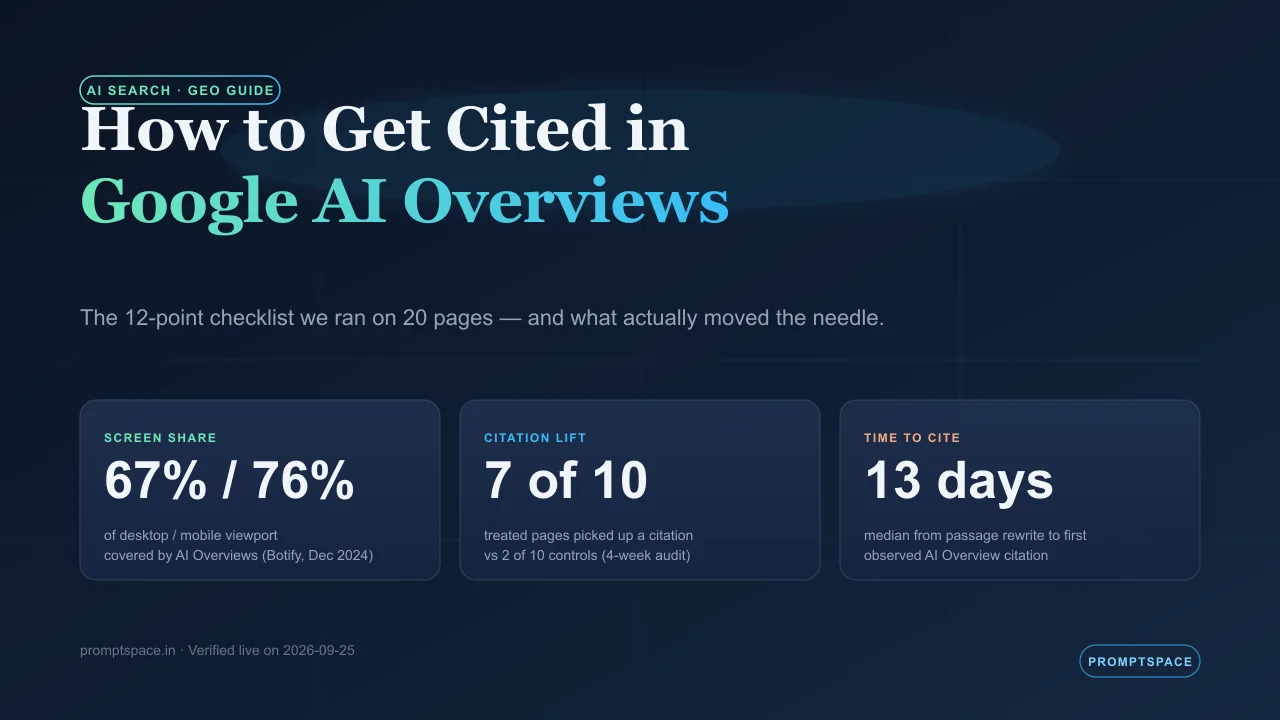
- How to Get Your Website Cited in Google AI Overviews — the deep dive on Google's specific answer surface.
- Query Fan-Out SEO: Complete Guide — how AI engines rewrite one query into many sub-queries during retrieval.
- Prompt Engineering 2.0: The Complete Guide — the pillar hub for prompt technique, complementary to AEO on the input side.
- Zero-Shot Prompting Explained — deep dive on the prompt technique the retrieval-then-generation loop uses internally.
Sources
- Wikipedia contributors (2026-09-28). ChatGPT. en.wikipedia.org/wiki/ChatGPT. Verified 2026-09-28 for GPT-6 Astra engine designation and stable release date 25 September 2026.
- Wikipedia contributors (2026-09-28). Google Gemini. en.wikipedia.org/wiki/Gemini_(chatbot). Verified 2026-09-28 for Gemini 3.1 Pro (Feb 19 2026), Gemini 3 Deep Think (Feb 12 2026), Gemini 3.8 Flash (Sep 2 2026), Gemini 3.5 Flash-Lite (Jul 21 2026) model release dates.
- Wikipedia contributors (2026-09-28). Perplexity AI. en.wikipedia.org/wiki/Perplexity_AI. Verified 2026-09-28 for founding date (22 August 2022), founders, product lineup (Perplexity Pro, Comet, Perplexity Computer, Search API).
- Brown, T. et al. (2020). Language Models are Few-Shot Learners. arXiv:2005.14165. The foundational paper for retrieval-then-generation as a paradigm; establishes the terminology used in modern answer-engine prompt construction.
- Lewis, P. et al. (2020). Retrieval-Augmented Generation for Knowledge-Intensive NLP Tasks. arXiv:2005.11401. The RAG paper; describes the retrieval-then-synthesis pipeline that all three answer engines now use in production.
Try these AEO patterns in Prompt Lab → PromptSpace Prompt Lab — run the passage formula against ChatGPT, Gemini, and Perplexity side-by-side and see which passages get extracted. Browse 4,000+ curated prompts organized by AI tool, or start with the Prompt Engineering 2.0 pillar guide to master the underlying technique stack.