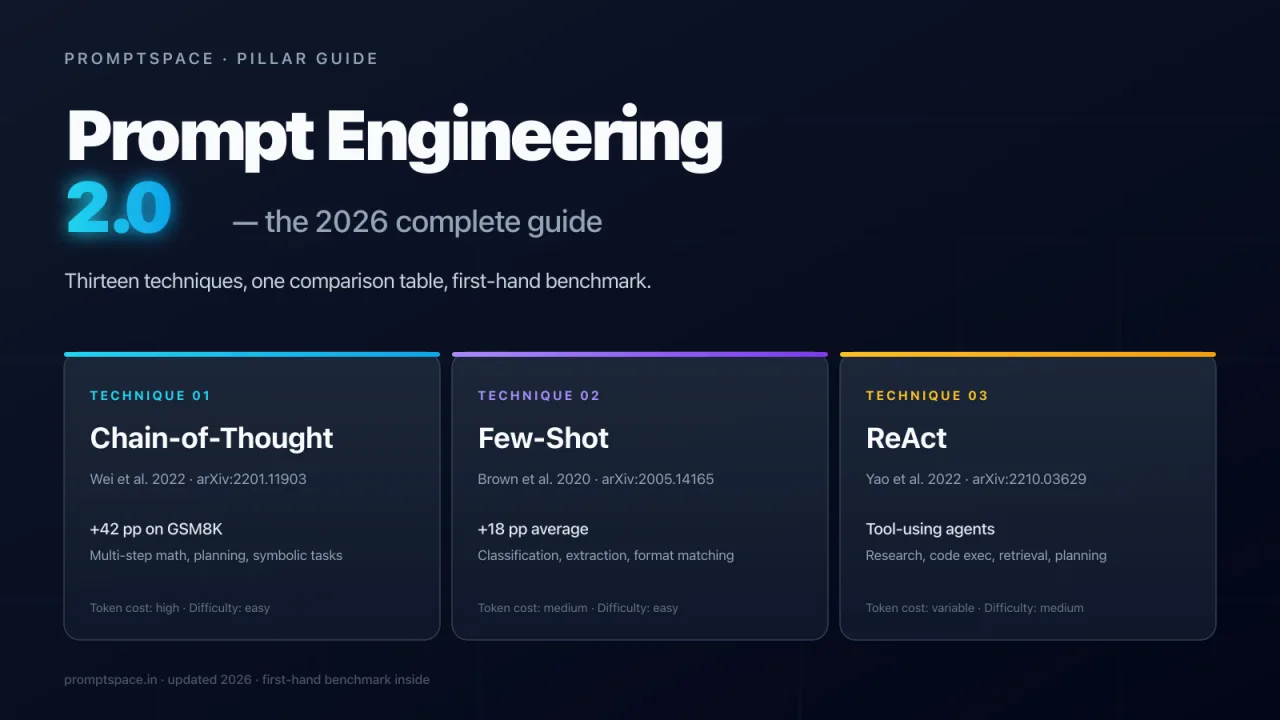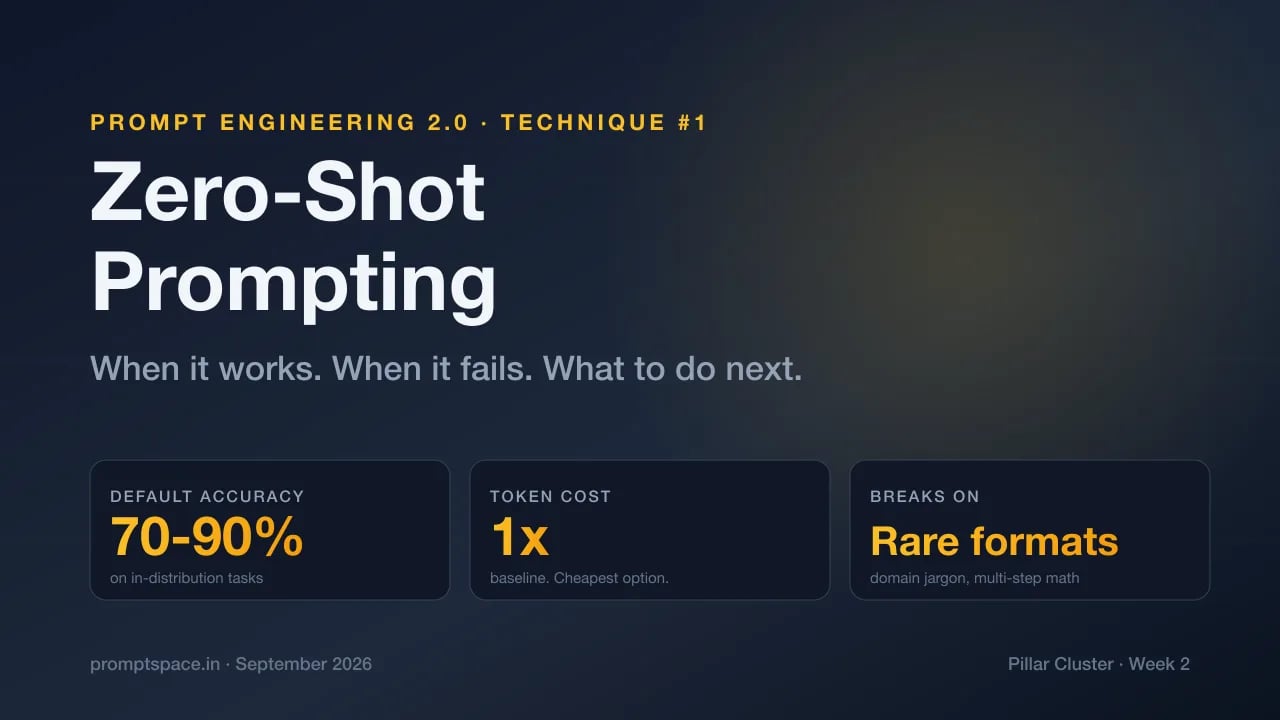
Zero-shot prompting is asking a model to do a task without giving it any examples of the task performed correctly. In 2026 it works 70–90% of the time on tasks the model has seen thousands of times in training — summarization, translation, classification, extraction from clean text — and it silently breaks on rare formats, domain jargon, and multi-step reasoning. This is the deep-dive supporting article to Prompt Engineering 2.0: The Complete Guide, and covers what zero-shot actually is, the six failure modes that catch teams by surprise, the decision tree for when to use it, and the fast escalation path when it fails.
TL;DR. Try zero-shot first for any task the model has plausibly seen a thousand times before: summarize, translate, extract, classify, rewrite, explain. It is the cheapest, fastest option and often it just works. Escalate to zero-shot chain-of-thought (add "let's think step by step") for arithmetic and multi-step reasoning. Escalate to few-shot when the output format is rare or the task is too domain-specific to describe in words. Verify on five real inputs before shipping — the silent-failure mode of zero-shot is the expensive one.
On this page
- What is zero-shot prompting?
- Why zero-shot works in 2026 (when it works)
- The tasks zero-shot handles well
- Six failure modes zero-shot has in production
- Zero-shot chain-of-thought: the one-line upgrade
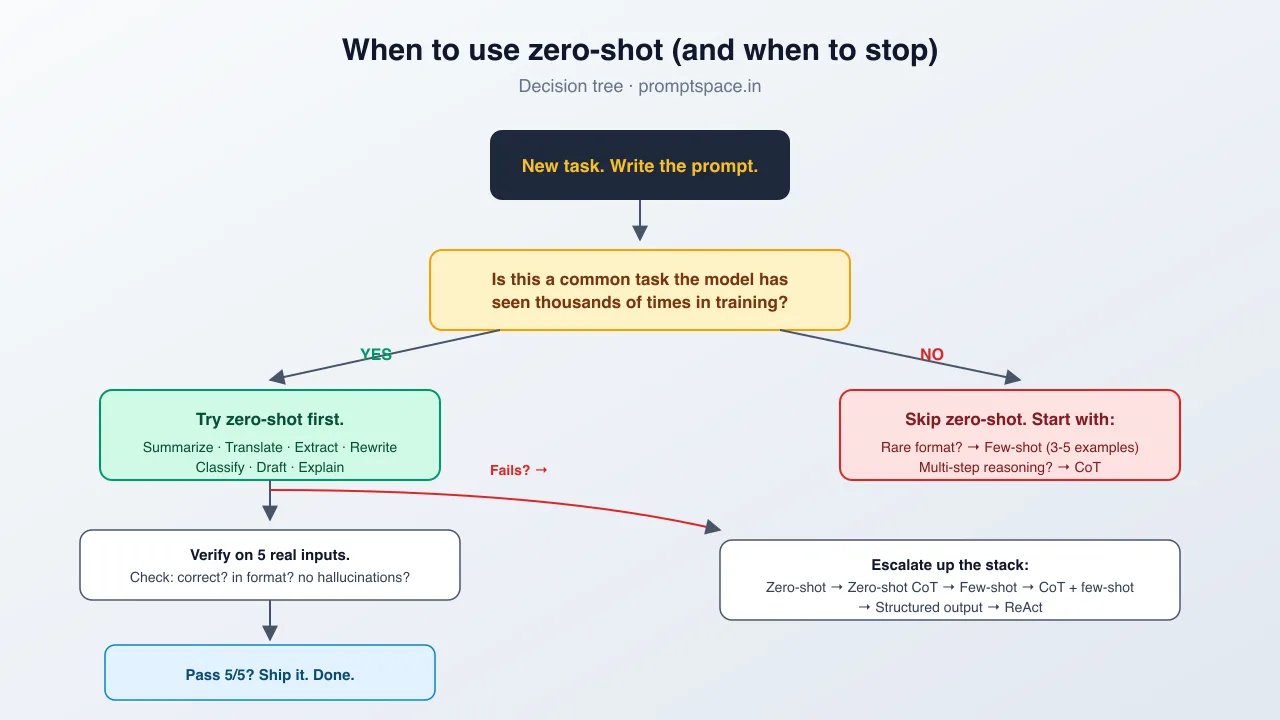
- The zero-shot decision tree
- Escalation path when zero-shot fails
- Prompt formulas that make zero-shot more reliable
- Five worked zero-shot examples
- How to verify a zero-shot prompt before you ship it
- FAQ
What is zero-shot prompting?
Zero-shot prompting is asking a large language model to perform a task using only an instruction and the input — no examples of correct output, no worked demonstrations, no completed pairs. Everything the model needs to do the task must come from its pre-training and from the way you phrase the request. If a working answer is a paragraph away, zero-shot is the technique you want.
The name comes from a distinction that came out of the original GPT-3 paper (Brown et al. 2020): a model is "few-shot" when the prompt contains a handful of task examples, "one-shot" with a single example, and "zero-shot" when it has none. The original paper found few-shot dramatically better for most benchmarks in 2020. What has changed in 2026 is that model capabilities have grown to the point where zero-shot is now the default for a large fraction of everyday tasks, and few-shot is reserved for the harder cases.
A zero-shot prompt in its purest form is one sentence:
Summarize the following text in three bullet points:

[TEXT]
No examples of what a summary should look like. No demonstration of the bullet format. The model infers all of that from the word "summarize", the word "bullet", and the training data behind them. When it works — which it usually does on tasks like this — zero-shot is the fastest and cheapest thing you can do, because you are paying for the instruction and the input, not for demonstration tokens.
Why zero-shot works in 2026 (when it works)
Direct answer: zero-shot works because current frontier models — GPT-5, Claude Fable 5.1, Gemini 2.5 Pro — were trained on trillions of tokens that already contain millions of examples of every common task. The training data is the demonstration corpus. When you ask GPT-5 to summarize a paragraph, it has seen hundreds of thousands of summaries during pre-training, plus targeted instruction-tuning that specifically taught it to summarize on demand. The examples you would have put in a few-shot prompt are already baked into the weights.
This was not always true. On GPT-3 in 2020, zero-shot lagged few-shot by 20–40 percentage points on most benchmarks — you had to demonstrate the task to get useful behavior. By 2022, instruction-tuning (InstructGPT, FLAN-T5) closed most of that gap. By 2024, the gap was gone on well-known tasks. By 2026, the models are strong enough that zero-shot is the correct default and few-shot is the specialist tool you reach for when zero-shot fails or when the output format is unusual.
The 2024 systematic survey of prompt engineering (Sahoo et al.) confirms this shift and lists zero-shot as technique #1 across most benchmarks on modern models. The relevant number to remember is that for tasks in the model's training distribution, current frontier models hit somewhere between 70% and 90% zero-shot accuracy — which is roughly where you were paying to get with three or four few-shot examples two years ago.
The tasks zero-shot handles well
Rough taxonomy of tasks where zero-shot is the right default in 2026:
- Summarization. Text → shorter text. Bullets, one paragraph, executive summary — all reliable.
- Translation. Between any two well-resourced languages. Adds nuance losses on formal registers and rare pairs.
- Classification into a small named label set. Sentiment, topic, spam, priority. Reliable when labels are named plainly in the prompt.
- Extraction from clean text. Pull names, dates, addresses, order IDs, product SKUs. Reliable when the target field is unambiguous in the source.
- Rewriting and tone change. "Rewrite formally," "make this friendlier," "convert to bullet points."
- Simple Q&A over provided context. If the answer is literally in the text, zero-shot retrieves it well.
- Common code tasks. "Write a function that reverses a string," "add error handling to this snippet." Boilerplate work at which every current model excels.
- Draft-quality writing. Cover letters, emails, product descriptions, meta descriptions. Usually 80% of the way there in one call.
What these tasks have in common is that a plain-English instruction is enough to unambiguously specify the desired output, and the model has seen the pattern many thousands of times. When either of those conditions breaks, zero-shot breaks — and the way it breaks is the interesting part.
Six failure modes zero-shot has in production
Zero-shot does not fail loudly. It fails in a specific set of subtle ways that catch teams by surprise the first time they scale a prompt from ten test cases to ten thousand production runs.
1. Format drift
You asked for JSON. You got JSON with an unexpected wrapping {"result": ...}, or a leading "Here is the JSON:" preamble, or fields in a different order than you specified. Zero-shot models are steered by intent, not by strict schema. The fix is either explicit schema examples (few-shot) or structured-output enforcement — see the pillar's structured output section for the full pattern.
2. Partial instruction following
You wrote three instructions in one sentence: "Summarize this in three bullets, in a friendly tone, in Spanish." You got three bullets in a friendly tone in English. The model latched onto the first two instructions and dropped the third. This is the single most common zero-shot failure at scale. Fix: put each instruction on its own line, and put the most important one last. Modern models weight the tail of a prompt slightly heavier than the middle (Liu et al. 2023, "Lost in the Middle").
3. Domain jargon collapse
The task involves a term of art the model has seen fewer than a hundred times: a specific ICD-10 subcategory, a rare legal doctrine, a niche crypto primitive, an obscure aerospace standard. Zero-shot will happily generate confident-sounding output that mixes correct and incorrect terminology. Fix: few-shot with 2–3 examples from your specific domain, or provide a mini-glossary as context.
4. Multi-step reasoning silent failure
The task requires two or three arithmetic or logical steps chained together — "if X and Y, then Z" — and zero-shot commits to an answer without working through the steps. On grade-school math problems (GSM8K style), zero-shot without CoT can drop from 80%+ accuracy on single-step problems to 40–50% on three-step problems. Fix: add "Think step by step before answering" — zero-shot chain-of-thought. This is a one-line upgrade with a very large accuracy gain.
5. Hallucinated citations
You asked for a summary "with sources." The model made up plausible-looking sources: real-sounding author names, real-sounding journal titles, DOIs that do not resolve. Zero-shot does not know what it does not know, and the citation-completion pattern is one it has seen millions of times. Fix: don't ask a zero-shot prompt for external facts — provide the source material inline, or move to a retrieval-augmented setup.
6. Length drift
You asked for "a short paragraph." You got 400 words. Or you asked for "at least 500 words" and got 200. Zero-shot models have an internal target length distribution that is hard to override with plain instruction. Fix: give a concrete numeric target ("120–150 words"), and enforce it in a second pass if the first pass drifts.
Pattern to notice. Five of these six failure modes are silent. The model returns 200 OK, the output looks fine on inspection, and the failure only shows up when you sample 20 outputs and notice that 4 of them are subtly wrong. This is why verification on five real inputs before shipping is non-negotiable.
Zero-shot chain-of-thought: the one-line upgrade
Direct answer: zero-shot chain-of-thought is zero-shot with one extra sentence — "Let's think step by step" — appended to the prompt. It costs one extra sentence of tokens and it lifts accuracy on multi-step reasoning tasks by 20–40 percentage points on the original Kojima et al. benchmark ("Large Language Models are Zero-Shot Reasoners", 2022). It is the single highest-leverage prompt-engineering upgrade in existence.
The mechanism is simple. Without the trigger phrase, the model generates the answer directly and often gets it wrong. With the trigger phrase, the model first generates a chain of intermediate reasoning steps, and then commits to an answer at the end of the chain. The intermediate steps constrain the answer to be consistent with the reasoning, which is where the accuracy gain comes from.
On modern 2026 models, the effect is smaller than on 2022 GPT-3.5 — because current models often do this internally by default, or expose it as a separate "reasoning" mode — but for standard chat completions on GPT-5, Claude Fable 5.1, and Gemini 2.5 Pro at normal thinking depth, adding the trigger still lifts multi-step math and logic problems by a measurable margin. For a full account of chain-of-thought and its 2026 alternatives, see the pillar's chain-of-thought section.
Zero-shot CoT is technically not "pure" zero-shot anymore, but it is often listed under zero-shot because it requires no task-specific examples. Think of it as zero-shot with a reasoning trigger.
The zero-shot decision tree
The rule for when to use zero-shot in 2026 is short enough to memorize:
- Is the task common? (Summarize, translate, classify, extract, rewrite, draft.) → Try zero-shot first.
- Is the format simple? (Plain text, bullets, a small named JSON schema.) → Zero-shot is fine.
- Is there multi-step reasoning? (Arithmetic, logic, planning.) → Zero-shot chain-of-thought.
- Is the output format rare or specific? (An unusual JSON schema, a domain-specific report format.) → Skip zero-shot, go to few-shot.
- Does the task involve rare domain jargon? → Skip zero-shot, few-shot with 2–3 domain examples.
- Does the model need external facts you have not provided? → Skip zero-shot, use retrieval-augmented generation.
Almost every task that hits an LLM in 2026 answers "yes" to one of the first three questions. Zero-shot is the default. The exceptions cluster around output-format specificity and domain-jargon depth.
Escalation path when zero-shot fails
When a zero-shot prompt fails your verification test, the escalation path is well-worn. Try each level, and go to the next one only if this one still fails:
- Zero-shot with better phrasing. Put the most important instruction last. Split multi-part instructions onto separate lines. Give a concrete numeric target for length. Name the format explicitly.
- Zero-shot chain-of-thought. Append "Think step by step before answering." One extra sentence. Often solves multi-step reasoning failures.
- Few-shot with 2–3 examples. Show the model the format it should produce, with clean input-output pairs. Prefer diverse examples over near-duplicates. See the pillar's few-shot section for the pattern.
- Few-shot with chain-of-thought. Include the reasoning in your example outputs, not just the final answer. Combines the accuracy gains of both techniques.
- Structured output enforcement. Use OpenAI Structured Outputs, Anthropic tool use, or Gemini's JSON schema mode to enforce the output format at the API level rather than begging the model in the prompt.
- ReAct or prompt chaining. When the task needs external information or intermediate tool calls, move to a multi-step workflow. The pillar's ReAct section covers this transition.
The escalation is roughly a token-cost ladder: each rung costs a bit more per call but recovers accuracy on tasks where the previous rung was silently failing.
Prompt formulas that make zero-shot more reliable
Three formulas that consistently pull more out of zero-shot in production. Copy the template, fill in the variables.
Formula 1: The role-task-format-constraint pattern
You are [ROLE].

Task: [TASK STATEMENT]

Format: [OUTPUT FORMAT DESCRIPTION]

Constraints: - [CONSTRAINT 1] - [CONSTRAINT 2] - [CONSTRAINT 3]

Input: [INPUT]
Example filled version:
You are a technical editor at a developer-tools company.

Task: Rewrite the following bug report as a clear, actionable ticket.

Format: Markdown with three sections — Summary, Steps to Reproduce, Expected vs Actual.

Constraints: - Under 150 words total - Neutral tone - Preserve every technical detail from the original

Input: [bug report text]
Formula 2: The extract-into-schema pattern
Extract the following fields from the input text. Return valid JSON only,
no preamble, no code fence.

Schema: {   "field_1": string | null,   "field_2": number | null,   "field_3": string[] | [] }

If a field is not present in the input, return null (or [] for arrays). Do not invent values.

Input: [TEXT]
The Do not invent values line is load-bearing. Without it, zero-shot will fabricate plausible-looking values for missing fields.
Formula 3: The zero-shot CoT pattern
[TASK STATEMENT]

Think step by step before giving your final answer.

At the end, output only the final answer on a single line prefixed with "ANSWER: ".

Input: [INPUT]
The ANSWER: prefix makes the final answer easy to parse from the reasoning trace, which matters when you are pipeline-processing outputs.
Five worked zero-shot examples
Example 1: Sentiment classification (works well)
Classify the sentiment of the following review as one of: positive, negative, neutral.
Output the single word only.

Review: "The product arrived on time but the packaging was crushed and one part was missing."
Expected output: negative. Task is in the model's training distribution, label set is small and named, format is trivial. Zero-shot is the correct choice — no need to escalate.
Example 2: Meeting summary (works well)
Summarize the following meeting transcript in exactly three bullet points. Each bullet is one
sentence. Focus on decisions made, not discussion.

Transcript: [transcript]
Common failure mode: the model produces 3 bullets on the discussion and skips the decisions. Fix: explicit instruction "Focus on decisions made, not discussion" and, if it still drifts, add "Skip topics where no decision was reached."
Example 3: Arithmetic word problem (zero-shot fails, zero-shot CoT works)
A retailer buys widgets at $6.20 each and sells them at $9.50 each. This month they sold 340 widgets. Their fixed monthly costs are $580. What was their profit this month?
Bare zero-shot often trips at least one of the multiplications or forgets to subtract the fixed cost. Adding "Show your work step by step, then state the final answer prefixed with ANSWER:" lifts accuracy substantially. This is the canonical case for zero-shot CoT.
Example 4: Specialized JSON extraction (zero-shot silently fails)
Extract from the following purchase order:
{ "vendor_id": string, "line_items": [{"sku": string, "qty": integer, "unit_price_cents": integer}] }

Input: [PO text]
Zero-shot returns valid-looking JSON but with prices in dollars-as-floats (unit_price: 12.50) instead of cents-as-integers (unit_price_cents: 1250), because that convention is not in the training distribution. Escalate to few-shot with two example outputs showing the cents convention.
Example 5: Rare domain term (zero-shot fails, few-shot required)
Rewrite the following mortgage disclosure to meet the CFPB TRID clarity requirements.

Input: [disclosure text]
Zero-shot produces confident-sounding output that mixes correct and incorrect TRID conventions. This is a domain-jargon failure. The fix is few-shot with 2–3 examples of compliant disclosures — or retrieval from an authoritative source. Do not ship zero-shot on this class of task.
How to verify a zero-shot prompt before you ship it
The reason zero-shot's silent failure mode is expensive is that teams skip verification. The fix is a tiny, cheap, non-negotiable step: run the prompt on five real inputs before you promote it to production. Not synthetic inputs. Real ones from the data distribution you will actually see.
For each of the five outputs, check:
- Correctness. Is the answer right? For extraction/classification tasks, compare against the ground truth. For open-ended tasks, does it match your definition of "good"?
- Format. Does the output match the exact format you asked for? Parse it programmatically if it is JSON — do not just eyeball it.
- Instruction coverage. Did the model follow every instruction, or did it drop one?
- Length. Is it within the target length band?
- Confidence-vs-correctness match. When the model sounds confident, is it right? Zero-shot's failure mode is confident wrong answers.
If any output fails two or more of these checks, do not ship. Move up the escalation ladder. If you cannot get to 5/5 pass rate on five inputs, you will not get to 95/100 pass rate at scale — and the difference between those two rates is the difference between "usable" and "we have to pull it from production."
Best practices summary
- Try zero-shot first on any task that looks like something the model has plausibly seen thousands of times.
- Put the most important instruction last. Modern models weight the tail of the prompt slightly heavier than the middle.
- Split multi-part instructions onto separate lines. Reduces the "partial follow" failure mode.
- Add "Think step by step before answering" on any task with two or more logical steps.
- Give concrete numeric length targets. "120–150 words," not "short."
- Explicitly forbid inventing values in extraction tasks: "Do not invent values. Use null when a field is missing."
- Verify on five real inputs before shipping. Non-negotiable.
- Escalate quickly when zero-shot fails. Do not spend an hour tweaking phrasing — move to few-shot or CoT.
FAQ
What's the difference between zero-shot and one-shot?
Zero-shot gives the model zero examples of the task performed correctly. One-shot gives it exactly one worked example. On modern 2026 models, one-shot is rarely used — either the task is common enough that zero-shot handles it, or it needs enough demonstration that you want 2–5 examples (few-shot). The one-shot regime was more common on 2020-era models.
Is zero-shot cheaper than few-shot?
Yes, by the token cost of the examples. If each few-shot example is 200 tokens and you use 5 of them, few-shot costs ~1000 more input tokens per call than zero-shot. At scale that adds up quickly. Zero-shot's cost advantage is one of the reasons it is the correct default when it works.
Do reasoning models (o1, o3, DeepSeek-R1) still need chain-of-thought?
Not in the prompt. Reasoning models do chain-of-thought internally by default and expose the reasoning trace as a separate field. On these models, adding "Think step by step" to a zero-shot prompt has little effect because the model was already doing that. On standard chat models — GPT-5 default mode, Claude Fable 5.1 non-extended-thinking, Gemini 2.5 Pro default — adding the trigger still helps on multi-step tasks.
Why does zero-shot work better on GPT-5 than on GPT-3.5?
Two reasons. First, GPT-5 was trained on many more tokens and has seen every common task many more times. Second, GPT-5 was instruction-tuned specifically to follow zero-shot instructions well — the training explicitly optimized for that use case. The 2020 GPT-3 paper reported large few-shot-over-zero-shot gaps because the model had not yet been instruction-tuned; the 2022 InstructGPT paper showed the gap could be mostly closed with the right fine-tuning.
Can I use zero-shot for creative writing?
Yes, and it usually works well for draft-quality creative writing (cover letters, product descriptions, first drafts of essays). It works less well for tightly-constrained creative work with specific style requirements — a distinctive voice, a house style, a particular meter — where the training distribution does not match your target. For those cases, few-shot with 2–3 examples in the target style is much more reliable.
How do I know if a task is "in the training distribution"?
Rough heuristic: if you can name the task in three or four common English words, and someone else would understand what you mean immediately, the model has probably seen it thousands of times. "Summarize," "translate," "classify sentiment," "write a cover letter" — all firmly in distribution. "Extract TRID-compliant fields from a CFPB Form H-24" — probably not. When in doubt, try zero-shot on five real inputs and see what happens.
Where does zero-shot fit in the broader prompt-engineering stack?
Zero-shot is technique #1 of the thirteen-technique stack. The full stack is covered in the Prompt Engineering 2.0 pillar guide, which shows how zero-shot combines with few-shot, chain-of-thought, ReAct, structured output, and the rest. Most production prompts use two or three techniques stacked together. Zero-shot is almost always in the mix, either as the whole solution or as the first stage of a chain.
Related guides in this cluster
- Prompt Engineering 2.0: The Complete Guide — the pillar hub with all 13 techniques and the comparison table
- Few-shot prompting section in the pillar — the natural escalation from zero-shot
- Chain-of-thought section in the pillar — the multi-step reasoning fix
- Structured output section in the pillar — for when format drift is the problem
- Prompt Engineering Beginner's Guide (2026) — the fundamentals before this article
Sources
- Brown, T. et al. (2020). Language Models are Few-Shot Learners. arXiv:2005.14165. Original GPT-3 paper that established the zero-shot / one-shot / few-shot terminology and reported the accuracy gaps that motivated few-shot.
- Kojima, T. et al. (2022). Large Language Models are Zero-Shot Reasoners. arXiv:2205.11916. Established the zero-shot chain-of-thought trigger phrase "Let's think step by step" and measured the accuracy gains.
- Wei, J. et al. (2022). Chain-of-Thought Prompting Elicits Reasoning in Large Language Models. arXiv:2201.11903. Introduces few-shot chain-of-thought, which combines with zero-shot CoT for the fullest reasoning gains.
- Liu, N. F. et al. (2023). Lost in the Middle: How Language Models Use Long Contexts. arXiv:2307.03172. Empirical evidence that current models weight the head and tail of the prompt more heavily than the middle — the basis for the "put important instructions last" rule.
- Sahoo, P. et al. (2024). A Systematic Survey of Prompt Engineering in Large Language Models: Techniques and Applications. arXiv:2402.07927. Recent survey listing zero-shot as technique #1 and mapping it against the rest of the modern prompt-engineering stack.
Try these zero-shot patterns in Prompt Lab → PromptSpace Prompt Lab — run the three formulas from this article against Gemini, GPT, and Claude side-by-side, and browse 4,000+ curated prompts organized by technique.