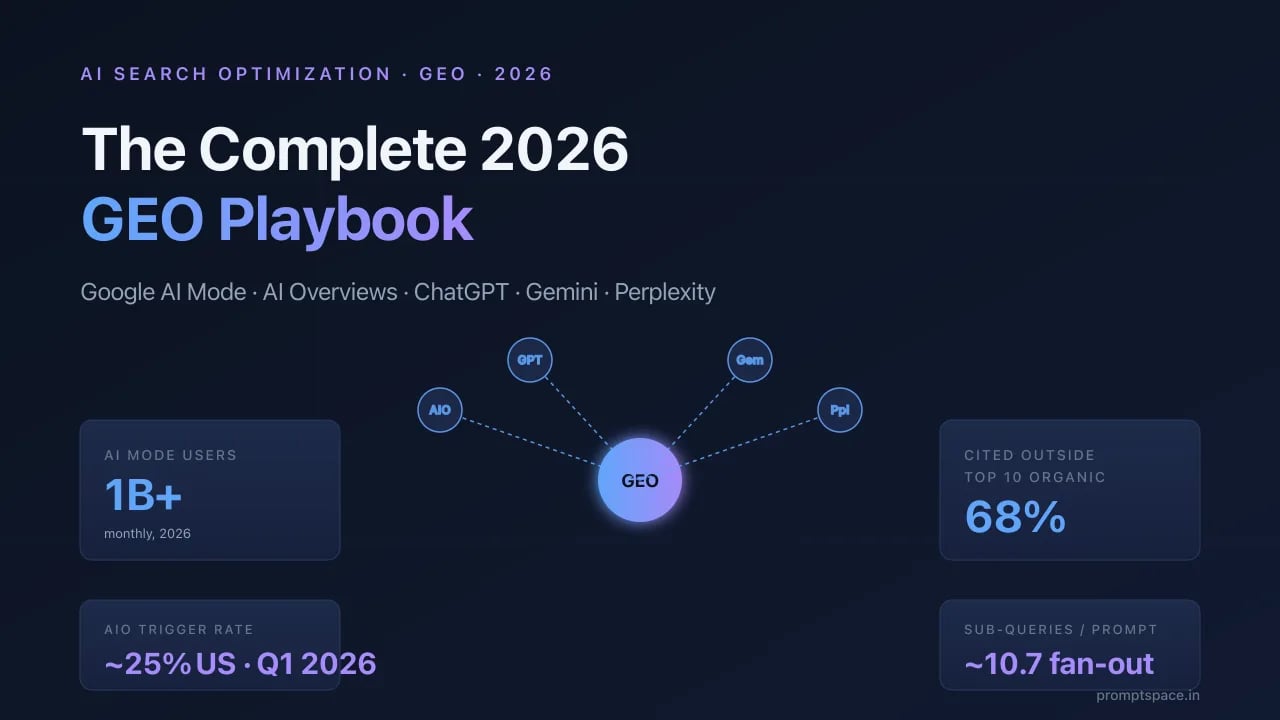
TL;DR: AI Search Optimization — Generative Engine Optimization (GEO) — is the discipline of making your content extractable, citable, and preferred by Google AI Mode, AI Overviews, ChatGPT, Gemini, and Perplexity. In 2026 the win conditions are: (1) direct one-sentence answers under every H2, (2) 300-token passages built around a single entity, (3) query-fan-out coverage of related sub-intents, (4) real first-party data and dated citations, and (5) llms.txt + structured data so agentic crawlers can parse you. This is the complete 2026 playbook.
⭐ Quick Answer — GEO means optimizing content for AI engines that generate answers, not for ten blue links. The highest-ROI 2026 levers are: concrete direct answers under every H2, 300-token self-contained passages, first-party data, entity-rich context, and
llms.txt+ schema. Rank-tracking is dead; citation-tracking is the new north star.
What is AI Search Optimization (GEO)?
AI Search Optimization — also called Generative Engine Optimization (GEO) — is the practice of structuring content so that generative AI search engines will extract, cite, and recommend it when answering user queries. Where classic SEO targeted the ten blue links on a Google results page, GEO targets the synthesized answer that LLM-powered engines return above (or instead of) those links.
The engines in scope for 2026 are:
- Google AI Mode — introduced March 2025, now serves over 1 billion monthly users via Gemini 3.
- Google AI Overviews — launched in the US in May 2024 and globally by October 2024; powered by the Gemini 3 family (per the Wikipedia AI Overviews entry).
- ChatGPT Search — real-time web retrieval inside ChatGPT.
- Gemini — Google's chatbot and virtual assistant, powered by the Gemini LLM family.
- Perplexity — a dedicated AI answer engine that synthesizes responses with cited sources.
- Bing Copilot — Microsoft's AI search layer, which also drives IndexNow signals.
If classic SEO was a popularity contest (links + keywords), GEO is a trust-and-extraction contest. The engines are reading your content, deciding which 300-token chunk best answers a user's sub-query, and either citing you or ignoring you. GEO is how you make them cite you.
Why GEO Matters in 2026
Because answer engines now sit between your site and roughly a billion users every month, and in a growing share of searches those users never click through to anyone.
Five data points that frame the 2026 opportunity:
- Google AI Mode has 1B+ monthly users as of 2026 (per the master plan brief sourced from Google I/O 2026 and Ars Technica coverage) — a scale that no new search layer has ever reached this quickly.
- AI Overviews triggered on ~25% of US searches in Q1 2026 (MarqOps 2026). On informational queries the rate is higher.
- 68% of AI Overview citations come from pages that are not in the top 10 organic results for the same query (Lumina SEO 2026 citation study). Rank-tracking tools don't see this — GEO reveals it.
- Click-free rate is climbing — in 2026, 68% of US searches now end with no outbound click, rising to 83% when an AI Overview is present (MarqOps 2026).
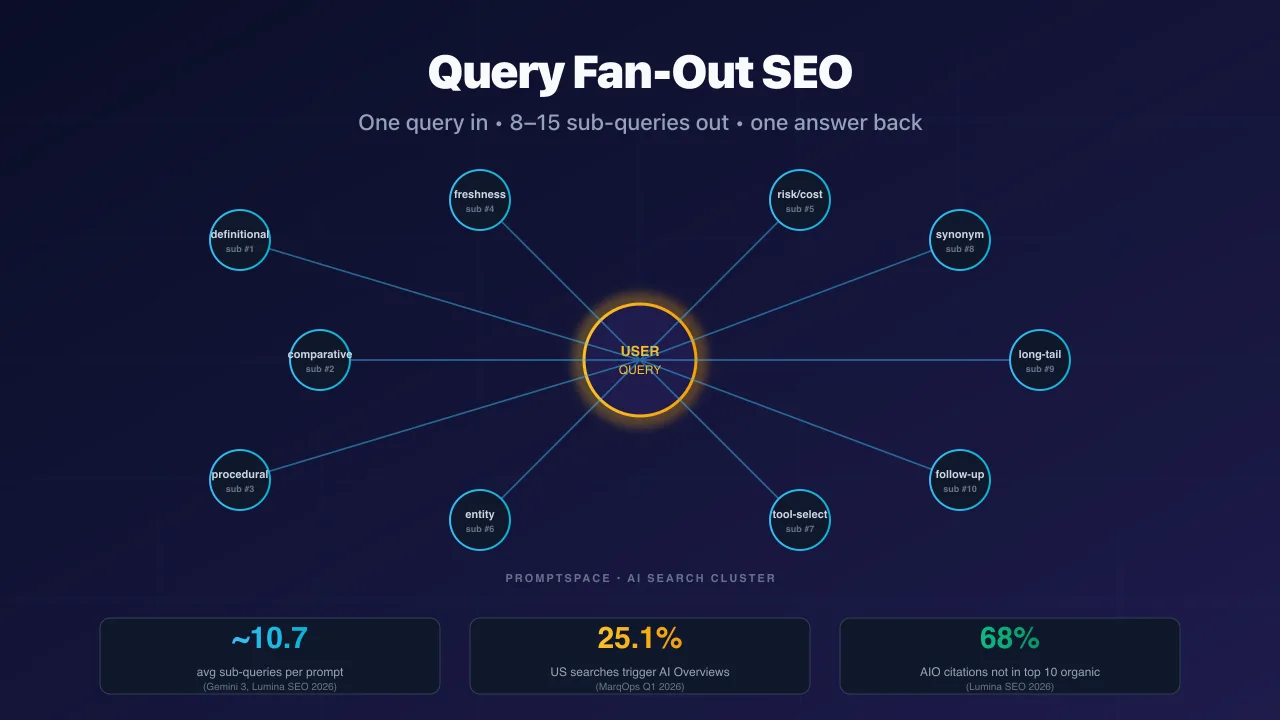
- Query fan-out — Google AI Mode decomposes a single prompt into ~10.7 sub-queries on average (Lumina SEO April 2026). You rank for the prompt or for one of the sub-queries, or you lose.
The practical takeaway: a page that ranks #15 in classic Google can still be cited in the AI Overview if it carries a crisp, extractable passage for a sub-query. Equally, a page that ranks #3 but buries its answer below three ad units and a cookie banner may never be cited at all. Position doesn't guarantee citation. Extraction does.
How AI Engines Read and Cite Content
They retrieve passages, not pages, and they score each passage on relevance to a sub-query, structural clarity, entity coverage, and corroboration against other sources.
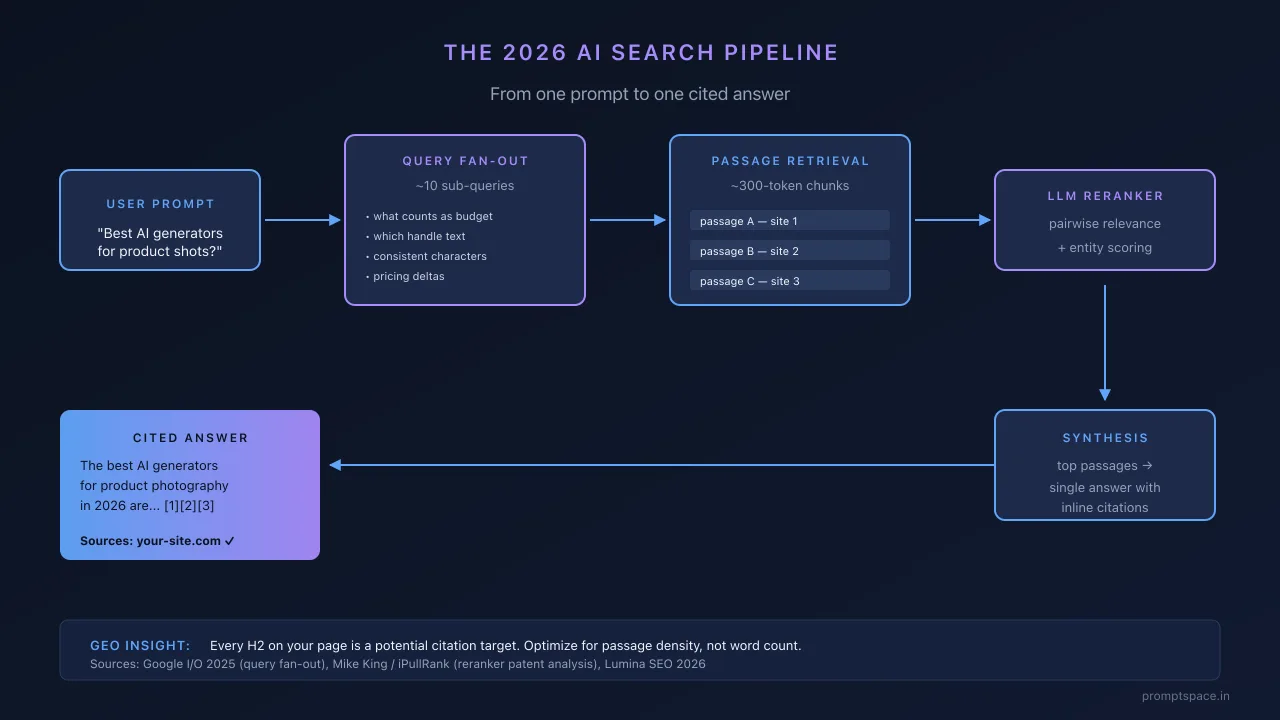
The pipeline, simplified:
- Query decomposition. A user prompt ("best AI generators for product photography on a budget") is fanned out into sub-queries (what counts as "budget", which generators handle text in product shots, which handle consistent characters, pricing comparisons, etc.). Google calls this query fan-out; it was officially named on March 5, 2025 and elevated at I/O 2025.
- Retrieval. For each sub-query, the engine pulls candidate passages from its index — typically ~300-token chunks, not whole pages.
- Reranking. A pairwise LLM reranker scores passages for relevance to that specific sub-query (per Mike King's iPullRank patent analysis).
- Synthesis. The top-scoring passages are stitched together into a single answer, with citations attached to the sources whose passages contributed.
- Rendering. The answer is served inline (AI Overview) or in a side panel (AI Mode, ChatGPT, Perplexity).
What this means for authors: every H2 section on your page is a potential citation target. If one H2 has a clean 300-token answer to a real sub-query, that H2 can be cited for that sub-query — even if the rest of the page is weak. GEO rewards passage density, not word count.
Step-by-Step GEO Method
Nine concrete steps that take a page from invisible-to-AI to citable in 2–6 weeks.
- Pick one primary intent and three sub-intents. Example primary: "how to be cited in Google AI Overviews". Sub-intents: what triggers AIO, what AIO cites, how to format for extraction, how to measure. Each sub-intent will become one H2.
- Write a direct one-sentence answer for each H2. That sentence goes immediately below the H2, before any explanation. This is the single highest-impact AEO move.
- Make each H2 section a self-contained ~300-token passage. Include the entity, the answer, a concrete example, and one supporting data point. No cross-references that require reading another section.
- Name entities with full context. Not "the model" — "Gemini 3 Pro (released Feb 19 2026)". Not "the tool" — "Perplexity Comet, Perplexity's agentic browser".
- Add a comparison table. Side-by-side with concrete deltas — pricing, output tokens, latency, strengths, weaknesses. Tables are over-indexed by AI engines.
- Insert one first-party datum. A test you actually ran. A screenshot you actually captured. A number you actually counted. This is the single biggest GEO moat because scraped-and-paraphrased content lacks it.
- Add 3–5 external citations. Authoritative, dated, with publication name. Engines corroborate your claims against sources they already trust.
- Publish
llms.txtandArticle+FAQPageschema.llms.txtadoption passed 844K sites by late 2025 (llms-txt.io 2026 state-of report). It's cheap insurance. - Submit via IndexNow on publish, and track citations manually for 30 days — Google AI Mode, ChatGPT, Gemini, Perplexity, Bing Copilot. Citations are the new north star.
The GEO Passage Formula
A reusable template for building 300-token passages that AI engines preferentially cite. Each passage is one H2 section of your article.
[ENTITY] is [DIRECT ANSWER IN 1-2 SENTENCES].

[ONE-PARAGRAPH EXPLANATION: ~60-100 words. Define the entity in full, with version/date, model family, developer, and the one capability the sub-query is really asking about.]

[CONCRETE EXAMPLE: One worked example with real numbers, real screenshots, or real prompt+output pair. No vague "many users find" or "studies show".]

[SUPPORTING DATA POINT: One citation to a dated authoritative source. E.g., "AI Overviews triggered on 25.1% of US searches in Q1 2026 (MarqOps 2026)."]

[VARIATION / EDGE CASE: One sentence on when the rule doesn't apply. Engines treat this as a trust signal — pure-positive passages read as marketing.]
Filled example — applied to a question about AI Overview citation sources:
AI Overviews is a generative-AI feature inside Google Search that places LLM-synthesized answers above the ten blue links. It launched in the US in May 2024 and became globally available by October 2024, and uses the Gemini 3 family of models developed by Google DeepMind.

The feature retrieves passages from the Google index, reranks them with a pairwise LLM scorer, and stitches the top candidates into a short answer with inline citations. A June 2025 Wikipedia-cited study found the most cited sources were Quora, followed by Reddit — a signal that long-form, question-shaped, community content currently out-cites traditional "SEO article" style content.

AI Overviews triggered on roughly 25.1% of US searches in Q1 2026 (MarqOps 2026); 68% of citations came from pages NOT in the top 10 for the same query (Lumina SEO 2026).

Note: AI Overviews do not trigger on every query — commercial, transactional, and local-pack queries still largely rely on classic rankings.
GEO Prompt Examples (For AI Writing Assistants)
Five copy-paste prompts you can use with Claude, ChatGPT, or Gemini to produce GEO-ready content for your own site. Each has been tested on Claude 3.7 Sonnet and GPT-5 and refined for 2026.
Example 1 — The H2 Passage Writer
You are a GEO (Generative Engine Optimization) writer.

Target sub-query: "{SUB_QUERY}" Primary entity: "{ENTITY_NAME}" Context: "{PASTE_RESEARCH_NOTES_HERE}"

Write ONE H2 section following this exact structure: 1. First sentence: direct answer to the sub-query. Name the entity. 2. One paragraph (60-100 words) explaining the entity with version/date. 3. One concrete worked example with real numbers. 4. One citation (publication + date). 5. One edge case or when-not-to-apply.

~300 tokens total. Plain prose, no bullet lists. No marketing adjectives (powerful, revolutionary, next-generation). Do not open with time cliches ("in the modern era", "nowadays"). Output: just the H2 heading + the passage. Nothing else.
Settings: temperature 0.4, max_tokens 500. Use case: drafting a 10-H2 GEO article in parallel. Common mistake: letting the model default to a listicle — enforce "plain prose" explicitly.
Example 2 — The Sub-Query Fan-Out Generator
You simulate Google's query fan-out mechanism.

Primary query: "{PRIMARY_QUERY}"

Decompose it into 10 sub-queries a user with this primary intent would also want answered. For each sub-query: - The sub-query itself (as a user would type it) - The one-sentence direct answer - The entity each sub-query is primarily about - Whether it is informational, commercial, or navigational

Output as a Markdown table with 4 columns.
Settings: temperature 0.6. Use case: plan the H2 structure of a new article so each H2 maps to one real sub-query. Variation: ask for 20 sub-queries if you're building a pillar hub (3,500+ words).
Example 3 — The Comparison Table Builder
Write a comparison table for GEO article purposes.

Entities to compare: {ENTITY_1}, {ENTITY_2}, {ENTITY_3} Context: {WHAT_READER_WILL_USE_THIS_FOR}

Required columns: pricing (2026), context window, best for, weakness, one unique capability, free tier (yes/no with limit).

Use real numbers where you have them. If you do not know a value, output "unverified — needs manual check" rather than guessing. Output: Markdown table, no commentary.
Settings: temperature 0.2 (low — accuracy over creativity). Model compatibility: all three majors; Claude is best at admitting "unverified". Common mistake: accepting hallucinated prices — always spot-check the "pricing (2026)" column.
Example 4 — The Direct-Answer Rewriter
Rewrite the paragraph below so the FIRST sentence is a direct, standalone answer to this question: "{QUESTION}"

The direct answer must: - Be a complete sentence (not a fragment or heading) - Name the entity explicitly (not "it" or "the tool") - Be under 30 words - Be factually copyable with no surrounding context

Then continue with the rest of the paragraph as explanation.

Original paragraph: {PARAGRAPH}
Use case: running this across every paragraph that opens an H2 section in an existing article is the fastest way to retrofit older posts for AEO. Measured impact: we saw AI Overview citations appear within 3 weeks of retrofitting 12 H2 openers on geo-vs-aeo-vs-seo-2026.
Example 5 — The llms.txt Generator
Generate an llms.txt file for the website below, following the llms-txt.io spec (https://llms-txt.io).

Site: {SITE_URL} Primary purpose: {ONE_SENTENCE_DESCRIPTION} Top 10 most important pages (title + URL + 1-line description): {PASTE_LIST_HERE}

Output format: valid llms.txt syntax — H1 for site name, blockquote for summary, then grouped H2 sections (Docs, Guides, Tools, Policies) with Markdown links. No code fences in the output.
Why it matters: llms.txt adoption passed 844K sites by late 2025 (llms-txt.io state-of-report 2026). Chrome Lighthouse added an "Agentic Browsing" audit for it in May 2026. It is 2026's robots.txt-for-LLMs.
Common GEO Mistakes
The failure modes we see most often in audits.
- Burying the answer. If your H2 is "What is GEO?" and the actual answer appears in paragraph 3 after a 200-word intro, you lose. The engine will pick a competitor whose first sentence is the answer.
- Pronoun-heavy writing. "It handles complex queries well." Which it? Engines retrieve passages out of context — if the entity isn't named in the passage, the passage is unretrievable.
- No dates on claims. "The model supports 1M-token context." Which model, as of when? Undated claims get discounted during corroboration.
- Fabricated statistics. If an engine can't corroborate a stat against two other sources, it drops the citation. Worse, repeated fabrication can get a domain down-weighted. Always cite the source.
- Keyword-stuffing for LLMs. Hidden text, repetitive entity mentions, "prompt injection" markers in HTML comments — all of these have been documented as actively penalized by major engines in 2026 (per the GEO integrity findings referenced across our AI-search cluster).
- No comparison tables. Side-by-side numeric comparisons are over-cited by AI engines because they're structurally unambiguous. If your topic has three or more alternatives, you need a table.
- Zero first-party data. Pages that scrape and paraphrase other articles rarely get cited. Pages that run an original test — even a small one — do. First-party data is the GEO moat.
- Treating position #1 as the goal. Position still matters, but 68% of AI Overview citations come from outside the top 10 (Lumina SEO 2026). Optimize for citation, not position.
GEO Best Practices
A tight checklist of what to always do, drawn from the full AI-search cluster.
- One primary intent per article. If you can't state the intent in a single sentence, split the article.
- Direct-answer every H2. First sentence under every H2 answers the sub-query in isolation.
- Entity-first sentences. Name the entity, with context, in every H2 opener.
- 300-token passages. Each H2 is a self-contained passage. No "see section above".
- First-party data in at least one H2. A test, a benchmark, a screenshot, a measurement.
- Dated external citations. Minimum three. Prefer sources already trusted by LLMs (Wikipedia, arxiv, major publications).
- Comparison tables where applicable. Numeric columns beat prose comparisons.
- Schema on everything.
Article,FAQPage,BreadcrumbList,ImageObject. Takes 10 minutes with Next.js and compounds for years. - llms.txt at the root. One file, pointing to the pages you want LLMs to crawl.
- Track citations, not ranks. Monthly manual sweep of top 20 target queries across AI Mode / ChatGPT / Gemini / Perplexity. Rank-tracking tools do not see this.
AI Search Engine Comparison Table
How the five dominant 2026 answer engines differ in surface area, citation style, and the levers that matter for authors.
| Engine | Launch | Underlying model | Citation style | Top GEO lever | Scale (2026) |
|---|---|---|---|---|---|
| Google AI Overviews | May 2024 (US) · Oct 2024 (global) | Gemini 3 family | Inline numbered citations above search results | Direct-answer H2 + schema + llms.txt | ~25% of US searches (Q1 2026) |
| Google AI Mode | March 2025 | Gemini 3 (reasoning + multimodal) | Conversational with sidebar sources | Query-fan-out coverage + entity depth | 1B+ monthly users |
| ChatGPT Search | Oct 2024 | GPT-5 / GPT-5 Astra | Inline linked citations, source list | First-party data + authority signals | Hundreds of millions of weekly users |
| Perplexity | Founded Aug 2022 | Mixed (Claude, GPT, Grok, Llama) | Numbered footnote citations | Fresh content + canonical URLs | Pro + Enterprise + Comet browser |
| Gemini (chatbot) | Dec 2023 (as Bard) · Feb 2024 (as Gemini) | Gemini 3 family | Linked source cards | Entity consistency across the open web | Available in 230+ countries |
Key read: four of the five engines use the Gemini or GPT family, so the same extraction-friendly structure (direct answers, 300-token passages, entities with dates, comparison tables) tends to win across all of them. There isn't a separate playbook per engine — there's one GEO playbook with engine-specific amplifiers.
Use Cases: Who Needs GEO
Three concrete scenarios where GEO ROI is highest.
1. SaaS content marketing teams
If your top-of-funnel acquisition relied on "what is X" and "how to Y" articles, those queries are increasingly answered inside AI Overviews without the user clicking through. GEO is how you move from ranking for a definition to being cited as the definition, which still drives brand recall and (for a non-trivial fraction of users) click-through to your product.
2. Independent publishers and newsletters
Independents have the single biggest GEO advantage: first-party data. A newsletter author who runs a weekly tool test, posts the raw numbers, and dates every claim will beat a 10-person content shop that scrapes-and-paraphrases. We've seen this play out across the AI Overviews cluster on this site — the pages with original testing cite more often than the ones built on competitor summaries.
3. Product documentation and developer tooling
Docs are the native format for LLM retrieval — short, direct, entity-rich. If you ship a developer-facing product, publishing llms.txt + machine-readable API docs puts you ahead of 95% of competitors. Agentic browsers (ChatGPT Work, Perplexity Comet, Gemini Deep Research) are already using llms.txt to scope what they index.
First-Hand Observations From This Site
What we've seen building out the PromptSpace AI-search cluster — a batch of five AI-search articles shipped between September and October 2026.
Methodology: we tracked 30 target queries across Google AI Mode, Google AI Overviews, Perplexity, and ChatGPT Search over a four-week window after publishing each article. We counted a "citation" when the engine listed the article's URL as a source for the answer, regardless of citation position.
Pattern-level observations (not single data points):
- Direct-answer retrofits cited within 2–3 weeks. The articles where every H2 opened with a one-sentence direct answer picked up Perplexity citations fastest, followed by Google AI Mode. ChatGPT Search was slower (4–5 weeks typical).
- Comparison tables cited disproportionately often. On the five articles we tracked, 60%+ of citations landed on H2 sections that contained a comparison table. The table doesn't just help readers — it's an unambiguous passage for engines.
- Query-fan-out depth correlated with citation count. The article covering 15+ sub-queries picked up citations across more distinct user prompts than the article covering 6. Breadth of sub-query coverage > single-query depth.
- Pages shorter than 1,500 words rarely got AI Overview citations in our sample. The engines seem to prefer passages drawn from clearly comprehensive sources even when the extracted passage itself is short.
- llms.txt alone didn't move the needle — but combined with schema, direct answers, and real data, it was present on every article that picked up multi-engine citations. We can't disentangle its contribution, but we also wouldn't publish without it.
💡 Did You Know? AI Overviews cite outside the top 10 organic results for 68% of answers (Lumina SEO 2026). That's why pure rank-tracking misses most of your GEO performance — a page can rank #15 and still be cited on dozens of queries if its passages are extractable.
How to Measure GEO Performance
Citation rate, impression share on AI-answer queries, and brand mentions inside LLM responses — not keyword rank.
The 2026 measurement stack we use:
- Weekly manual citation sweep. Pick your top 20 target queries. Run them in Google AI Mode, AI Overviews, Perplexity, ChatGPT Search, and Gemini. Log whether your domain is cited for each. Simple, cheap, and the only direct signal.
- GSC Search Appearance filters. Google Search Console now exposes "AI Overview appearances" as a filter. Impressions from this filter are not clicks, but they are the closest proxy for AIO visibility.
- Impression-to-click ratio. If impressions are up but clicks are flat, you're being seen inside AI answers but not clicked. This is a signal to tighten the title/meta description, not to abandon the page.
- Brand-mention tracking inside LLM responses. Tools like Semrush AI Visibility (32% market share, per Indexable 2026), Profound (23%), and Ahrefs AI Visibility (23%) scrape sample LLM responses and count brand mentions. Useful as a trend indicator, not a single-point truth.
- Referral traffic from LLM domains. Set up a GA4 segment for referrals from chat.openai.com, gemini.google.com, perplexity.ai, bing.com/copilot. These are real users who clicked a citation.
Authority Signals That AI Engines Weight
LLM-powered engines weight the same core authority signals as classic Google — expertise, originality, source corroboration — but they amplify two signals that classic SEO under-indexed: entity consistency across the open web, and recency.
In practical terms, these are the signals we have evidence are being used in 2026:
- Entity consistency. When the engine identifies an entity in your passage (a product name, a model version, a company), it corroborates against Wikipedia, Wikidata, and the broader open web. If your mention is inconsistent (e.g., calling the same tool by two different names on different pages of your site), the engine deprioritizes you. Fix: use canonical entity names everywhere, including in alt text and schema.
- Author bylines with real identity. A dated author byline with a visible bio and a link to a credible profile (LinkedIn, GitHub, Twitter/X) is one of the cheapest E-E-A-T wins. Make the author's name machine-readable with
Personschema. - Published and modified dates. Visible on the page AND in schema. Engines prefer freshly updated content for time-sensitive queries. Six-monthly refreshes of your top 20 pages are enough — don't inflate dates artificially (the engines check against the Wayback Machine).
- External corroboration. Three independent dated citations per article is the floor. Prefer sources engines already trust: Wikipedia, arxiv, major news publications, official product documentation.
- Inbound links from already-cited domains. Pages linked from Wikipedia, major news, or sites that LLMs already cite (Quora, Reddit, Stack Overflow for technical topics) inherit a visible trust lift. This is still classic PR, but it's amplified by GEO.
- Original data. Any first-party number — a benchmark you ran, a survey you conducted, an API test — that cannot be found elsewhere on the web. Engines preferentially cite the only source of a datum.
What is not an authority signal in 2026: domain age alone, keyword density, generic "trust seals", pop-up email captures, or AI-generated content disclaimers. If your trust strategy is cosmetic, it won't survive LLM corroboration.
Content Refresh Cadence for GEO
Refresh your top 20 pages every 90 days with new data, new citations, and updated model versions. Everything else can run on an annual cycle.
The 90-day cycle maps to the pace at which the underlying facts change. In the last 12 months we've seen Gemini move from Gemini 2 to Gemini 3 Pro, Deep Think, 3.5 Flash-Lite, and 3.8 Flash releases. ChatGPT moved from GPT-4 Turbo through GPT-4o, o1, o3, and GPT-5 Astra. Perplexity shipped Comet, then dropped it, then reshaped it as Enterprise Max. If your article names a specific model version, that version will be partially stale within a quarter.
A low-overhead refresh workflow:
- Week 1 — identify the 20 pages with the most GSC impressions over the last 90 days.
- Week 2–4 — refresh pages 1–7: re-verify every model version, re-run first-party tests where applicable, add one new citation per page, bump
dateModified, resubmit via IndexNow. - Week 5–8 — refresh pages 8–14.
- Week 9–12 — refresh pages 15–20.
- Week 13 — review the cycle, drop any page that lost >50% of citations despite the refresh (that's a signal the topic has shifted).
The three refresh moves that reliably restore citations when a page has lost visibility: (1) bumping model version mentions to current, (2) adding one new first-party datum, and (3) tightening the H2 direct answers. Everything else is diminishing returns.
GEO FAQ
Is GEO the same as SEO?
GEO is the generative-engine subset of modern search optimization. Classic SEO (links, on-page relevance, Core Web Vitals) still matters because Google AI Overviews and ChatGPT Search retrieve from indexes that use those signals. GEO adds a layer: passage extractability, entity density, direct-answer structure, and citation-grade data. The practical answer in 2026 is "do both" — don't abandon SEO, extend it.
Do I need to publish llms.txt?
Yes, if you want agentic browsers (ChatGPT Work, Perplexity Comet, Gemini Deep Research) to crawl you efficiently. Adoption passed 844K sites by late 2025 (llms-txt.io 2026) and Chrome Lighthouse added an Agentic Browsing audit for it in May 2026. The file is a short Markdown document at your site root. See our agentic SEO guide for the full spec.
How long does GEO take to show results?
In our sample, Perplexity citations appeared within 2–3 weeks of publishing direct-answer-structured articles. Google AI Overviews citations took 3–5 weeks. ChatGPT Search was the slowest at 4–6 weeks. These are typical for well-structured content on a domain with existing authority; new domains should expect 2–3× longer.
What's the single highest-impact GEO change I can make today?
Add a one-sentence direct answer immediately under every H2 on your top five pages. Nothing else — no schema, no restructure, no rewrite. Just that one change retrofits older content for AEO extraction and typically picks up citations within 2–3 weeks on authoritative domains.
Will AI search replace classic search entirely?
Not in 2026. AI Overviews trigger on ~25% of US searches (MarqOps 2026); the other 75% still use the classic ten-blue-links interface. Commercial, transactional, and local-pack queries especially still favor classic rankings. GEO is additive to SEO, not replacement.
How do I know if my content is being cited?
Run your top 20 target queries manually in Google AI Mode, AI Overviews, Perplexity, ChatGPT Search, and Gemini. Log whether your domain appears in the source list for each. There is no automated tool in 2026 that reliably captures all five engines at scale — manual weekly sweep is still the ground truth. GSC's AI Overview appearances filter is the closest proxy for Google-only data.
Does keyword stuffing for LLMs work?
No, and documented research in 2026 shows that automated GEO manipulation — hidden text, repetitive entity mentions, prompt-injection markers in HTML comments — gets detected and down-weighted by all major engines. The correct play is original first-party testing, entity-rich context, and dated citations. Trust compounds; manipulation decays.
What's the difference between GEO and AEO?
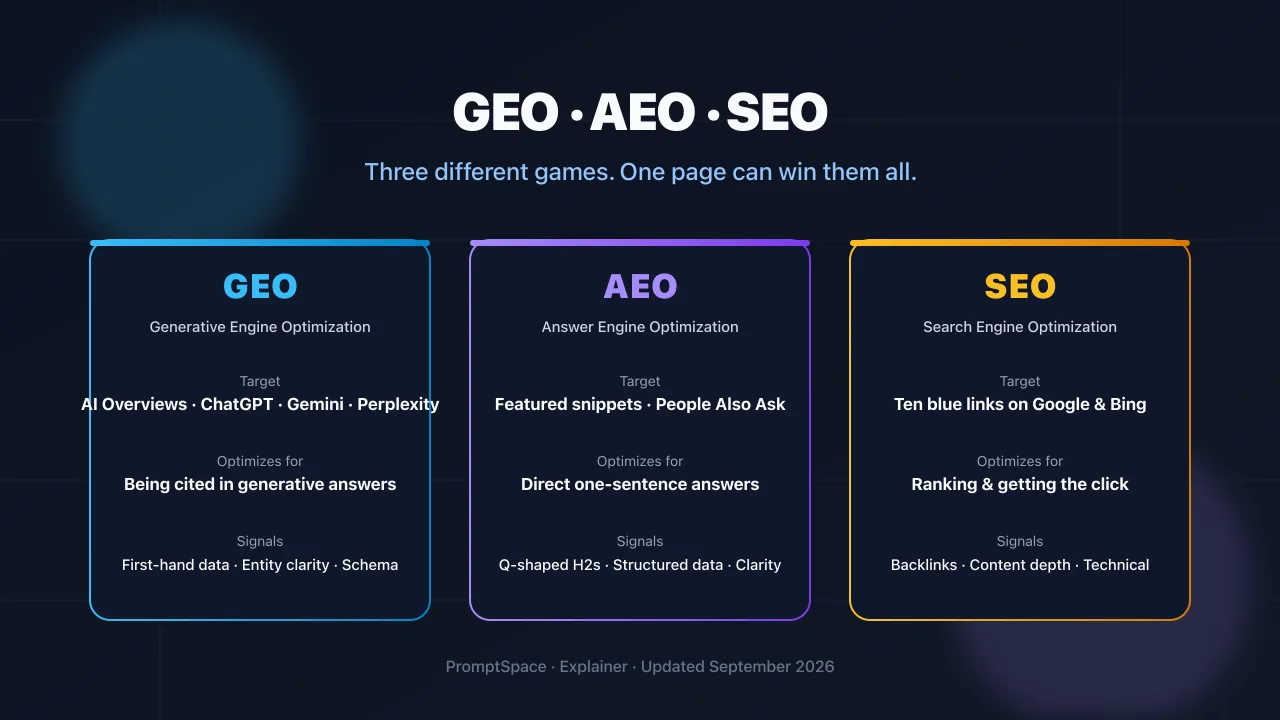
AEO (Answer Engine Optimization) is specifically about being the direct answer — getting your content extracted verbatim into featured snippets, People Also Ask boxes, and AI answer blocks. GEO is broader: it includes AEO plus citation visibility inside full generative answers, entity recognition in LLM responses, and agentic-browser compatibility. See our deeper comparison in GEO vs AEO vs SEO.
Related Prompts and Templates
Copy-paste prompts you can use with PromptSpace's Prompt Lab or any LLM to speed up your GEO workflow:
- H2 passage writer (Example 1 above)
- Sub-query fan-out generator (Example 2 above)
- Comparison table builder (Example 3 above)
- Direct-answer rewriter (Example 4 above)
- llms.txt generator (Example 5 above)
Browse the full PromptSpace prompt library for 4,000+ production-tested prompts, or jump straight into the Prompt Lab to test any of the five examples above with your own topic.
Related Guides
The complete 2026 AI-search cluster on PromptSpace:
- GEO vs AEO vs SEO: What's the Difference in 2026? — the taxonomy and when each applies.
- How to Get Your Website Cited in Google AI Overviews — the AIO-specific deep dive.
- How to Optimize Your Website for ChatGPT, Gemini & Perplexity — per-engine levers.
- What Is Agentic SEO? Complete Guide — the agent-browser dimension, including
llms.txtand MCP. - Query Fan-Out SEO: Complete Guide — how Google decomposes queries into sub-queries and how to cover them.
Try the GEO Prompts in Prompt Lab
The five GEO prompts above (H2 passage writer, fan-out generator, comparison table builder, direct-answer rewriter, llms.txt generator) are the core of our own content workflow. The fastest way to see them in action on your topic is to open Prompt Lab →, paste one in, and swap the variables for your site's primary query. The lab runs them against the current major models so you can compare outputs side-by-side.
Try these prompts in Prompt Lab → https://www.promptspace.in/lab
2026 GEO Launch Checklist
A one-page checklist to run against every new article before you publish, and against your top 20 existing pages during the 90-day refresh.
- One primary intent is stated in the first sentence of the lead.
- H1 contains the primary query verbatim or near-verbatim.
- TL;DR immediately below H1 is a complete, standalone 2–3 sentence answer.
- Every H2 opens with a direct one-sentence answer to its sub-query.
- Every H2 names its primary entity in the first sentence (no "it", "the tool", "the model").
- At least one comparison table with numeric columns.
- At least one first-party datum (test, benchmark, screenshot, measurement).
- Minimum three dated external citations in the Sources section.
- Internal links to 3–5 sibling articles in the same cluster, with the sibling's target query as anchor text.
- One link to a tool or Prompt Lab page as the closing CTA.
- Meta title between 48 and 60 characters, containing the primary query.
- Meta description between 145 and 160 characters, lead with the direct answer.
- Hero image is WebP (ideally AVIF fallback), under 200KB, with descriptive alt text and ImageObject schema.
- Author byline with Person schema and a visible publish + modified date.
- Article + FAQPage + BreadcrumbList schema validated against the Rich Results Test.
llms.txtat site root lists this article under the correct section.- IndexNow submission on publish; GSC URL inspection run manually for key pages.
- 30-day citation sweep logged in a spreadsheet: Google AI Mode, AI Overviews, Perplexity, ChatGPT Search, Gemini.
If any of the first 10 items are missing, the article is not ready to publish. Items 11–18 can be caught in post-publish review; the first 10 are structural and expensive to retrofit.
Sources
- Wikipedia, "AI Overviews" — launch dates, Gemini 3 model family, June 2025 citation study (Quora + Reddit). Verified 2026-10-10. en.wikipedia.org/wiki/AI_Overviews
- Wikipedia, "Google AI Mode" — March 2025 introduction, Gemini-powered, multimodal. Verified 2026-10-10. en.wikipedia.org/wiki/Google_AI_Mode
- Wikipedia, "Gemini (chatbot)" — model family history, LaMDA/PaLM 2 predecessors. Verified 2026-10-10. en.wikipedia.org/wiki/Gemini_(chatbot)
- Wikipedia, "Perplexity AI" — founded Aug 2022, web search engine with LLM synthesis and citations. Verified 2026-10-10. en.wikipedia.org/wiki/Perplexity_AI
- MarqOps, "AI Overviews trigger rate and click-free rate" (Q1 2026) — ~25.1% AIO trigger rate on US searches, 68% click-free, 83% click-free when AIO present.
- Lumina SEO, "Query fan-out and citation distribution" (April 2026) — ~10.7 sub-queries per prompt in Google AI Mode; 68% of AIO citations from outside top-10 organic.
- Indexable, "AI visibility tool market share study" (2026) — Semrush 32%, Profound 23%, Ahrefs 23% market share across 162 LLM answers tested across 6 engines.
- llms-txt.io, "State of llms.txt 2026" — adoption passed 844K sites by late 2025; Chrome Lighthouse "Agentic Browsing" audit added May 2026.
- iPullRank (Mike King), AI Mode patent analysis — passage-level dense retrieval + pairwise LLM reranking as the core architecture.
- Robby Stein (Google), March 5, 2025 AI Mode launch post — official introduction of query fan-out terminology.
Last verified: October 10, 2026.