Search 'free SEO tools 2026' and you'll get ten listicles recommending Ahrefs, Semrush, and Moz. Those aren't free. They're 7-day trials that ask for a credit card on signup and start charging $129/month the moment you forget to cancel.
This list is different. Every tool here is actually free — not freemium-with-a-paywall, not trial-to-paid, not 'free until you hit 50 keywords'. The real usage limits are stated upfront so you know what you're getting.
If you run a 200-product Shopify store, a Next.js blog with 50 posts, or a small agency with under a dozen clients, these seven tools cover roughly 95% of the SEO work you actually need to do. No upsells below. Promise.
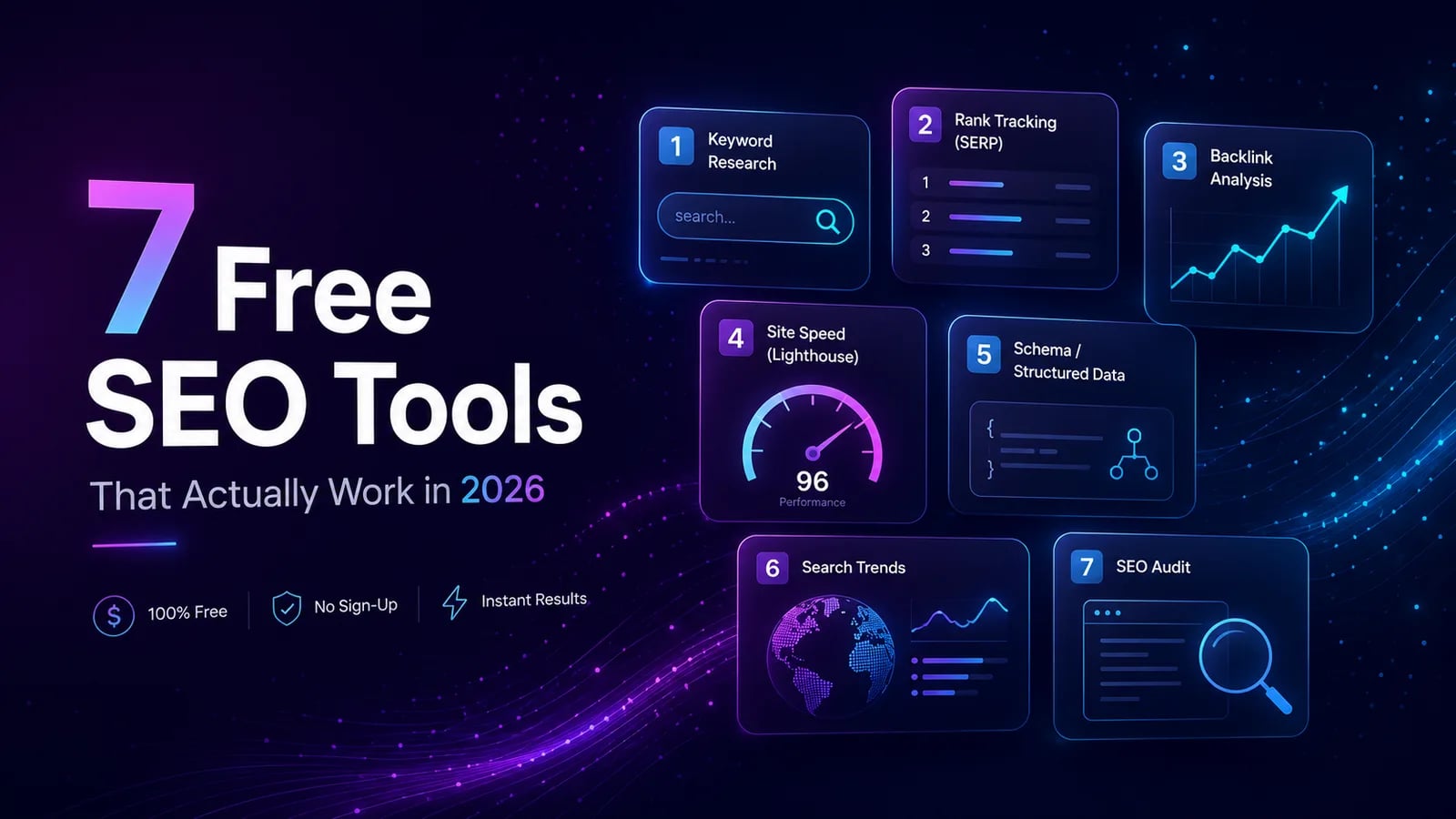
1. Google Search Console
If you only use one tool from this list, use this one. Google Search Console (GSC) is free forever, owned by Google, and has zero usage caps. It's the closest thing to ground truth you'll ever get — because it is the source.
What it actually shows you:
- Queries: every search term that triggered an impression of your site, with clicks, CTR, and average position
- Indexing status: which pages are indexed, which are excluded, and exactly why (soft 404s, canonical conflicts, crawl errors)
- Core Web Vitals field data from real Chrome users, grouped by URL pattern
- Mobile usability issues, structured data errors, manual actions, and security flags
The one real downside: GSC only stores 16 months of performance data, and the query-level export caps at 1,000 rows per request. If you want longitudinal trends, hook it to BigQuery (free tier covers most small sites) or export to CSV monthly. A Next.js blog with 50 posts can get away with a quick CSV download on the first of every month.
2. Bing Webmaster Tools
Yes, really. Bing handles roughly 7% of US desktop search and powers DuckDuckGo, Yahoo, and a chunk of ChatGPT's web grounding. That's millions of users you're ignoring if you skip it.
Bing Webmaster Tools is genuinely better than GSC in two areas:
- Free site audit: a real crawler that flags technical issues across your site — no page limits, no scheduling restrictions
- Keyword research tool: actual search volume data, free, with no monthly query cap. Nothing else in this tier offers this
Verification takes five minutes (you can import directly from GSC). For a 200-product Shopify store, the keyword tool alone is worth the signup.
3. PromptSpace Web Scraper
Most SEO audits need one boring task done a hundred times: pull the meta tags, headings, and structured data off a page so you can compare them to yours. The PromptSpace Web Scraper does that in about three seconds per URL.
Practical SEO uses:
- Extract competitor meta tags — title, description, OG tags, canonical — for any URL ranking above you
- Audit your own JSON-LD schema before pushing to production (catches missing required fields without opening DevTools)
- Count internal vs external links on a page to spot orphan content or excessive outbound links
- Find missing alt text on image-heavy pages (critical for product catalogs)
- Export to CSV for side-by-side competitor audits in Sheets
Limits stated upfront: 1 free scrape per day anonymously, 20 per day signed in. No credit card, no trial timer. Try it at promptspace.in/tools/web-scraper.
4. Lighthouse (Chrome DevTools or PageSpeed Insights)
Lighthouse runs four audits — Performance, Accessibility, Best Practices, and SEO — and gives you a 0–100 score for each plus a list of specific fixes. It's built into Chrome (DevTools → Lighthouse tab) and also available at pagespeed.web.dev if you want shareable reports.
The Performance score is built around Core Web Vitals: Largest Contentful Paint, Interaction to Next Paint, and Cumulative Layout Shift. Google uses these as a ranking signal. PageSpeed Insights shows lab data (Lighthouse) and field data (real Chrome users from CrUX) side by side. Run it on every page you publish — for a Next.js blog this catches things like a 400KB hero image you forgot to optimize before it tanks your LCP.
5. Ahrefs Webmaster Tools (AWT)
This is the one place Ahrefs gives you real data for free — and only for domains you've verified ownership of. No credit card, no trial countdown.
What you get:
- Backlink profile: every referring domain Ahrefs has crawled, with anchor text and DR
- Top pages by organic traffic (estimated from their click-stream model)
- Broken pages and broken backlinks — the broken backlinks report alone is worth signing up for
- Site audit with a generous crawl credit per project
The catch: you can't research other people's sites, and historical data is shallower than the paid product. But for monitoring your own backlinks and finding 404s where competitors linked to a moved page? It's the best free option that exists.
6. Google Trends
Google Trends gets ignored because it doesn't give you absolute search volume — only relative interest. That's also why it's free with no caps.
Where it actually earns its place in your stack:
- Content planning: is this topic growing or dying? 'Headless CMS' vs 'WordPress' over five years tells you what to bet on
- Seasonality: when do searches for 'tax software' peak? When does 'pool maintenance' start ramping? Plan content 6–8 weeks ahead
- Regional interest: critical for local SEO and choosing which English-speaking market to target first
- Compare up to 5 terms head-to-head to settle internal arguments about which keyword to optimize for
Pair it with Bing's keyword tool (Tool #2) for absolute volume and you've replicated 70% of what people pay $99/month for.
7. Schema.org Validator + Google Rich Results Test
Two tools, same job: verify your JSON-LD parses correctly and qualifies for rich results before you ship.
- Schema.org Validator: checks raw schema syntax against the spec. Use this first.
- Google Rich Results Test: checks whether Google specifically will render rich results (FAQ, Product, Recipe, Article, etc.) from your markup
The combo workflow with Tool #3: use the PromptSpace scraper to extract JSON-LD from any page (yours or a competitor's), then paste into either validator. This is how you verify a competitor's Product schema before copying their pattern, or catch a missing aggregateRating field before pushing to production.
How to combine these into a free SEO workflow
Tools are useless without a routine. Here's a weekly schedule that takes about 90 minutes total and covers an indie site or small agency client:
- Monday — GSC review (30 min): open Search Console, sort queries by impressions, find any page with high impressions and CTR under 2%. Those are easy title-tag and meta-description rewrites. Check the Indexing report for new errors.
- Wednesday — Lighthouse audit on new pages (20 min): run PageSpeed Insights on every URL you published since last week. Fix anything scoring under 80 on mobile.
- Friday — Competitor scrape (30 min): pick 3 pages currently outranking you for a target keyword. Use the PromptSpace scraper to pull their meta tags, headings, and JSON-LD. Diff against yours. Export to CSV.
- Monthly — Bing + Trends + AWT (10 min): pull a Bing keyword report, check Trends for seasonal shifts, scan AWT for new backlinks or broken ones
That's it. No $300/month subscription required.
When you actually need paid tools
Honest take: free tools cover 95% of small-site SEO. The remaining 5% genuinely needs paid software. You should pay for Ahrefs, Semrush, or similar if:
- You manage a site with more than 100,000 pages and need automated weekly crawls
- You need historical SERP rank tracking on hundreds of keywords (free tools don't store this)
- You do client SEO at scale — 10+ clients with monthly white-label reports
- You're doing large-scale link prospecting across competitor backlink profiles you don't own
- You need keyword difficulty scores on thousands of keywords for content production planning
If none of those apply — and for 99% of indie sites and small agencies, they don't — you're better off spending the $1,500/year on a freelance writer or a Core Web Vitals fix.
Audit three competitors this week
The single highest-leverage thing on this list is auditing your competitors' on-page SEO and structured data. Run three competitor URLs through the PromptSpace Web Scraper, export the CSV, and you'll have a side-by-side audit in Sheets in under ten minutes. No signup needed for your first scrape — sign in for 20/day.
FAQ
Are these really free forever?
Yes. GSC, Bing Webmaster Tools, Lighthouse, Google Trends, Schema.org Validator, and Rich Results Test are free with no caps and no trial timers. Ahrefs Webmaster Tools is free for verified domain owners with no expiry. The PromptSpace Web Scraper has stated daily limits (1 anon, 20 signed in) but no paywall — you'll never be asked for a card.
Can I use just GSC?
For a brand new site under 20 pages, honestly, yes. GSC plus Lighthouse will get you 80% of the way. Add Bing Webmaster Tools and the PromptSpace scraper once you start optimizing for specific keywords or auditing competitors.
What about AI SEO tools?
Most AI SEO tools in 2026 are wrappers around GPT-class models that generate meta descriptions and content briefs. Useful, but not in the same category as the data tools on this list. Use AI for drafting; use these tools for measuring. Don't confuse the two.
How often should I run audits?
GSC: weekly (Monday review). Lighthouse: every time you publish a page. Bing keyword tool and Google Trends: monthly during content planning. Competitor scrape: weekly for active campaigns, monthly otherwise. AWT backlink check: monthly. Schema validator: every time you ship structured data.