#Kokoro TTS vs Qwen3 TTS: Which Free Open-Source AI Voice Model Wins in 2026?
Kokoro dropped in early 2024. Qwen3 TTS shipped mid-2024. Together they killed most of the paid AI voice market for anyone who doesn't need voice cloning. Here's how the two stack up after 6 months of production use — from someone who has actually shipped audio in both, watched the HuggingFace queues fill up, and had to explain to a client why the free model sounded better than the $99/month one they were paying for.
If you are trying to pick between Kokoro TTS vs Qwen3 TTS for a real project in 2026, this is the comparison you want. No affiliate fluff, no hand-waving, no benchmark scores I can't point to.
#TL;DR
Kokoro wins for English narration — audiobooks, YouTube voiceovers, e-learning, anything long-form. Qwen3 wins for multilingual and personality-driven voices — character work, gaming, anime dubs, Chinese/Japanese/Korean content. Both are free, both run on HuggingFace ZeroGPU, both are commercial-safe. Pick Kokoro if you want a narrator. Pick Qwen3 if you want a character.
#Quick verdict — who each model is for
Before the deep dive, here's the fastest path to a decision:
-
You are making an English audiobook, YouTube video, or podcast intro. → Kokoro TTS. It is closer to ElevenLabs for clean narration than anything else in the free tier.
-
You are making content in Japanese, Korean, Chinese, or a European language other than English. → Qwen3 TTS. Kokoro is English-first with limited multilingual support; Qwen3 was trained multilingual from day one.
-
You need a distinct character voice — a game NPC, an anime dub, a virtual assistant with personality. → Qwen3 TTS. Voices like Cherry, Ryan, Sohee and Ono Anna have real character to them.
-
You need to voice a 30-minute script in one pass. → Neither, honestly. Both have character limits and queue latency. Chunk your script.
-
You need voice cloning from a 10-second sample. → Neither. Look at XTTS-v2 or a paid service. Both Kokoro and Qwen3 ship fixed voice catalogs.
Now the details.
#Kokoro TTS — deep dive
Kokoro is the surprise story of open-source TTS in the last two years. Released by hexgrad on HuggingFace under Apache 2.0, it sits at roughly 82M parameters — tiny by modern standards. For context, that is about a hundredth the size of some paid TTS models. And yet on clean English narration it holds its own against services charging $30 per million characters.
Architecture
Kokoro is a StyleTTS2-derived model. Non-autoregressive, which is why it is fast — it generates the entire waveform in one shot rather than token by token. StyleTTS2 uses a diffusion-based reference encoder and style adapter that captures prosody and speaker identity from a compact embedding. In practice this means Kokoro sounds natural without needing gigabytes of weights.
Because it is non-autoregressive, Kokoro does not do the classic autoregressive TTS failure modes — it does not spiral off into random noise on long inputs, and it does not skip or repeat words as often as bigger AR models do. It just cuts off at the character limit.
Voice catalog
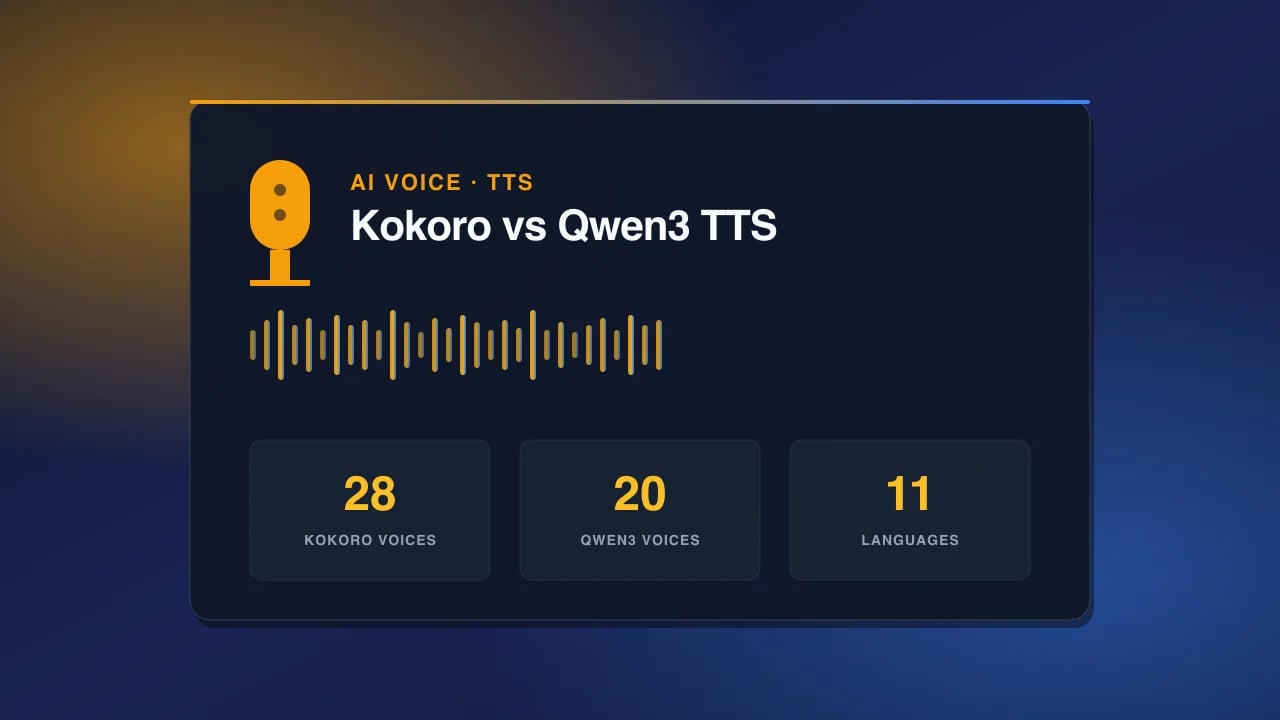
Kokoro ships 28 voices at last count. The core set:
-
American English: roughly 10 voices split male/female, including narrator-tier voices that are the workhorse of the model.
-
British English: 6-8 voices, generally warmer and slightly more expressive than the US set.
-
Novelty: yes, there really is a Santa voice, plus a few character-adjacent voices that ship as extras.
-
Limited support for Japanese, Mandarin, Spanish, French, Hindi and Italian — but these are second-class citizens in the model. Quality drops noticeably outside English.
Speed
On HuggingFace ZeroGPU, a short paragraph (200-300 characters) renders in 5-15 seconds cold, 3-8 seconds warm. Longer outputs near the ~500 character limit push toward 20-30 seconds. If you self-host on a modest GPU (a T4 will do), Kokoro is real-time or better — you can generate faster than a human speaks.
Quality tier
For English narration, Kokoro is the closest free model to ElevenLabs I have used. It is not identical — Eleven still has an edge on emotional emphasis and long-range prosody consistency — but for straight documentary-style narration, most listeners cannot tell the difference in a blind test. That is a real claim I have watched people fail in practice.
Where does it fall short? Anything requiring dramatic emotion. Kokoro sounds calm, professional, slightly detached. That is exactly what you want for an audiobook and exactly wrong for a game villain.
Best for
Audiobooks, podcast intros and outros, e-learning modules, YouTube narration (especially long-form explainer videos), corporate training, IVR systems, and accessibility features like screen-reader output. If your reader is going to listen for more than 30 seconds, Kokoro is the pick.
#Qwen3 TTS — deep dive
Qwen3 TTS is Alibaba's open-source contribution to the TTS space, released alongside the wider Qwen3 model family. Where Kokoro is a specialist, Qwen3 is a generalist — and its multilingual chops are the whole reason to reach for it.
Architecture
Qwen3 TTS is autoregressive. It generates audio tokens sequentially, then a decoder converts those tokens to a waveform. This is the same broad approach that powers models like VALL-E and Bark. Autoregressive TTS tends to produce more expressive, less flat output than non-autoregressive models — at the cost of speed and, occasionally, stability on long inputs.
The model is meaningfully larger than Kokoro. Alibaba has not published a headline parameter count for the demo checkpoint, but generation latency and memory footprint put it comfortably in the hundreds of millions of parameters. That extra capacity is where the multilingual coverage and voice personality come from.
Voice catalog
This is where Qwen3 flexes. Around 20 named voices, each with a distinct personality baked into the training data. Some of the standouts:
-
Cherry: young, energetic, slightly playful — the default for demos and it earns its keep.
-
Ryan: male, warm, mid-range, works for casual narration.
-
Sohee: Korean-native voice, clear and precise, great for K-content dubs.
-
Ono Anna: Japanese-native, breathy character-actor tone, popular in anime-adjacent projects.
- Plus more than a dozen others spanning Chinese, English, and European languages.
These are not just accents on the same underlying voice. They are distinct speakers with distinct timbres, cadences and emotional defaults. When you hear a Qwen3 voice you can pick it out of a lineup.
Languages
Qwen3 TTS officially supports 11 languages with an Auto-detect mode:
- English
- Chinese (Mandarin)
- Japanese
- Korean
- Russian
- Italian
- Spanish
- French
- German
- Portuguese
- Auto (language detection from input text)
Auto-detect is the underrated feature here. Paste a mixed-language script and Qwen3 will code-switch mid-sentence with reasonable accuracy. Kokoro cannot do this in any usable way.
Speed
On HuggingFace ZeroGPU, expect ~10 seconds per generation for a typical paragraph. Slower than Kokoro on the same infrastructure, because autoregressive decoding is slower per token. Not a dealbreaker for short-form content, painful for long-form.
Quality tier
Premium personality-driven. Qwen3 does not compete with Kokoro on flat narration — it wins when the content needs character. The trade-off is that "neutral corporate narrator" is not really in its wheelhouse. Every Qwen3 voice has an opinion about how the line should be read.
Best for
Multilingual content of any kind, character voices for games or animation, anime and manga dubs, virtual assistants that need a personality, dialogue-heavy content, localized marketing videos, and any project where a Chinese, Japanese or Korean speaker is not optional.
#Head-to-head comparison table
| Feature | Kokoro TTS | Qwen3 TTS |
| --- | --- | --- |
| Params | ~82M | Hundreds of millions (undisclosed) |
| Architecture | Non-autoregressive (StyleTTS2) | Autoregressive |
| Voice count | 28 | ~20 |
| Languages | English (primary), 6 others (limited) | 11 + auto-detect |
| Voice cloning | No | No |
| Emotion tags | No | No (personality baked into voice) |
| Character limit per generation | ~500 | ~500 |
| Speed on ZeroGPU | 5-30s | ~10s |
| License | Apache 2.0 | Alibaba open license (commercial with attribution) |
| Best strength | English narration quality | Multilingual + personality |
| Weakness | Weak outside English | Slower, less neutral |
| Where to try free | promptspace.in/ai-voice-generator | promptspace.in/ai-voice-generator |
#Same-text head-to-head test
Numbers only get you so far. Let me walk through three sample texts and describe how each engine handles them in practice.
Test 1 — English narration
*"The signal arrived at 3:14 in the morning. Nobody expected it. Nobody had prepared for it. And yet, for those who were listening, it changed everything."*
Kokoro reads this like a documentary narrator. Measured pacing, natural pauses at the periods, a slight lift on "everything" as the sentence resolves. The output is clean, listenable, and would fit under a Netflix opener without anyone noticing it was synthetic.
Qwen3 reads the same line more dramatically. With the Cherry voice you get a slightly younger, more engaged delivery — she leans into "nobody expected it" like a storyteller. With Ryan it is warmer, closer to Kokoro but with more emotional shading. Neither is bad, but Kokoro sounds more professional. Qwen3 sounds more human.
Winner for this text: Kokoro if you are making a documentary, Qwen3 if you are making a podcast.
Test 2 — Japanese
*"今日は本当にいい天気ですね。散歩に行きませんか?"*
Kokoro technically supports Japanese but the output has a synthetic quality — the pitch accent is often wrong, and native speakers notice immediately. Not shippable for a Japanese audience.
Qwen3 with Ono Anna reads this cleanly. Native pitch accent, natural pausing, believable prosody. This is what you would actually ship. Sohee reads it with a Korean-accented Japanese, which is a legitimate stylistic choice for certain characters but not what you want for neutral Japanese content.
Winner: Qwen3, decisively.
Test 3 — Character voice
*"You dare enter my dungeon? Fool. You will not leave alive."*
Kokoro reads this as a mildly bored British narrator describing a dungeon. There is no menace. It is not the model's fault — Kokoro was not trained for this.
Qwen3 does not add villain menace either, but the personality voices give it a fighting chance. Ryan lands closer to a stern warning; some of the male European-language voices in the catalog have a naturally darker timbre that helps.
Winner: Qwen3, but honestly you want ElevenLabs or a voice actor for this one.
#Licensing and commercial use
Both models are commercial-safe. This is the most important point in the whole post, so pay attention.
Kokoro TTS is Apache 2.0. This is one of the most permissive open-source licenses in existence. You can use Kokoro in commercial products, sell the audio it generates, embed it in a paid app, and you do not owe anyone anything. You are supposed to include the license text if you redistribute the model itself, but audio output has no strings attached.
Qwen3 TTS is under Alibaba's open license. It permits commercial use but includes attribution requirements and some restrictions around scale (very large deployments may need a specific license). For any normal indie or small-business use case, it is fine. Read the license file on the repo before you ship a product built on it at scale — that is not legal advice, it is just what you should always do.
Neither model imposes per-character fees. Neither requires an API key. Neither will shut off your access because a new pricing tier launched. That is the entire point of using open models — you own your pipeline.
#Which one loses to Cloudflare MeloTTS or ElevenLabs
Time to be honest about what these models cannot do.
They lose to ElevenLabs on:
-
Voice cloning. Neither Kokoro nor Qwen3 lets you upload a 10-second sample and get "your" voice back. Eleven does. If you need cloning, you need Eleven or XTTS-v2 self-hosted.
-
Emotion tags. Eleven lets you write `
` or `` inline. Neither open model supports emotion tags. What you hear is what the base voice gives you.
- Consistency across long documents. Eleven maintains voice character over multi-minute outputs. Both Kokoro and Qwen3 need to be chunked at around 500 characters, and the joins can drift slightly in tone.
- Low-latency streaming. Eleven streams audio as it generates. Kokoro and Qwen3 through the HuggingFace demos do not.
They lose to Cloudflare MeloTTS on:
- Edge deployment. MeloTTS on Workers AI runs at Cloudflare's edge with sub-second first-byte times. Kokoro and Qwen3 on the free HuggingFace ZeroGPU sit behind a queue that can spike to 30+ seconds under load.
- Predictable production latency. If you are building a real-time application, the free HF endpoints are demos, not production infrastructure. You either self-host or you pay somewhere.
What you actually give up by going free
Character limits (~500 per generation, so you chunk), no cloning, no emotion tags, queue latency during peak hours, and the responsibility for hosting if you want production reliability. In exchange you pay $0.
Is that trade worth it? For most content creators, yes. For a real-time app with paying users, probably not — you self-host or you buy managed inference.
#How to try both in your browser without setup
You do not need to install anything, sign up for an account, or figure out HuggingFace Spaces to hear these models. PromptSpace hosts a single unified interface at promptspace.in/ai-voice-generator that lets you switch between Kokoro TTS and Qwen3 TTS with a dropdown. Paste your text, pick a voice, download the audio. Free. No account required. Same interface as our free ElevenLabs alternative writeup, which covers four engines including these two.
If you are building something bigger, our prompt library has voice-directing prompts that work with both engines, and our AI image generator covers the visual side if you are making video content. More writeups on our blog.
#FAQ
Is Kokoro TTS really free for commercial use?
Yes. Apache 2.0 means you can use the audio commercially with no fees, no attribution required for output, and no per-character charges.
Is Qwen3 TTS free for commercial use?
Yes, with attribution. Alibaba's open license permits commercial use but you should read the license file for scale-specific terms if you are deploying at very high volume.
Which one is faster?
Kokoro. Non-autoregressive architecture means it generates the whole waveform in one shot rather than token by token. On the same hardware Kokoro typically finishes in half the time.
Can I clone my own voice with either?
No. Both ship fixed voice catalogs. For cloning, look at XTTS-v2, OpenVoice, or a paid service like ElevenLabs.
Which one supports Japanese properly?
Qwen3. Kokoro has limited Japanese support but native speakers can tell it is synthetic. Qwen3's Ono Anna voice is shippable-quality Japanese.
What is ZeroGPU and why does it matter?
ZeroGPU is HuggingFace's free tier for hosting model inference. It is dynamic GPU allocation — great for demos, but during peak hours you sit in a queue. If you need reliable latency, self-host or use managed inference.
Can I run these models on my own laptop?
Kokoro yes, comfortably — 82M params runs on almost any GPU and even acceptably on CPU. Qwen3 needs a real GPU (8GB+ VRAM) to run comfortably.
No. Neither model supports SSML markup or inline emotion tags. The personality is baked into the voice selection itself, especially for Qwen3.
What is the character limit per generation?
Roughly 500 characters for both on the public demos. For longer content, chunk your script at sentence boundaries and concatenate the audio. Some quality drift happens across chunks — expect small tonal shifts at join points.
Which one is closer to ElevenLabs quality?
For English narration, Kokoro. For everything else, they trade blows and Eleven still wins on cloning, emotion, and streaming. But the gap on plain narration is smaller than the price difference suggests.
Can I use these models on my phone?
Not natively — both need GPU inference. But you can access both through promptspace.in/ai-voice-generator from any browser on any device.
Which one should I pick if I only pick one?
If you speak English and you are making long-form content, pick Kokoro. If you need any other language or you want a voice with character, pick Qwen3. If you cannot decide, use both — that is what the PromptSpace interface is for.
#Closing
The open-source TTS landscape in 2026 is genuinely good. Two years ago you were choosing between paid APIs and Frankenstein self-hosted setups. Now you can point people at a browser tab and let them pick between two production-quality models with a dropdown.
Neither Kokoro nor Qwen3 is going to replace ElevenLabs for a Hollywood-grade voice-clone project. But for the 90% of use cases where you just need a good voice reading text out loud — audiobooks, videos, e-learning, podcasts, multilingual content, character work — you should not be paying anymore. Start with PromptSpace's free AI voice generator, try both engines on your actual script, and decide from what you hear rather than what a benchmark table says.
The correct comparison is not Kokoro TTS vs Qwen3 TTS versus each other. It is both of them versus the paid tools they replaced. On that comparison the free side has already won.