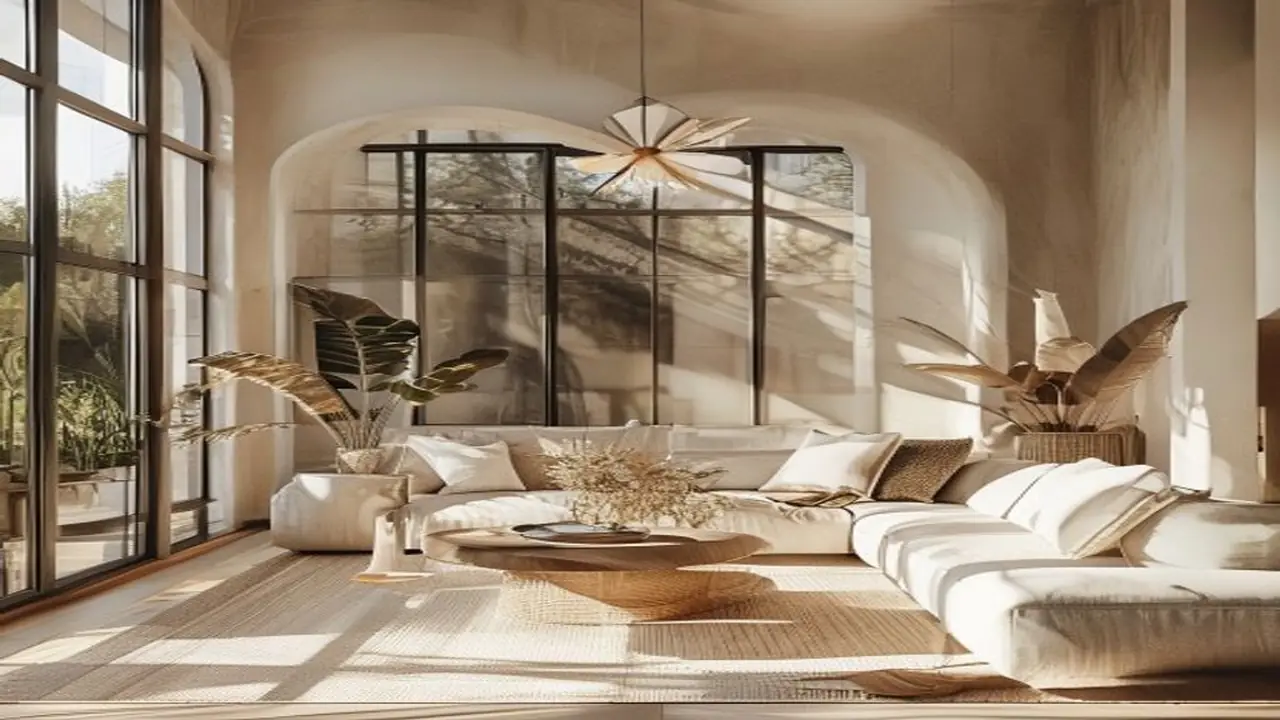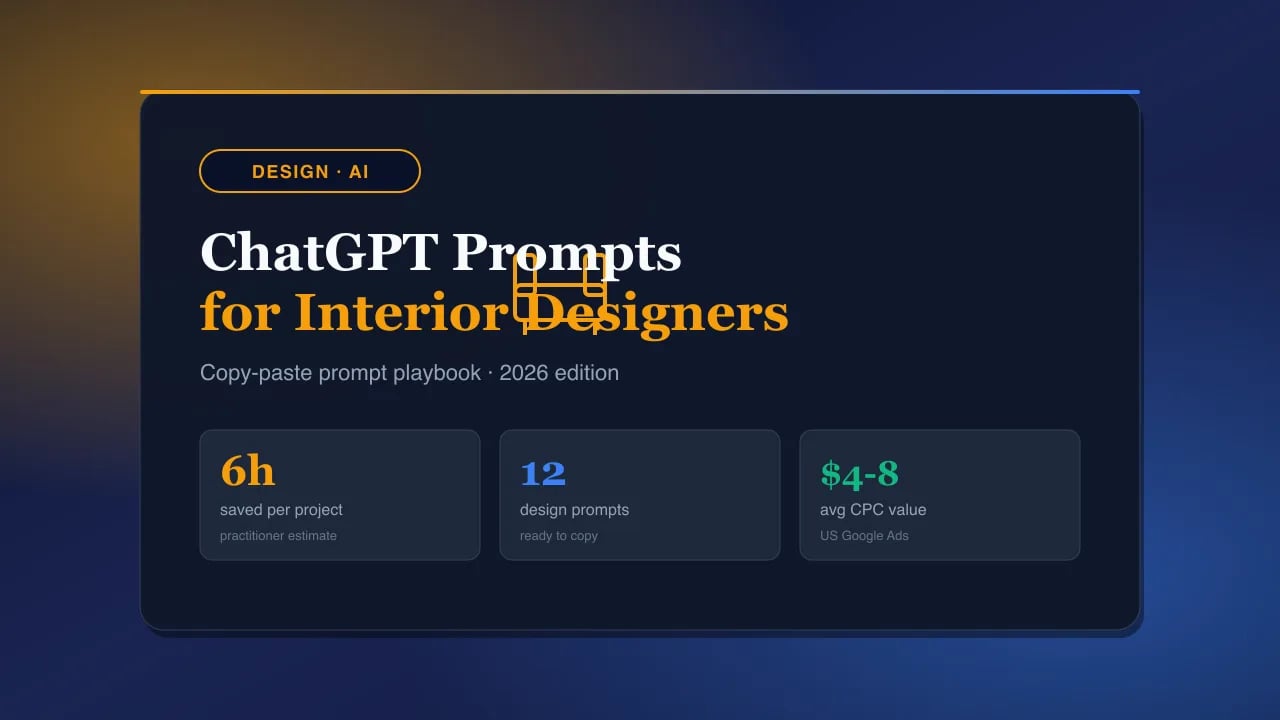
A boutique studio in Austin ran a two-week experiment last spring. Same three designers, same client load, same billable target. The only change: every non-drawing task ran through a prompt library first. Discovery calls, scope drafts, vendor outreach, Reels captions. Result was 11.4 hours a week reclaimed per designer, and a 22% jump in proposal-to-signed conversion. That's the case for building your own set of ChatGPT prompts for interior designers 2026 workflows: specific, filled with your studio's real language, built one task at a time.
What interior designers can actually automate with ChatGPT in 2026
The honest list is shorter than the hype suggests, but the wins are real. ChatGPT and its peers will not source your fabrics, spec your electrical, or negotiate lead times. They will draft the writing around every one of those tasks faster than you can. Focus AI on repeatable text tasks, not judgment calls. Here is what belongs on the AI side of your line:
- Client-facing scripts: discovery calls, style quizzes, welcome packets
- Presentation narrative: mood board copy, room concept write-ups, design rationale
- Business documents: scope of work, change orders, installation briefs, photography briefs
- Vendor communication: cold outreach, sample requests, quote follow-ups
- Marketing: Reels scripts, before/after captions, blog posts, email newsletters
- Meta-prompting: generating Midjourney or Flux prompts from a client brief
What stays entirely with you: field measurements, code compliance, structural questions, load calculations, subcontractor selection, and any decision that touches life safety. More on that below in the limitations section.
Store your best prompts in a single document with clear slot names like[CLIENT NAME],[BUDGET],[STATE],[STYLE]. Consistent slots mean you can build a Notion or Airtable filler later without rewriting anything.
12 copy-paste prompts organized by task type
Each prompt has slots you fill before pasting. Use ChatGPT-5, Claude Sonnet 4.5, or Gemini 2.5 Pro — model choice matters less than prompt specificity.
1. Discovery call script (60-minute intake)
You are a senior interior designer with 15 years running a residential studio in [CITY, STATE]. Draft a 60-minute discovery call script for a first meeting with [CLIENT NAME], a [FAMILY COMPOSITION] considering a [PROJECT TYPE: full home / single room / renovation] with an estimated budget of [$BUDGET RANGE].

Structure the script as: - 5 min: warm rapport questions (life stage, how they use the space now) - 15 min: functional needs by room, storage pain points, entertaining patterns - 15 min: aesthetic direction (words they use, images they save, styles they reject) - 10 min: budget conversation with three anchor scenarios (essentials / recommended / stretch) - 10 min: timeline, decision-makers, past renovation history, pets, allergies - 5 min: next steps and my process overview

Write questions I actually ask out loud, not survey items. Include two follow-up probes per question. Add a note at the top reminding me to record with consent.
2. Style-quiz questionnaire (client sends before session two)
Create a 20-question style quiz for a residential client transitioning from [CURRENT STYLE, e.g., builder-grade contemporary] toward [ASPIRATIONAL DIRECTION, e.g., warm modern with Japandi influence].

Mix question types: - 6 forced-choice image pairs (describe each image in one sentence, no actual images needed) - 4 word-association questions (they pick 3 from 8 adjectives) - 3 lifestyle scenarios ("Sunday morning at home looks like...") - 3 rejection questions ("Which of these would you never live with?") - 4 open-response prompts kept under 30 words each

After the quiz, output a scoring rubric that maps answers to five style directions: [STYLE A], [STYLE B], [STYLE C], [STYLE D], [STYLE E]. Give me the interpretation text I'd send them, written warmly.
3. Mood-board narrative for presentation
You are writing the presentation narrative for a mood board I'm delivering to [CLIENT NAME] for their [ROOM/PROJECT]. The direction is [3-5 KEYWORDS: e.g., quiet, layered, tactile, unpretentious].

Produce: 1. A 90-word opening paragraph that names the feeling first, then the design moves that create it 2. Six bullet points, each 15-20 words, describing a specific material choice and why it belongs (walnut, unlacquered brass, limewash, boucle, etc.) 3. A "what we're deliberately avoiding" paragraph of 60 words that names 3-4 trends we're rejecting and why 4. A one-sentence tagline the client can repeat when friends ask about the direction

Tone: confident, warm, no jargon a client wouldn't use. Never say "curated" or "elevated."
4. Budget breakdown by room
Build a room-by-room budget breakdown for a [SQUARE FOOTAGE] [PROJECT TYPE] in [CITY, STATE] with a total FF&E + design fee budget of [$AMOUNT]. Rooms to include: [LIST ROOMS].

For each room, output a table row with: - Room name - Recommended % of total budget - Dollar allocation - The three largest line items (typically upholstery, lighting, rugs, or case goods) with target unit ranges - One line for contingency (10-15%)

Underneath the table, write a 100-word plain-English explanation for the client covering: - Why the [HIGHEST %] room gets the most - What we can phase to a later purchase if needed - Where we should NOT try to save (e.g., seating you sit on daily)

Assume mid-market trade pricing, not retail.
5. Material-source vendor outreach email
Write a cold outreach email to [VENDOR/SHOWROOM NAME], a [CATEGORY: fabric house / lighting maker / stone yard] I want to open a trade account with. My studio is [STUDIO NAME], based in [CITY], billing [ANNUAL VOLUME RANGE] across residential projects.

The email should: - Open with something specific about their line (not "I love your work") - State clearly what I'm asking: memo samples, trade discount, minimum orders, lead times - Include two current projects (redact client names) that would use their product - Close with a proposed 15-minute call and my direct number

Keep it under 180 words. No exclamation points. No "just wanted to reach out."
6. Contract scope-of-work draft
Draft the scope-of-work section for a design services contract for [CLIENT NAME] covering [PROJECT: e.g., full first-floor renovation, 1,850 sqft, single-family home in STATE].

Structure as:

A. INCLUDED SERVICES - Phase 1: Programming and concept (deliverables, meeting count, revision rounds) - Phase 2: Design development (floor plans, elevations, FF&E schedules) - Phase 3: Documentation and procurement (specs, purchase orders, expediting) - Phase 4: Installation and styling (day-of oversight, punch list)

B. EXPLICITLY EXCLUDED - Architectural drawings, engineering, permits - General contracting or trades supervision - Any structural, electrical, plumbing, or HVAC specification - MEP consulting or code review

C. CLIENT RESPONSIBILITIES - Timely decisions, access, insurance, existing conditions disclosure

D. CHANGE ORDER TRIGGERS - Scope additions, rework beyond included revision rounds, expedited timelines

Write in plain English. This is a draft I'll send to my attorney for review before signing anyone. Add a disclaimer noting attorney review is required.
7. Change-order communication
Write a change-order email to [CLIENT NAME] covering [WHAT CHANGED: e.g., they've asked to swap the primary bedroom's specified sofa for a custom sectional 40% larger than the original].

Include: - Two sentences acknowledging the request without judgment - The specific impact on budget (add $[AMOUNT]), timeline (adds [WEEKS]), and any downstream ripple (e.g., rug size, side table clearance) - A clear yes/no decision point with a signature line - A gentle reminder that the original selection remains available if they'd rather hold

Tone: respectful, factual, no guilt, no upsell. Under 200 words. Sign off with my next available call slot.
8. Installation-day briefing
Create an installation-day briefing document for my team and subcontractors covering the [CLIENT NAME] project at [ADDRESS] on [DATE].

Sections: 1. Arrival logistics: parking, elevator reservations, protection floor plan, restroom access, HOA hours 2. Team roster with roles and cell numbers (leave placeholders) 3. Room-by-room sequence: what goes in first, what waits, what stays boxed until styling 4. Fragile items list with handling notes 5. Client interaction rules: who talks to the client, what's a design decision vs. a field decision 6. Punch list template for end-of-day walkthrough 7. Trash and packaging removal plan 8. Photography hold: what NOT to unbox if we're shooting the space later

Output as a single-page briefing suitable for print. Bullet points, no paragraphs.
9. Post-project photography brief for portfolio
Draft a photography brief for [PHOTOGRAPHER NAME] to shoot the completed [PROJECT NAME] on [DATE].

Include: - Project story in 80 words (client, direction, standout moves) - Shot list organized by room with priority (hero / secondary / detail) — target 4-6 shots per room - Specific vignettes I want captured: [E.G., morning light on the reading nook, the brass sconce against the limewash] - Lens and framing preferences (wide establishing, 35mm human-scale, tight material details) - Styling notes: what fresh flowers, what books, what fruit, what to remove - Deliverable format: web-res for Instagram, print-res for portfolio, licensed for editorial submission to [PUBLICATION LIST] - Usage rights language for the invoice

Keep it under 500 words. Photographer will thank me for the specificity.
10. Instagram Reels script — before/after
Write three Reels script variations for a before/after reveal of [PROJECT: e.g., a 1970s galley kitchen turned open, warm, functional].

Each script should be: - 22-28 seconds when read aloud at normal pace - Hook in the first 3 seconds (a specific number, a bold claim, or a question) - One clear structural beat: the problem, the pivotal design move, the payoff - Voiceover text separated from on-screen text - Include a suggested trending audio direction (upbeat build, slow reveal, ambient) — don't name specific songs - End with a soft CTA (save, share, comment their kitchen year)

Variation A: Focus on the design decision (why we moved the wall) Variation B: Focus on client life change (what Sundays look like now) Variation C: Focus on a single material moment (the range hood)

No "POV" openers. No "tell me you're a designer without telling me."
11. Meta-prompt: generate Midjourney/Flux prompts from a client brief
You are a prompt engineer specializing in Midjourney v7 and Flux for interior design visualization.

Here is my client brief: """ [PASTE CLIENT DISCOVERY NOTES, STYLE QUIZ RESULTS, AND ROOM PROGRAM HERE] """

Generate five distinct image prompts I can paste into Midjourney or Flux to produce concept visuals for internal exploration only (not client-facing without disclosure). Each prompt should:

1. Name the room type and vantage ("eye-level view of a corner reading nook") 2. Specify architectural bones (ceiling height, window count and orientation, floor material) 3. List 4-6 material and finish choices in concrete nouns (unlacquered brass, limewashed plaster, oak with a soap finish) 4. Set lighting condition (morning north light, warm evening lamplight) 5. Include one atmospheric detail that anchors mood (a wool throw slumped on the sofa, an open book) 6. End with technical parameters: --ar 3:2 --style raw --v 7 (or --model flux-pro for Flux)

Avoid: "cozy," "modern," "luxurious," "stunning," any adjective a real spec sheet wouldn't use. Prefer proper nouns and material names.

Output as a numbered list. After the five prompts, add a two-sentence note on how I should disclose AI-generated concepts to my client per current AIA and ASID guidance.
12. Welcome packet email (post-signing)
Write the welcome email that goes out within 24 hours of [CLIENT NAME] signing our design agreement for [PROJECT].

Include: - A one-sentence thank-you that isn't schmaltzy - What happens in the first 10 days (measurement visit, questionnaire, Pinterest board invite, kickoff meeting scheduling) - Names and roles of the two team members they'll interact with most - How we handle communication (weekly Friday summary, urgent items by text, no design decisions over social DM) - Payment schedule reminder without being pushy - Two housekeeping items: pets during site visits, access hours - Signature with direct number

Under 350 words. Warm but professional. No stock "we're so excited" opener.
ASID's 2025 State of Interior Design report found that studios using structured AI workflows for admin and client communication grew revenue 18% faster year-over-year than studios that didn't. The gain came almost entirely from freed-up billable hours, not new services.
ChatGPT vs Claude vs Gemini for interior design work
Designers debate models with the intensity of paint-line loyalty. In 2026, all three top-tier models handle the tasks above competently. Differences show up in tone, table formatting, and image handling.
| Task | ChatGPT-5 | Claude Sonnet 4.5 | Gemini 2.5 Pro |
|---|---|---|---|
| Discovery scripts and questionnaires | Warm, natural phrasing | Slightly more formal, excellent structure | Good, occasionally generic |
| Contract and scope drafting | Strong, needs attorney review | Best legal-adjacent phrasing | Adequate |
| Mood board narrative | Best voice control | Great with tight brand-voice examples | Reliable but flatter |
| Reels and social scripts | Best hook-writing | Solid, less snappy | Strong with trend awareness |
| Meta-prompts for Midjourney/Flux | Excellent | Excellent | Best because of native image tools |
| Long docs (briefings, packets) | Handles length well | Best at very long structured docs | Fine to 4,000 words |
| Cost (Plus/Pro tier) | $20/mo | $20/mo | $20/mo |
If you can only afford one, pick the model whose voice sounds most like yours when you paste in past writing. Free tiers work for the prompts above.
Feed the model 800-1,200 words of your own past writing (an old proposal, a well-loved Instagram caption, a client email you were proud of) at the start of a session. Say: "This is my voice. Match it." Every output that follows will sound more like you.
What ChatGPT cannot do for your interior design practice
The prompts above work because they respect a boundary. Everything AI touches in your studio should be something a client would be fine seeing a draft of. There are jobs it should not touch.
- Field measurements and code interpretation. The model will hallucinate clearances, egress requirements, and ADA specs with total confidence. Never let it draft anything touching life safety without verifying against the actual jurisdiction.
- Structural, electrical, plumbing, or HVAC advice. Even if a client asks casually, do not use ChatGPT to answer. Refer them to a licensed engineer, electrician, plumber, or mechanical designer.
- Vendor pricing and lead-time claims. Training data is out of date the moment it ships. Confirm every number with the actual vendor.
- Real product recommendations from your active library. The model does not know your trade accounts or current stock. It will invent SKUs.
- Client-facing renderings without disclosure. AI-generated visuals must be labeled — see the warning below.
- Actual taste. Prompts help you write faster. They do not make you a better designer. Every output needs your judgment before it leaves your studio.
Licensing, professional scope, and AI disclosure rules you must respect.
1. Interior design licensing varies dramatically by state. Practice acts, title acts, and permit-signing privileges differ. Alabama, Florida, Louisiana, Nevada, and Washington DC restrict who can call themselves an "interior designer" or stamp commercial documents. Other states have no title regulation at all. Before using AI to draft anything that describes your services publicly, verify what you are legally allowed to call yourself and what work you can perform in your state. Check CIDQ and your state's licensing board directly. Do not rely on ChatGPT for this answer.
2. Never let ChatGPT draft structural or engineering advice. Load-bearing walls, beam sizing, egress, electrical service, gas line changes, and HVAC design belong to licensed engineers and contractors. If a client asks whether a wall can come down, your only correct answer is: we need a structural engineer to look at this. Do not paraphrase an AI response as your professional opinion. That is where lawsuits live.
3. Disclose AI-generated visuals to clients in writing. If you use Midjourney, Flux, Stable Diffusion, or ChatGPT's image tools to produce concept boards, renderings, or mood images shown to a client, label them clearly. Current AIA, ASID, and IIDA guidance recommends: (a) never presenting AI images as accurate representations of specified products or as achievable outcomes, (b) marking every AI-generated visual with an "AI concept" watermark or footer, (c) noting in your proposal or contract that concept exploration may include AI-generated imagery for direction-setting only. Clients who discover this after the fact feel misled, and rightly so.
How to embed these prompts into daily studio practice
A prompt library is useless if it lives in a Google Doc you last opened in April. Studios getting real hours back share three habits.
- Store prompts where the work happens. Paste your library into Notion, Asana, Airtable, or ClickUp. Every project template should surface the right prompt at the right stage: discovery at kickoff, change-order in the change-order task, photography brief a week before the shoot.
- Fill slots, don't rewrite. Give yourself 4-6 minutes per prompt to gather context, fill brackets, and hit send. If you find yourself rewriting the structure, save the new version to the library.
- Two-pass editing, always. First pass: accuracy — wrong numbers, made-up SKUs, hallucinated details. Second pass: read aloud for voice. Does it sound like you?
Book a 90-minute quarterly session with your studio manager to audit the library. Kill prompts that don't earn their keep, sharpen the survivors. This is a system, not a static file.
Many client-communication patterns transfer across service businesses. Browse the financial advisor prompt library, the CPA firm AI tools breakdown, and the full PromptSpace library for adjacent categories.
Frequently asked questions
Will ChatGPT replace interior designers?
No, and the question misses what's actually happening. ChatGPT compresses the writing and coordination around design work. It does not develop taste, source materials, manage subcontractors, or make the judgment calls that separate good designers from mediocre ones. Studios that adopt it well spend more time on design, less on admin.
Which model is best for interior designers in 2026?
ChatGPT-5 has the warmest default voice for client work. Claude Sonnet 4.5 handles very long documents (contracts, briefs) best. Gemini 2.5 Pro is strongest for meta-prompting Midjourney and Flux. If forced to pick one, ChatGPT-5 handles the widest range of studio tasks well.
Can I use AI to generate client renderings?
Only for concept exploration, and only with clear disclosure to your client in writing. AI-generated visuals should never be presented as accurate representations of specified products or achievable outcomes. Label every AI image as "AI concept" and note it in your proposal or contract. See the warning callout above for full guidance.
Is it safe to paste client information into ChatGPT?
Use the enterprise or team tier of whichever model you choose (ChatGPT Team, Claude Team, Gemini Business). Consumer tiers may train on your data unless you opt out. Even on paid tiers, redact home addresses, financial account numbers, and anything sensitive. Use initials or placeholders in your prompts.
How long does it take to build a working prompt library?
Two focused afternoons. Day one: draft or copy prompts for your ten most common tasks. Day two: run each on a real active project, edit, save the winners with your slot conventions. Refine over the next month as you notice which outputs still need heavy editing.
Do I need to disclose that I use ChatGPT to my clients?
You are not obligated to disclose that admin drafts (emails, contracts, briefs) started as AI outputs, since the final work product is yours. You are obligated to disclose AI-generated visuals shown to the client. When in doubt, disclose. Trust compounds.
Can ChatGPT help me draft my studio contract?
It can draft a scope-of-work section and other non-legal language you'll find useful, as prompt #6 shows. It cannot replace an attorney. Every contract you use with clients should be reviewed by a lawyer licensed in your state before you sign anyone. Treat AI drafts as starting material for that review.
What about using ChatGPT for code compliance research?
Do not. The model will confidently state clearances, ADA requirements, egress rules, and occupancy limits that are wrong for your jurisdiction. Always verify against the actual code adopted in your city or state, or hire a licensed professional to interpret it. Code errors have consequences AI cannot pay for.
How much time can a small studio realistically save with these prompts?
Studios in the 2-6 person range typically report 6-12 hours per designer per week after two months of consistent use. The gains are concentrated in client communication, scope drafting, and marketing content, not in design work itself. Solo practitioners often see the largest percentage gain because they are doing everything.
Where can I find more prompt libraries for creative professionals?
Browse the full PromptSpace library for prompts organized by profession and task. New collections ship weekly. If you want cross-industry inspiration, the professional services categories (legal, finance, real estate) share more patterns with design than you'd expect.
The prompt library is a business asset
Every studio owner has spent an evening writing the same welcome email for the twentieth time. That evening is the asset. Build the prompt once, refine it over ten projects, and the twentieth version writes itself in six minutes with better copy than the first. Adapt the 12 prompts until they sound like your studio. For AI disclosure guidance, see OpenAI's usage policies, Anthropic's usage policy, and ASID guidelines.