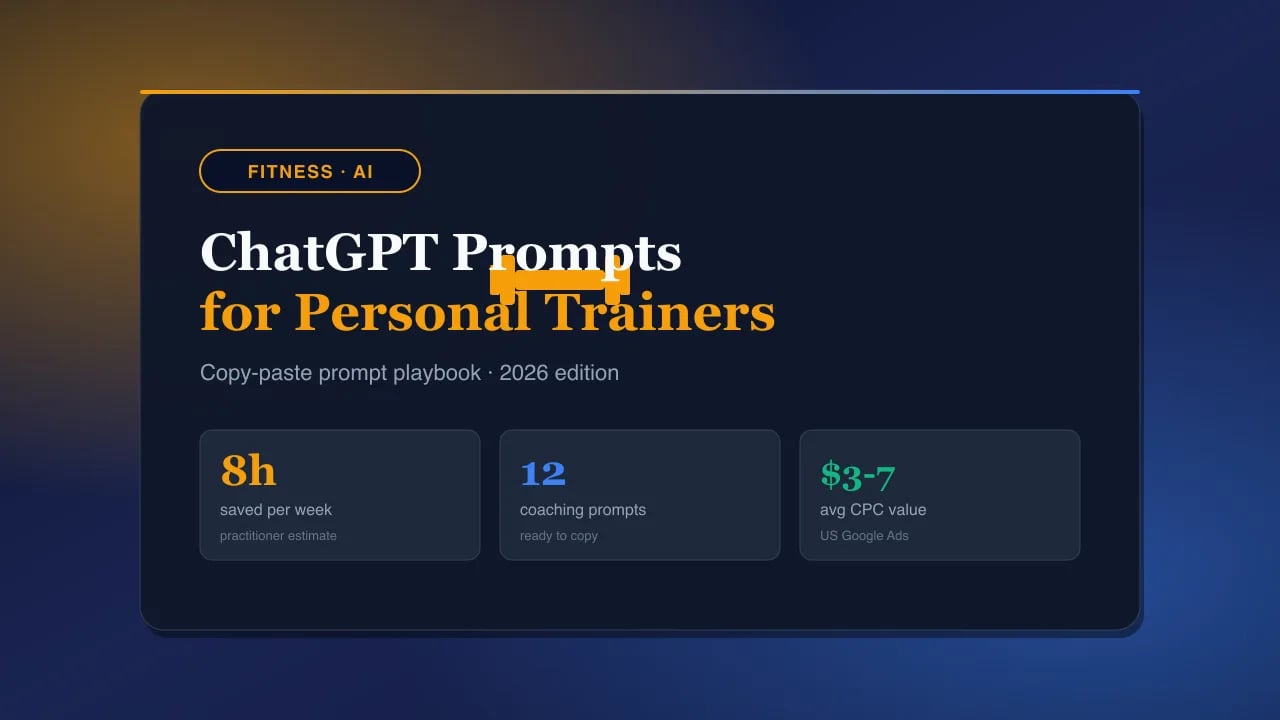
A busy independent trainer runs 28 sessions a week, sends 40 program updates, writes 12 Instagram captions, and answers roughly 60 DMs. Add intake calls, cancellation saves, and monthly check-ins, and admin hits 14 hours before you've deadlifted a single client. That's what pushed most trainers into ChatGPT in 2025, and what keeps them there in 2026. Not because AI writes better programs than you do — it writes the boring parts faster, so coaching gets your full brain. This guide gives you 12 prompts you can paste today. Every one has fillable slots, a scope-of-practice guardrail baked in, and output you can actually send. ChatGPT prompts for personal trainers 2026 don't need to be clever. They need to save four hours a week and never put your certification at risk.
ChatGPT prompts for personal trainers 2026: what to automate first
ChatGPT is good at three things a trainer needs daily: rewriting the same information for different audiences, drafting long-form copy from short bullet inputs, and turning a client's messy check-in reply into a structured plan for next week. It is not good at replacing your eyes on a squat, deciding when to progress a de-loaded athlete, or reading a client's stress the way a coach with 8 years of floor time can. Automate: intake questionnaires, first-draft 4-week programs, macro templates, transformation captions, cold DMs, injury modification lists (with referrals), progress emails, retention scripts, group class copy, and testimonial requests. Keep human: form corrections, real-time cues, medical-adjacent conversations, and exercise selection for a client with a diagnosed condition.
A 2025 survey of 412 US-based independent trainers by Trainerize found that trainers using AI for admin reported an average of 4.7 hours saved per week, and 63% used the reclaimed time to add 2-3 more client sessions rather than shorten their workday.
The trainers getting real value aren't running one giant prompt. They're running 10-15 small prompts saved in a Notes file, tweaked over three months, matched to specific weekly tasks. That's the pattern this guide follows. For context on how the same discipline applies to regulated professions, see ChatGPT prompts for financial advisors.
12 copy-paste ChatGPT prompts for personal trainers
Every prompt below uses bracket slots you fill in: [CLIENT NAME], [GOAL], [INJURY], [CITY]. Don't remove the scope-of-practice line at the end — it keeps ChatGPT from drifting into medical or nutrition prescription territory that your NASM, ACE, or NSCA credential does not cover.
1. Client intake questionnaire generator
You are drafting a client intake questionnaire for a certified personal trainer working with general population adults. The client is [CLIENT NAME], age [AGE], primary goal [GOAL: fat loss / hypertrophy / strength / general fitness], training history [BEGINNER / INTERMEDIATE / ADVANCED].

Write 22 questions organized in 4 sections: (1) training history and current activity, (2) injury and medical history with a clear PAR-Q style flag for red-flag conditions, (3) lifestyle factors including sleep, stress, and work schedule, (4) goal specifics with measurable 12-week and 6-month targets.

For the medical section, do NOT ask for diagnoses in a way that requires me to interpret them. Include one closing question: "Has a physician cleared you for exercise in the last 12 months?" End the questionnaire with this exact line: "This form is used to design your training plan only. I am not licensed to provide medical or nutrition prescription and will refer you to the appropriate professional when relevant."
2. Custom 4-week program with progression
Design a 4-week resistance training program for [CLIENT NAME], goal [GOAL], training [3 or 4] days per week, [60] minutes per session, equipment access [FULL GYM / HOME DUMBBELL SET / RESISTANCE BANDS], experience level [LEVEL], known injuries or limitations [LIST OR "NONE"].

Structure: - Week 1: introduction, RPE 6-7, movement quality focus - Week 2: same exercises, add 1 rep per set or 2.5% load - Week 3: same exercises, add another progression variable - Week 4: de-load OR test week, my choice — give me both options

For each session include: warm-up (5 min), main lifts with sets/reps/RPE, accessory block, and a 3-minute cool-down. Use compound lifts as anchors. Explain progression logic in one sentence per week. Flag any exercise that would be unsafe given the listed limitations and suggest a substitute. Do not prescribe exercises for undiagnosed pain — recommend referral to a physical therapist first.
3. Nutrition macro breakdown (with scope disclaimer)
Calculate a starting macronutrient target for a general-population adult client for educational discussion only. Do NOT write this as a prescription.

Inputs: sex [M/F], age [AGE], height [HEIGHT], weight [WEIGHT], activity level [SEDENTARY / LIGHTLY ACTIVE / MODERATELY ACTIVE / VERY ACTIVE], goal [FAT LOSS / MAINTENANCE / MUSCLE GAIN], any dietary preferences [E.G., VEGETARIAN, GLUTEN-FREE].

Output a table with: estimated maintenance calories using Mifflin-St Jeor, target calories for the stated goal (deficit or surplus of a reasonable size, not extreme), and gram targets for protein (1.6-2.2 g/kg), fat (0.8-1.0 g/kg minimum), and carbs (remainder).

End with this exact line: "These are general educational estimates, not a nutrition prescription. For any client with a medical condition, eating disorder history, or specific dietary needs, refer to a registered dietitian (RD/RDN)."
Save the macro prompt as a template with the scope-of-practice line locked in. If ChatGPT strips that line in a follow-up message, paste it back manually before you send anything to a client. Your certification body considers macro prescription without an RD credential to be outside your scope in most US states.
4. Instagram transformation post caption
Write an Instagram caption for a client transformation post. Client [FIRST NAME OR INITIAL], age [AGE], trained with me for [WEEKS] weeks, primary result [E.G., "lost 18 lb, added a 135 lb squat, sleeps 7 hours instead of 4"]. My coaching voice is [DIRECT AND WARM / DATA-HEAVY / MOTIVATIONAL BUT NOT HYPEY].

Deliver 3 caption variants: (1) 60 words, story-led opening line, ends with a soft CTA, (2) 120 words, three short paragraphs, one specific number in each, (3) 200 words, includes the client's own quote in the middle. All three must have permission-to-post language implied ("shared with permission"). No fake before-and-after urgency. No "look what I did" ego framing — the client did the work. Suggest 8 hashtags mixing local ([CITY]) and niche fitness tags.
5. DM cold outreach for gym leads
Write 5 short Instagram DM openers for cold outreach to potential clients I've seen posting from [GYM NAME] in [CITY]. My offer is [YOUR OFFER, e.g., "free 30-min form check"]. My credentials are [NASM-CPT / ACE / NSCA-CSCS].

Rules for every DM: - Under 40 words - Reference one specific thing from their recent public post (leave a [OBSERVATION] slot for me to fill in) - No "Hey, saw your page!" opener - No claim I can guarantee results - No pitch on the first message — the goal is a reply, not a sale - End with a low-friction question they can answer in one word

Also give me 2 second-message follow-ups I can send only if they reply.
6. Injury modification workaround
My client [CLIENT NAME] has a self-reported [INJURY OR LIMITATION, e.g., "cranky right shoulder, no diagnosis, aggravated by overhead pressing"]. They are not currently under care of a physical therapist or physician for this issue.

Task 1: Recommend that I refer them to a licensed physical therapist or physician BEFORE continuing to load the affected area if any of these red flags are present — sharp pain, night pain, numbness/tingling, pain lasting more than 2 weeks, or recent trauma. Draft the exact wording I should use to make that referral suggestion in a professional, non-alarming way.

Task 2: Assuming no red flags and the client is cleared for general activity, suggest 5 substitute exercises that train the same movement pattern with reduced load on the affected joint. For each substitute give the exercise, why it's a reasonable swap, and one coaching cue.

Do not diagnose. Do not name a condition. Use phrases like "until this is assessed" not "since you have X."
7. Monthly progress-check email
Write a monthly progress-check email to [CLIENT NAME], who has trained with me for [MONTHS] months. Their current program focus is [FOCUS]. Objective wins this month [LIST 2-3]. Areas that stalled or regressed [LIST OR "NONE"]. Their stated goal is [GOAL] with a target date of [DATE].

Email structure: - Subject line (under 50 characters, no emojis, not clickbait) - Opening: acknowledge one specific thing they did well this month, by name - Middle: honest read on progress against goal, including any stall, in plain language - Ask: 3 short questions about sleep, stress, and appetite this month - Close: what next month's program will emphasize and why - Sign-off in my voice [DESCRIBE VOICE IN 3 WORDS]

Under 220 words. No corporate tone. No "just checking in."
8. Retention script for a client about to cancel
[CLIENT NAME] has messaged that they want to cancel their coaching package. Stated reason [REASON, e.g., "too busy this quarter" / "not seeing results" / "cost"]. Coaching history [MONTHS] months, results so far [SUMMARY].

Draft a reply that does all of these: 1. Acknowledges their reason without arguing with it 2. Asks ONE clarifying question specific to their stated reason 3. Offers a specific modification (e.g., pause for 30 days, drop to 2 sessions/week, switch to check-in-only tier) — I'll fill in what's actually available 4. Does NOT guilt them or use scarcity language 5. Makes it easy to cancel if that's what they want — a coach who traps clients loses referrals

Under 180 words. Warm, direct, adult-to-adult. End with two clear options they can pick between.
9. Group class social copy
Write social copy for a new group class I'm launching. Class name [NAME], format [E.G., "45-min strength circuit, capped at 8"], schedule [DAYS AND TIMES], location [GYM OR STUDIO], price [PRICE OR "included in membership"], ideal participant [WHO IT'S FOR IN ONE SENTENCE].

Deliver: - 1 Instagram feed post caption (100 words) - 3 Instagram Story slides (under 20 words each, one hook, one detail, one CTA) - 1 Facebook event description (150 words, more logistical detail) - 1 SMS blast to existing clients (60 words max, sounds like a text not a broadcast)

No hype adjectives. Use the class's actual constraint (capped at 8, only Tuesdays, 45 minutes) as the hook rather than fake urgency.
10. Testimonial request template
Draft a testimonial request message I can send to a client who has just hit a meaningful milestone. Client [FIRST NAME], milestone [E.G., "first bodyweight bench press" / "6 months consistent training" / "pain-free running for the first time in 3 years"], relationship warmth [1-10].

Message rules: - Under 120 words - Reference the specific milestone by name - Give them 3 prompt questions to make writing easy ("what changed day to day", "what almost stopped you", "what would you tell someone on the fence") - Explicitly ask permission to share it and where (website, IG, both) - Offer an easy out ("totally fine if you'd rather not — no pressure") - Do not offer a discount in exchange, that turns a testimonial into a paid ad and requires disclosure under FTC endorsement guidelines

Also write a 40-word follow-up if they don't reply in 10 days.
11. Session note summarizer
Turn my messy post-session notes into a structured client-facing recap. Raw notes: [PASTE YOUR NOTES].

Output a short recap the client can screenshot: today's main lift and top set, one thing they did well, one thing to work on next session, homework (mobility, walking, sleep target), and next session's focus. Under 100 words. Second person. No jargon a beginner wouldn't understand.
12. Quarterly business review self-audit
Act as a business coach for independent personal trainers. My last-quarter numbers: [ACTIVE CLIENTS], [SESSIONS/WEEK], [MONTHLY REVENUE], [CHURN RATE], [NEW LEADS], [CLOSE RATE]. My biggest complaint about my business right now is [COMPLAINT].

Give me a one-page audit: 3 numbers that are healthy, 2 that are warning signs, and 1 experiment to run next quarter with a concrete success metric. Do not give generic advice — tie every recommendation to a specific number I gave you. If a number is missing, tell me to track it starting Monday.
Paste all 12 prompts into a single Notes or Notion file, then duplicate them into your ChatGPT "Custom Instructions" or a saved Claude Project. Editing the same prompt in-line every time trains you to spot which slots you actually need for your practice and which are dead weight.
ChatGPT vs Claude vs Gemini for personal trainers
All three models will run every prompt in this guide. The differences show up in tone, refusal patterns around medical-adjacent questions, and how well they hold a client persona across a long chat.
| Use case | ChatGPT (GPT-5) | Claude (Sonnet 4.5) | Gemini 2.5 |
|---|---|---|---|
| Program design drafts | Fast, tends to over-prescribe volume | More conservative, better progression logic | Good structure, occasional exercise name errors |
| Macro breakdowns | Will comply, sometimes without scope disclaimer | Consistently adds RD referral language | Comparable to ChatGPT |
| Injury conversations | Will attempt exercise substitutes, needs firm guardrails | Most likely to insist on PT referral first | Middle of the road |
| Instagram captions | Punchy, occasionally too hypey | Warmer, less clickbait | Neutral, needs more voice steering |
| Cold DMs | Best at short punchy openers | Best at follow-ups that don't sound pushy | Adequate |
| Free tier usable? | Yes, GPT-5-mini free | Yes, Sonnet limited free | Yes, most generous free tier |
| Monthly cost for pro | $20 | $20 | $20 (via Google One AI Premium) |
For pure trainer workflow in 2026: run ChatGPT for speed on marketing copy and Claude for anything touching injuries, macros, or client mental health. Gemini is a fine free-tier backup. You do not need all three paid — pick one, learn its quirks, save your prompts.
What ChatGPT cannot do for personal trainers (and where it will hurt you)
The failure modes are predictable, and every one has bitten a trainer publicly in the last 18 months. It cannot practice medicine or dietetics. If a client mentions a diagnosed condition — hypertension, diabetes, pregnancy, EDNOS history, post-surgical rehab — ChatGPT will happily produce exercise and food plans. Producing those without the appropriate license is a scope violation under NASM, ACE, and NSCA ethics codes, and in some US states a legal issue. See the NASM Code of Professional Conduct, the ACE Code of Ethics, and the NSCA Code of Ethics. It cannot see form. A prompt will not tell you a client's knee is caving on rep 8. Real-time coaching is still human work.
It hallucinates exercise names and equipment. ChatGPT has invented lifts that do not exist, mixed up muscle actions, and confidently suggested cable movements at gyms that only have dumbbells. Read every program before you send it. It writes fake reviews if you let it. Do not ask ChatGPT to "write a testimonial from a client." That's an FTC violation and the fastest way to lose community trust. Use prompt #10 to request real ones. It cannot disclose itself. If you publish AI-assisted content, you are the one on the hook for disclosure — see the warning callout below.
Compliance and ethics — read before you paste anything into a client thread. (1) Scope of practice. A CPT credential does NOT authorize you to diagnose conditions, prescribe medications, or write nutrition prescriptions. Macro estimates for a general-population client are education, not prescription. For any client with a diagnosed medical condition, eating disorder history, pregnancy, or post-surgical status, refer to the appropriate licensed professional (physician, RD/RDN, physical therapist) before programming touches the issue. (2) Certification body ethics. NASM, ACE, and NSCA codes require truthful marketing, informed consent, and referral when a client's needs exceed your training. AI-drafted programs still fall under these codes — the words you send are yours regardless of who drafted them. (3) AI-generated content disclosure. If a blog post, email, or caption is substantially AI-drafted, disclose it. FTC 2024 endorsement guidelines and platform terms require good-faith disclosure of AI-generated material claiming to be human experience. "Written with AI assistance, edited by [YOUR NAME]" at the end of a caption is enough. Fake before-and-afters, fabricated testimonials, and AI-invented client stories are prohibited and will end careers.
Workflow: how to embed these prompts into a real trainer week
The trainers who get 4+ hours a week back don't sit down Monday to "use AI." They batch. Sunday, 30 minutes: prompt #9 for the week's featured class, prompt #7 for any client on a month-end, and 3 IG posts with prompt #4 using permission-cleared client wins. Daily, 5 minutes: voice-dictate raw session notes on your walk to the car, paste into prompt #11 that evening, send the recap.
Every new lead, 10 minutes: prompt #1 generates a tailored intake, and when they book a call, prompt #2 drafts a 4-week outline you refine live. Monthly business audit, 20 minutes: log the 6 numbers prompt #12 asks for, pick one experiment for next month. Two batch windows a week — Sunday evening and Wednesday afternoon.
Do not run prompts one at a time during a coaching session. Clients notice the pause, and it undercuts your authority. Batch admin, then be fully present on the floor.
Browse the PromptSpace library for adjacent templates. Running the business side of a small studio too? Our writeup on AI tools for CPA firms lists tools you can hand to your accountant.
FAQ: ChatGPT prompts for personal trainers 2026
Can I use ChatGPT to write nutrition plans for my clients?
No, not as prescription. As a CPT you can share general educational estimates (calories, macro ranges based on standard formulas) but you cannot prescribe individualized diet plans for clients with medical conditions, eating disorder history, or specific therapeutic needs. Those need an RD/RDN. Prompt #3 stays on the education side of that line.
Will using AI to write my Instagram captions hurt my reach?
Instagram's 2025-2026 policies don't penalize AI-assisted captions, only fake engagement and undisclosed sponsored content. Meta itself uses AI to help creators. The bigger risk is voice drift — captions that stop sounding like you. Edit heavily and disclose AI assistance where it applies.
How do I stop ChatGPT from prescribing exercises for injured clients?
Put the guardrail in the prompt itself, not a follow-up message. Prompt #6 does this — it forces ChatGPT to recommend PT referral for red flags before offering substitutions. If ChatGPT tries to bypass it, paste the referral line back manually or switch to Claude.
What's the best free tool for a trainer just starting with AI?
Gemini's free tier is the most generous in 2026 for text tasks. ChatGPT free (GPT-5-mini) is a close second and integrates with more third-party tools. Claude's free tier is limited but quality is highest for sensitive tasks. Start with one for 30 days.
Do I need to tell clients when a program was AI-drafted?
Ethically, yes. You don't need a legal disclaimer on every PDF, but if a client asks, answer honestly. The program is still yours because you reviewed and prescribed it. Disclosure is about trust, not gotcha.
Can ChatGPT replace my coaching certification?
No. Certifications exist because trainers work with real human bodies under load, and liability, insurance, and gym contracts all require credentials. AI helps a certified trainer work faster. It is not a substitute for the certification itself.
How much time will these prompts actually save me?
Trainers who batch admin twice a week with a saved prompt library report 3-6 hours saved weekly. Variance is editing effort — week-one users accept AI output as-is (bad), week-eight users edit aggressively (good). Aim to spend 30-40% of saved time editing.
What about voice notes and AI transcription for session recaps?
Voice-to-text into ChatGPT or Claude, then run prompt #11, is the fastest workflow in 2026. Whisper transcription is free in ChatGPT's mobile app. Do not record clients without written consent, and never upload identifying information (full name, DOB, address, medical info) to a non-HIPAA tool. First names and initials only.
Are there any US states where AI-drafted trainer content is regulated differently?
As of September 2026 no US state specifically regulates AI-drafted personal training content. Several states (California, New York, Colorado) have general AI disclosure laws that apply to marketing content. FTC endorsement guidelines apply nationally. Check your state's dietetics licensing rules if your macro content could be read as prescription — those laws vary widely.
Next steps: build your own prompt library this week
Pick the three prompts above that map to your ugliest recurring admin task. Copy them into a Notes file. Run each one three times this week on real client scenarios, editing aggressively each time. By Friday you'll have three prompts that sound like you, save an hour each, and stay inside your scope of practice. Add three more next week. Bookmark the full PromptSpace library for adjacent prompt templates, and if you build something useful, send it in. The best prompts in this guide came from working trainers, not from a lab.