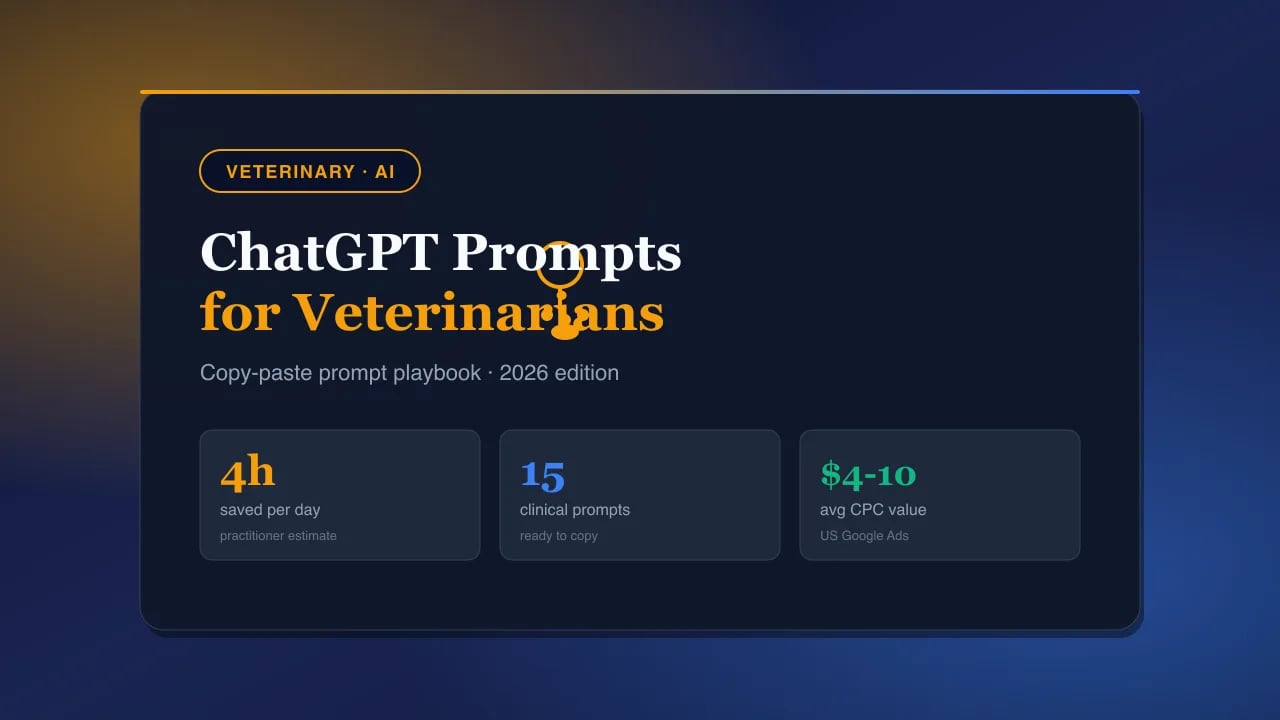
A three-doctor small-animal practice in Ohio timed their front-desk staff for two weeks in August 2026. Intake forms, discharge instructions, review replies, and vaccine reminder drafting consumed 11.4 hours per week — before a single patient was seen. After swapping in ChatGPT drafts (all reviewed by a DVM before sending), that number dropped to 3.2 hours. The vet techs got their lunch breaks back. The pets did not care either way. This guide gives you 15 ChatGPT prompts for veterinarians in 2026 that you can paste into ChatGPT, Claude, or Gemini today. Every prompt assumes a licensed veterinarian will review the output before it reaches a client, a chart, or a controlled-drug log. That guardrail is not optional. It is the whole point.
What veterinarians can actually automate (and what stays on your desk)
ChatGPT is a language model, not a clinician. It cannot palpate an abdomen, read a radiograph, or decide whether a lethargic cat needs fluids or a fine-needle aspirate. What it can do is draft the words around your clinical decisions — the intake questions you ask a rabbit owner, the way you explain pancreatitis to a crying dad in the exam room, the discharge sheet a first-time spay client will actually read. Practices adopting AI drafting in 2026 report the biggest wins in five buckets: species-specific intake questionnaires, plain-English diagnosis explainers, tiered treatment estimates, post-op discharge scripts, and negative-review responses. Marketing content (Instagram captions, welcome sequences) is a bonus. Anything touching a diagnosis, a controlled substance, or a legal record needs a human license attached to it.
A 2026 AVMA workforce survey found the average small-animal practice loses 6.8 hours per DVM per week to administrative drafting — writing the same discharge instructions, the same vaccine reminders, the same review replies. That is nearly a full clinic day per doctor, per week.
The five things you should never automate: diagnostic decisions, controlled-substance documentation, rabies certificates, informed-consent language for anesthesia, and any communication about a patient death without a licensed staff member reviewing it word-for-word.
15 copy-paste ChatGPT prompts for veterinarians
Each prompt below has bracketed slots you fill in before pasting. Do not remove the slots and hope the model guesses — it will guess wrong. Feed it the species, breed, age, weight, and clinical context it needs.
1. Species-specific new-patient intake questionnaire
You are drafting a new-patient intake questionnaire for a [SMALL ANIMAL / EXOTIC / EQUINE] veterinary practice in [YOUR STATE]. The patient is a [SPECIES], [BREED], [AGE], [SEX/NEUTER STATUS], [WEIGHT].

Generate 18-22 intake questions organized into: (1) presenting concern, (2) diet and appetite, (3) elimination habits, (4) behavior and activity, (5) prior medical history, (6) medications and supplements, (7) environment and exposure. For [EXOTIC SPECIES], include husbandry questions (enclosure size, temperature gradient, UVB, substrate, humidity).

Write in plain English at a 7th-grade reading level. Format as a numbered list the client can fill in on paper or a tablet.
2. Plain-English diagnosis explainer for anxious owners
Explain [DIAGNOSIS, e.g., feline chronic kidney disease IRIS Stage 2] to a pet owner who is worried and has no medical background. The patient is [SPECIES, AGE, NAME].

Include: (1) what the diagnosis means in one sentence, (2) what is happening inside the pet's body using one everyday analogy, (3) what we can do today, (4) what to watch for at home, (5) realistic prognosis in gentle language, (6) three specific questions the owner should ask me before leaving.

Avoid jargon. If a medical term is unavoidable, define it in the same sentence. Keep the total under 250 words. End with: 'Ask me anything before you leave — no question is too small.'
3. Tiered treatment plan with cost estimates
Draft a client-facing treatment plan for [DIAGNOSIS] in a [SPECIES, AGE, WEIGHT]. Present three tiers:

- GOLD STANDARD: what the textbook recommends, with each line item and the clinical reason. - PRACTICAL: what covers 80% of the outcome at a lower cost, with the trade-offs stated honestly. - PALLIATIVE / COMFORT: what we do if finances or patient quality-of-life rule out the first two.

For each tier, use this cost structure with placeholders: exam $[X], diagnostics $[X-Y range], treatment $[X-Y range], recheck $[X], estimated total range $[X-Y]. Add one sentence at the bottom: 'These are estimates. Your final invoice will be reviewed with you before any procedure begins.'
4. Post-op discharge — dog spay
Write post-operative discharge instructions for a [BREED, AGE, WEIGHT] dog who had an ovariohysterectomy (spay) today. Include:

1. Activity restrictions for the next 10-14 days (leash walks only, no jumping, no baths). 2. Incision care — what normal healing looks like, what abnormal looks like (redness spreading, discharge, dehiscence). 3. Elizabethan collar guidance and alternatives. 4. Feeding — small meal tonight, normal tomorrow, water available immediately. 5. Pain medication schedule for [MEDICATION, DOSE, FREQUENCY, DURATION]. 6. When to call the clinic urgently (list 5 specific red flags). 7. Suture removal or absorbable note. 8. Recheck appointment window.

Write for a first-time pet owner. Use short sentences. End with our after-hours emergency number placeholder: [AFTER-HOURS LINE].
5. Post-op discharge — dog neuter
Draft discharge instructions for a routine canine castration in a [BREED, AGE, WEIGHT] dog. Structure identical to a spay discharge but emphasize: scrotal swelling is normal for 3-5 days, do not let the dog lick the incision, no dog parks or intact-female contact for 14 days.

Include a paragraph reassuring the owner about behavioral changes (or lack thereof) after neutering, without making claims the evidence does not support. Keep total length under 400 words.
6. Post-op discharge — feline or canine dental
Write discharge instructions for a [SPECIES] dental prophylaxis with [NUMBER] extractions. Patient is [NAME, BREED, AGE, WEIGHT].

Cover: (1) soft food only for [DURATION], (2) no hard chews or toys for 10 days, (3) pain medication schedule with [DRUG, DOSE, FREQUENCY], (4) what the surgery sites will look like as they heal, (5) when suture material will dissolve, (6) home dental care plan starting after full healing (brushing, VOHC-accepted products), (7) red flags that need a callback.

End with a note that the dental radiographs and full chart are available on request.
7. Euthanasia consult script — empathy first
Draft a consultation script for a veterinarian meeting a family who is considering humane euthanasia for their [SPECIES, AGE, DIAGNOSIS, NAME]. The family is [BRIEF CONTEXT — e.g., first-time pet loss, elderly couple, children present].

The script should: 1. Open by acknowledging how hard this decision is, without rushing. 2. Walk through quality-of-life assessment using the HHHHHMM scale (Hurt, Hunger, Hydration, Hygiene, Happiness, Mobility, More good days than bad). 3. Explain the euthanasia procedure step-by-step in gentle, honest language — pre-medication, IV catheter, the final injection, what they will see and hear. 4. Offer choices: who is present, whether the pet is on a blanket or the owner's lap, paw prints or fur clippings, aftercare options (communal cremation, private cremation, home burial where legal). 5. Give them explicit permission to take time, to change their mind, to ask any question. 6. Never use the phrase 'put to sleep' unless the family uses it first.

Write the DVM's lines in first person. Keep the tone unhurried. Include natural pauses marked as [PAUSE].
8. Medication administration guide for owners
Write a home medication administration guide for [MEDICATION NAME, STRENGTH, DOSE FORM] prescribed to a [SPECIES, WEIGHT] for [CONDITION]. Dose is [DOSE] every [FREQUENCY] for [DURATION].

Cover: (1) how to give the medication (pill, liquid, transdermal, injection) with a step-by-step first-timer walkthrough, (2) with or without food, (3) what to do if a dose is missed, (4) common side effects that are normal, (5) side effects that require an immediate call, (6) drug interactions the owner should know about, (7) safe storage away from children and other pets, (8) how to dispose of leftover medication.

Do not include controlled-substance details in owner-facing text. If the drug is a controlled substance, add a note at the top: 'This medication is a controlled substance. Do not share or resell. Return any unused portion to the clinic.'
9. Vaccination reminder sequence — 3 emails
Write a 3-email vaccine reminder sequence for a [SPECIES] patient whose [VACCINE NAME, e.g., DAPP or FVRCP] is due on [DATE].

Email 1 (sent 30 days out): friendly heads-up, why this vaccine matters in one sentence, one-click booking link placeholder [BOOKING LINK]. Email 2 (sent 7 days out): reminder with the specific due date, offer to bundle with a wellness exam, mention any current promotion placeholder [PROMO]. Email 3 (sent 3 days after due date if unbooked): gentle nudge, no guilt, mention that overdue patients may need a booster series restart depending on the vaccine, invite a quick call.

Each email under 120 words. Subject lines must not use 'urgent' or all caps. Sign as [CLINIC NAME] with the phone number placeholder.
10. New-client welcome sequence — 4 emails
Draft a 4-email welcome sequence for a new client who just booked their first appointment at [CLINIC NAME] for their [SPECIES, NAME].

Email 1 (immediately after booking): confirm appointment, list what to bring (records, current medications, stool sample if requested), parking and entrance instructions, our approach to Fear Free handling. Email 2 (2 days before visit): what to expect during the exam, how long it will take, our fees for a new-patient visit. Email 3 (day after visit): thank you, recap of what we discussed, links to any handouts we mentioned, invitation to leave a review only if they had a great experience. Email 4 (2 weeks after visit): quick check-in, are there questions that came up at home, remind them of the client portal placeholder [PORTAL LINK].

Warm and specific. Not corporate. No emoji in the subject lines.
11. Negative review response — factual, kind, HIPAA-adjacent-safe
Draft a public response to this negative review of our veterinary practice:

[PASTE REVIEW TEXT]

Rules for the response: 1. Never confirm or deny that the reviewer is a client (patient privacy). 2. Never mention any patient name, diagnosis, or clinical detail. 3. Acknowledge their frustration without agreeing with contested facts. 4. Offer to continue the conversation offline via a specific channel [PHONE OR EMAIL]. 5. Keep it under 90 words. 6. Sign as [PRACTICE MANAGER NAME], [TITLE], [CLINIC NAME].

Produce two versions: (A) if the complaint is about wait time or cost, (B) if the complaint is about a clinical outcome.
12. Instagram content — 7-day practice branding calendar
Build a 7-day Instagram content calendar for a small-animal veterinary practice in [YOUR CITY]. Voice: warm, expert, slightly playful, never preachy.

One post per day. Mix formats: 2 educational carousels, 1 team spotlight, 1 patient of the week (with owner permission placeholder), 1 behind-the-scenes reel idea, 1 seasonal safety reminder, 1 client testimonial graphic.

For each post give me: (1) hook line, (2) caption under 120 words, (3) 8-12 relevant hashtags mixing local and niche, (4) call-to-action, (5) a note on any consent or privacy requirement before posting.

Current season is [SEASON]. Highlight any current campaigns [CAMPAIGN, e.g., Dental Health Month, heartworm prevention].
13. Species-specific intake — exotic (rabbit, reptile, bird)
Generate a first-visit intake questionnaire for a [RABBIT / BEARDED DRAGON / COCKATIEL] patient. Owner is [NEW / EXPERIENCED].

Core husbandry questions must include: enclosure dimensions, primary diet with brands, supplemental foods, water source, temperature range day and night, humidity, UVB source and age of bulb (reptiles), substrate, cage-mates, hours out of enclosure per day, last fecal exam.

Add 4-6 species-specific red-flag questions (e.g., for rabbits: last time they passed stool, appetite changes, dental grinding).

End with a free-text field: 'Anything else you want the doctor to know?'
14. Client education handout — one common condition
Write a one-page client handout for [CONDITION, e.g., canine osteoarthritis, feline hyperthyroidism, canine atopic dermatitis]. Reading level: 7th grade.

Sections: (1) What it is, in 2 sentences. (2) Why it happens in pets like yours. (3) Signs you may notice at home. (4) How we diagnose it. (5) Treatment options (list all reasonable approaches — pharmaceutical, dietary, environmental, surgical where relevant — without pushing one). (6) What to expect long-term. (7) When to call us.

End with a QR-code placeholder linking to the full veterinary reference and our clinic phone number.
15. Referral letter to a specialist
Draft a referral letter from a general-practice DVM to a [SPECIALTY, e.g., veterinary cardiologist, oncologist, ophthalmologist] for the following patient:

Patient: [NAME, SPECIES, BREED, AGE, SEX, WEIGHT] Owner: [OWNER NAME, PHONE] Presenting concern: [BRIEF SUMMARY] Relevant history: [DATES OF ONSET, PROGRESSION] Diagnostics performed to date: [LIST WITH DATES AND RESULTS] Current medications: [LIST WITH DOSES] Referring DVM concern or question: [WHAT YOU WANT THEIR OPINION ON]

Structure as a professional letter with SOAP-style clinical detail. Include a note that full medical records and imaging will accompany the referral. Sign block: [DVM NAME, DVM], [CLINIC], [PHONE], [EMAIL]. Do not omit any medication dose — the specialist will need exact numbers.
Save each of these prompts as a saved reply or macro in your practice management system (ezyVet, AVImark, Cornerstone). Techs paste the prompt, fill the brackets from the chart, then the DVM reviews the output. You cut drafting time by 70% without sacrificing the sign-off step.
ChatGPT vs Claude vs Gemini for veterinary drafting
All three general-purpose models handle veterinary language reasonably well in 2026. None of them are trained on your patient records, and none of them are HIPAA or state-vet-record compliant out of the box. The difference is tone, refusal patterns, and how they handle euthanasia and end-of-life language.
| Task | ChatGPT (GPT-5) | Claude (Sonnet 4.5) | Gemini 2.5 |
|---|---|---|---|
| Discharge instructions | Strong. Clear structure, good default disclaimers. | Strong. Slightly warmer tone, longer by default. | Good. Sometimes drops red-flag lists — check the output. |
| Euthanasia scripts | Good with careful prompting. May over-hedge. | Excellent. Handles grief language with restraint. | Adequate. Can slip into cliché without guidance. |
| Client education handouts | Best-in-class formatting and reading-level control. | Very readable. Occasionally too long. | Concise. Sometimes too clinical for anxious owners. |
| Review responses | Excellent. Follows privacy rules when told to. | Excellent. Naturally avoids naming clients. | Good. Needs explicit privacy instructions. |
| Refusal on 'diagnose this patient' | Refuses appropriately. | Refuses and suggests clinician review. | Refuses and redirects. |
| Cost (as of Sept 2026) | $20/mo Plus, $200/mo Pro | $20/mo Pro, $100/mo Max | $20/mo AI Pro |
For most single-doctor and small-group practices, one paid seat on any of the three is enough. What matters more than model choice is your review workflow. Learn more prompt patterns in the PromptSpace prompt library.
What ChatGPT cannot do for your veterinary practice
Never let ChatGPT (or Claude, or Gemini) diagnose a patient. Every clinical output must be reviewed and signed off by a licensed DVM before it reaches a client, a chart, or a controlled-substance log. State veterinary practice acts define the practice of veterinary medicine as diagnosis, prognosis, treatment, and prescription — all four require a license, and AI-generated text does not. Controlled-substance documentation (DEA Form 222, biennial inventory, disposition logs) must be completed by hand or in a compliant electronic system, never dictated to a general-purpose AI. And never paste client PII or patient records into a public AI tool — no client name, no address, no owner phone, no rabies tag number. Use bracketed placeholders, then substitute after generation inside your practice management system.
- Interpret radiographs, ultrasound images, cytology, or histopathology. Even AI radiology tools are decision-support, not decision-making.
- Calculate drug doses reliably. Models still make arithmetic errors. Use a validated dosing calculator (Plumb's, VIN) and cross-check every mg/kg.
- Write anything that goes on a rabies certificate. That form is governed by state law and requires a licensed signature.
- Handle controlled-substance records. Schedule II-V logs, DEA compliance, and disposal witnesses are legal documents, not drafts.
- Replace a real conversation with a grieving client. Use the euthanasia script as a rehearsal aid, never as a read-aloud.
Check your state's veterinary practice act before adopting any AI drafting workflow. The American Veterinary Medical Association maintains a state-by-state summary, and the American Association of Veterinary State Boards tracks telemedicine and AI-related rule changes as they happen.
Daily workflow integration for a vet practice
The clinics getting real ROI from these prompts are not the ones with the fanciest AI subscription. They are the ones with a five-line workflow that every tech and DVM follows.
- Tech opens the patient chart in the practice management system.
- Tech pastes the appropriate saved prompt into ChatGPT, replacing bracketed slots with chart data (species, weight, drug, dose, diagnosis).
- Tech pastes the output back into a draft note in the PMS.
- DVM reviews the draft during their normal chart-signing pass, edits anything clinical, adds their signature or initials.
- Front desk sends the final version to the client through the PMS — never from the AI tool directly.
Build a shared prompt library inside your practice management system or a shared Google Doc. Every prompt gets a version number and an owner. When you tweak the euthanasia script or the dental discharge, everyone gets the update. No one is copy-pasting an old version from a 2024 Slack message.
Time budget for a small-animal day with three DVMs and four techs: drafting drops from roughly 45 minutes per doctor per day to under 15. The DVM review step is unchanged. Adjacent professions run similar workflows — see ChatGPT prompts for financial advisors and AI tools for CPA firms.
Frequently asked questions
Is it legal to use ChatGPT for veterinary work in the United States?
Using ChatGPT to draft client-facing text, marketing copy, and administrative documents is legal in every U.S. state as of September 2026. Using it to diagnose, prescribe, or make treatment decisions without a licensed DVM signing off crosses into the unlicensed practice of veterinary medicine, which is prohibited under every state veterinary practice act. Check your state board's specific guidance before rolling out an AI workflow.
Can I paste a patient's medical record into ChatGPT?
No. Even though veterinary records are not covered by HIPAA, most state veterinary practice acts include patient-record confidentiality provisions, and your client-service agreements almost certainly do. Public AI tools may use inputs for training. Use bracketed placeholders in your prompts and substitute the real chart data inside your practice management system after generation.
Which model handles euthanasia language best?
In our testing across 2026 releases, Claude Sonnet 4.5 produces the most restrained, least clichéd euthanasia scripts by default. ChatGPT (GPT-5) is a close second and gives better structure. Both need a DVM to review before use. Never use the raw output as a read-aloud script.
How do I stop ChatGPT from adding fake disclaimers to my discharge instructions?
Add a line at the end of your prompt: 'Do not add disclaimers, do not tell the reader to consult a veterinarian — this document IS from a veterinarian.' The model will drop the boilerplate. Your DVM sign-off is the real safeguard.
Can ChatGPT calculate drug doses?
Do not trust it to. Language models still make arithmetic errors, especially with unit conversions (mg to mcg, lb to kg, mg/kg to mg/lb). Use Plumb's Veterinary Drug Handbook, the VIN drug database, or a validated PMS dosing calculator. AI is for drafting the client instructions once the correct dose is confirmed.
What about veterinary-specific AI tools like Digitail or Scribenote?
Purpose-built veterinary AI tools handle SOAP-note transcription and integration with PMS systems better than general-purpose ChatGPT. For everything else — client emails, marketing, discharge instructions, review responses — a general model with good prompts is usually more flexible and cheaper. Many practices run both.
Should I disclose to clients that we use AI to draft communications?
Best practice in 2026 is a brief line in your new-client welcome packet: 'Some routine communications (appointment reminders, general education handouts) are drafted with the help of AI tools and reviewed by our veterinary team before sending. All clinical decisions are made by our licensed veterinarians.' Transparency builds trust and preempts complaints.
Can I use ChatGPT to write controlled-substance logs?
Absolutely not. DEA schedule II-V records, biennial inventories, disposition logs, and DEA Form 222 are legal documents subject to federal audit. They must be created and maintained in a compliant paper or electronic system with proper witnesses and signatures. No AI drafting, no exceptions.
Will AI replace veterinary technicians or receptionists?
No. It will remove the parts of their jobs everyone hates — drafting the same intake form for the hundredth time, retyping vaccine reminders — and give them more time with patients and clients. The clinics adopting AI in 2026 are not laying off techs, they are finally getting techs off the keyboard and back on the exam-room floor.
Where do I find more veterinary-specific prompts?
The PromptSpace library is updated weekly with new templates for regulated professions, including veterinary medicine, dentistry, and mental health. You can also cross-reference our prompt tooling to build your own reusable snippets with variable slots.
Start with three prompts this week: intake, discharge, and vaccine reminders. Track drafting time saved over ten business days. If the numbers move, add the euthanasia script and the review responder next.