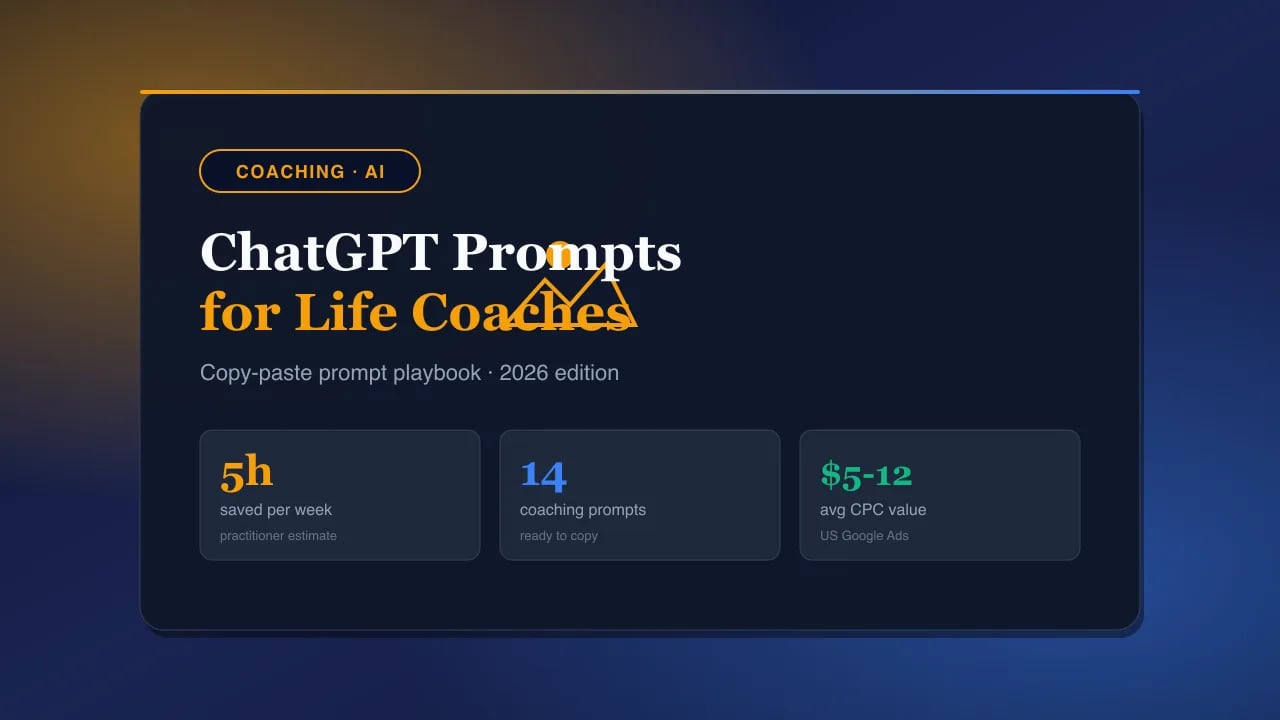
A solo life coach with 12 one-on-one clients spends roughly 9 hours a week on things that are not coaching. Discovery-call intake forms. Session recap emails. Weekly accountability nudges. Sales pages for the next cohort. Instagram carousels nobody asked for. The actual coaching, the 60 minutes where transformation happens, is the smallest slice of the calendar. ChatGPT prompts for life coaches in 2026 are not about replacing the coaching itself. They hand the paperwork to a very fast intern. This post gives you 14 prompts a working coach can paste into ChatGPT, Claude, or Gemini today. None try to do therapy.
What ChatGPT prompts for life coaches in 2026 can actually automate
Coaching itself is not automatable. The 60-minute container, the silence after a hard question, the moment a client hears their own contradiction, none of that lives in a language model. What does live there is every asynchronous artifact around the session. Here is the honest list of what ChatGPT prompts for life coaches in 2026 handle well:
- Discovery-call questionnaires tailored to the niche (career pivot, postpartum, executive, relationship)
- Values-clarification worksheets that go beyond the same 60-word Schwartz list
- Weekly accountability check-in templates that do not sound like a bank email
- Session-recap emails written in your voice within 90 seconds of hanging up
- Reframing scripts for difficult emotions that stay firmly inside coaching scope
- Q1 to Q4 goal-setting templates that survive contact with real life
- Group program launch sequences (waitlist, cart open, day-before, close)
- Testimonial capture prompts that produce quotes you can legally use
- Price-anchor sales scripts for $2k, $5k, and $10k packages
- Instagram carousel scripts written for the swipe, not the algorithm gods
Feed ChatGPT your last three session notes (with client names redacted) before you ask for a recap template. The model will match your actual tone instead of defaulting to LinkedIn-influencer voice. This one habit lifts every prompt in this post.
14 copy-paste prompts organized by task
1. Discovery-call questionnaire
You are helping a life coach who works with [NICHE, e.g. mid-career professionals considering a pivot] design a discovery-call intake form.

Write 12 questions the prospect fills in BEFORE the free 30-minute call. The questions should: - Surface the real problem underneath the stated goal - Reveal readiness (hours per week, budget range, timeline) - Filter out people looking for therapy or advice (both out of scope) - Include one open-ended question that reveals values without using the word values - End with logistics (time zone, preferred format)

Tone: warm, specific, no coach-speak. Avoid the words journey, transformation, unlock, potential. Output as a numbered list with a one-sentence rationale after each question in italics.
2. Values-clarification worksheet
Create a values-clarification worksheet for a client who is [BRIEF CONTEXT, e.g. leaving a 12-year finance career to open a bakery].

Structure: Part A: 8 prompts that surface values through past decisions, not lists (e.g. "describe a week in the last two years you would live again exactly the same") Part B: A sorting exercise using the client's own words from Part A Part C: Three integration questions that force the client to name where their current calendar contradicts their top three values

Completion under 40 minutes. Client-facing PDF, no coach jargon.
3. Weekly accountability check-in email
Draft a weekly accountability check-in email template for clients in my [PROGRAM NAME, e.g. 12-week Career Pivot Container].

Requirements: - Sent every [DAY, e.g. Sunday evening] - Under 120 words - Three sections: What you did (2 questions), What got in the way (1 question), What's the one thing for this week (1 question) - One line at the bottom: skipping a week is data, not failure - Sign-off in my voice: [PASTE 3 SAMPLE SIGN-OFFS FROM SENT FOLDER]

Output plain text for a scheduled email tool.
4. Session-recap email in 90 seconds
I just finished a coaching session with [CLIENT FIRST NAME]. Rough notes:

[PASTE 6-12 BULLETS FROM SESSION NOTEPAD]

Write a recap email that: - Opens with the one sentence that mattered most (client's words if quoted) - Lists 2-3 commitments the client named, in their language not mine - Includes one open question to sit with before next session - Attaches nothing, promises nothing outside our agreement - Signs off in my voice (warm, direct, no exclamation points)

Under 180 words.
5. Reframing script for a difficult emotion (coaching scope only)
A client is stuck in [EMOTION, e.g. resentment toward a former business partner] and it's blocking a decision about [SITUATION].

Write a reframing sequence I can walk them through in session. It must: - Stay strictly inside coaching scope (present, future, choice, action) - NOT process trauma, NOT diagnose, NOT interpret childhood - Include a clear STOP line: if the client reports [intrusive thoughts, sleep loss over two weeks, self-harm ideation, panic symptoms], I pause and refer to a licensed therapist - Offer 3 questions, not statements, that separate story from next action - End with the client choosing one 24-hour experiment

Format as a session script with my lines and expected client pause points.
6. Q1 through Q4 goal-setting template
Build a 2026 annual goal-setting template for a coaching client in [NICHE].

Four quarterly sprints, not a January wishlist: Q1 (Jan-Mar): One foundation goal, one visibility goal, one energy goal. Weekly review. Q2 (Apr-Jun): Mid-year audit built in. Keep, kill, double? Q3 (Jul-Sep): Rest and integration. One learning goal only. Q4 (Oct-Dec): One shipping goal, one relationship goal, one financial goal. Close-out ritual in December.

Each quarter: three goals, three leading indicators, one anti-goal (what you will NOT do), and a 15-minute Friday review prompt.

Output as a fillable worksheet.
7. Group program launch sequence (waitlist to close)
Write a 7-email launch sequence for my group program [PROGRAM NAME], [DURATION], [PRICE], starting [DATE].

Email 1: Waitlist thank-you, sets expectations Email 2 (cart open): Specific problem, one client story with permission, price and terms Email 3: Objection #1 (I don't have time) addressed honestly, not overcome Email 4: Objection #2 (coaching didn't stick before) addressed with the structural difference here Email 5: What's inside the weeks, with reading/homework time budget Email 6 (day before close): Payment plan reminder, honest note about who this is NOT for Email 7 (close day): Final hours, no false scarcity, clear next step for those who miss it

Voice: direct, no urgency theater, no "only 3 spots left" unless it's literally true.
8. Testimonial capture prompt (post-program)
Write a testimonial request email I send to clients 30 days AFTER their program ends, not the last day.

Include 5 questions designed to produce a quotable, specific testimonial (not "amazing experience"): 1. What were you trying to solve when you signed up? 2. What did you try before that didn't work? 3. What specifically changed in the last 90 days? (numbers if possible) 4. What would you say to someone on the fence? 5. Can we use your first name and last initial, full name, or keep it anonymous?

Add a permission checkbox for website, social, and sales pages. Reference GDPR/state privacy compliance in one line.
9. Price-anchor sales script for a $2,000 package
Write a sales conversation script for the end of a discovery call where I offer my [PACKAGE NAME] at $2,000 (6 sessions over 3 months).

- Recap the three things the prospect said mattered most (I'll fill live) - Present the package as ONE option, not the only option - Anchor: mention my $5,000 6-month and $10,000 year-long FIRST, then land on $2k as the entry point - Payment: pay-in-full or 3 monthly, no interest - After stating price: "[PAUSE - do not fill the silence]" - Handle two objections: "I need to think about it" and "Can you do a lower price?" - For the price objection, offer a smaller scope (3 sessions, $1,100) NOT a discount

No pressure language. No "this offer expires." A real coach's voice.
10. Price-anchor sales script for a $5,000 package
Same structure as the $2k script, but for the $5,000 6-month container (12 sessions, WhatsApp support Mon-Thu, one 90-min deep-dive quarterly).

Additions: - Explain what WhatsApp support IS and IS NOT (24h response Mon-Thu, not therapy, not crisis) - Anchor UP to the $10k year-long before landing here - Address the $5k buyer objection: "why not just do 3 months at $2k twice?" (answer: continuity, quarterly deep-dives, and the accountability curve after month 3 is where most change lands) - 15-day exit clause, prorated refund, stated up front
11. Price-anchor sales script for a $10,000 package
Sales script for my $10,000 12-month container. Prospect is either a founder/exec earning $250k+ or a career-pivoter with real savings runway. Do not sell to someone who cannot afford it comfortably.

- Open by asking what they've invested in themselves in the last 3 years (coaching, therapy, courses, retreats). Under $3k lifetime, this package is likely wrong for them; the script says so out loud. - 24 sessions, WhatsApp, quarterly in-person or full-day virtual intensive - Payment: pay-in-full ($9,000, save $1k) OR 12 monthly ($833) - Anchor DOWN from a $25k mastermind or $50k executive-coaching benchmark, cite the market honestly - Handle the top objection: "Is a year too long?" — 12 months lets you fail, integrate, and stabilize; anything shorter is a workshop.

End with the client sleeping on it. No same-day close.
12. Instagram carousel script (educational, not salesy)
Write a 10-slide Instagram carousel for a life coach in [NICHE].

Topic: [SPECIFIC PAIN POINT, e.g. "why your Sunday-night dread is data, not a character flaw"]

Rules: - Slide 1: Hook with a specific number or contradiction ("73% of my career-pivot clients quit within 90 days of a raise, not before it") - Slides 2-8: One idea per slide, under 40 words each, one concrete example per slide - Slide 9: The reframe or tool (one thing they can try tonight) - Slide 10: Soft CTA — link in bio to free discovery call OR values worksheet freebie, not "DM me for coaching"

Write on-slide copy AND caption (150-word max). Caption ends with a question that gets non-hollow replies.
13. Instagram carousel: client story (with permission)
I have written permission from a client to share their story. Facts (anonymize as needed):

[CLIENT SITUATION IN 4-6 BULLETS: what they came in with, what they tried before, what shifted, what they did, where they are now, what surprised them]

Build a 10-slide carousel that tells this story without turning it into a testimonial ad. Slide 1 hooks with the moment of decision, not the outcome. Middle slides walk through the messy middle. Slide 9 is what the client would tell their past self. Slide 10 is a soft CTA to the discovery-call waitlist.

Do not use the word transformation. Do not use before/after framing. Do not exaggerate income or weight numbers.
14. Difficult conversation script (client wants to quit mid-program)
A client 6 weeks into a 12-week program has emailed to pause or stop. Their reasons: [PASTE THEIR WORDS].

Write my reply that: - Acknowledges what they said in one paragraph, no coach-splaining - Names the two most common reasons clients quit mid-container: (a) it's working and the discomfort is real, (b) it's genuinely not the right container - Offers three options: continue as-is, pause for 30 days with a hard restart date, or close it out with a final integration session - Includes the refund policy plainly - Ends with a specific question, not "let me know your thoughts"

Under 250 words. No guilt, no pressure, no save-the-sale energy.
Save your best 4 prompts as a custom GPT or a Claude Project with your voice samples, package prices, and refund policy already loaded. You stop pasting the same context every time. A 20-minute setup once beats retyping [YOUR NICHE] 200 times a year.
ChatGPT vs Claude vs Gemini for coaching admin
The three big models are not equally good at coaching-adjacent work. Tone differences alone save or cost an hour of editing per week. Here is what holds up in 2026 after running the same prompts through all three.
| Task | ChatGPT (GPT-5) | Claude (Sonnet 4.5 / Opus) | Gemini (2.5 Pro) |
|---|---|---|---|
| Session recap emails in your voice | Strong once fed 3+ voice samples | Best out of the box, less coach-jargon default | Decent, tends toward corporate polish |
| Values worksheets | Excellent structure, sometimes generic | Warmer, more human phrasing | Fastest, weakest at nuance |
| Sales scripts ($5k+) | Best; handles anchor logic cleanly | Good; refuses aggressive tactics (a feature) | Weakest; slides into hype |
| Instagram carousels | Best hook-writing | Best captions | Best hashtag research |
| Scope-of-practice guardrails | Solid with explicit instruction | Strongest default guardrails, refuses therapy-adjacent asks cleanly | Inconsistent |
| Free tier usefulness | Limited GPT-5 access | Generous Claude Sonnet free tier | Most generous free access |
| Monthly cost for a solo coach | $20 (ChatGPT Plus) | $20 (Claude Pro) | $20 (Gemini Advanced) or free |
The Anthropic and OpenAI models both explicitly train against providing therapy, medical advice, or crisis counseling. When you write a prompt that asks either model to "help a client process trauma," both will hedge or redirect. That refusal is a feature. It matches the ICF ethics code you already agreed to follow.
What ChatGPT cannot do for a life coach (and why that's fine)
Coaching is NOT therapy. This is not a soft distinction, it is a scope-of-practice line that protects clients and protects your business. The ICF Code of Ethics (sections 4.14 and 4.15) requires you to refer any client showing symptoms of mental-health conditions to a licensed mental-health professional. If a client discloses suicidal ideation, self-harm, active substance abuse, persistent panic symptoms, disordered eating, intrusive thoughts, or any diagnosed condition they are not currently treating, you refer. You do not coach through it. You give them the number of a licensed therapist or, in a crisis, 988 in the US or the equivalent in your country. Any prompt in this post that touches emotion is designed for present-and-future choice work only. Simulating therapy with these prompts puts you outside your scope and outside your insurance.
- Hold confidentiality the way you can. Anything you paste is processed by the provider. Redact names, exact numbers, and identifying details from every prompt.
- Replace a supervisor or mentor coach. ICF-credentialed coaches need mentor coaching hours; a language model is not a mentor.
- Assess crisis. It hedges on suicide-risk language but is not trained as a crisis responder.
- Know your local regulations. Some US states, Canadian provinces, and EU countries restrict what unlicensed coaches can call themselves and charge for. Verify with a lawyer familiar with coaching regulations in your jurisdiction.
- Write anything you have not read. Never send an email you have not reviewed word by word.
Before you paste ANY client information into ChatGPT, strip it: replace real name with [CLIENT], remove employer names, round income and revenue numbers to the nearest $50k. If you would not want a stranger reading it over your shoulder at a coffee shop, do not paste it verbatim.
Workflow: embedding these prompts into a real coaching week
A prompt library only saves time if it lives where the work happens. Coaches who spend one Saturday morning wiring the prompts into calendar, email, and CRM save 6 to 8 hours the following week and every week after. Here is a working week for a solo coach with 10 to 15 one-on-one clients and one group program in launch:
- Monday morning (30 min): Run the weekly check-in prompt on last week's data. Send Sunday-evening check-ins on Sunday so replies land before your first session.
- Right after each session (2 min): Voice-note session bullets, paste into the recap prompt, review, send. Under 5 minutes from hanging up to email sent.
- Wednesday deep-work block (2 hours): Content batch. Run 3 carousel prompts, edit, schedule for the week.
- Friday admin block (1 hour): Discovery-call intake reviews. Testimonial-request emails to clients who wrapped 30 days ago.
- Monthly (2 hours, first Monday): Regenerate anything stale. Audit which prompts you actually used.
- Quarterly (half day): Rerun the Q1-Q4 goal template on your own business, not just clients. Coaches with unclear goals sell fuzzy packages.
The whole system lives in three places: a Notion or Obsidian doc with all 14 prompts and your filled-in slots, a Claude Project or custom GPT loaded with your voice samples, and a scheduled block in your calendar for content batching. Anything more elaborate is procrastination dressed as productivity.
Track a single metric for 90 days: hours-per-week on admin. Log it every Friday. If ChatGPT prompts do not cut that number by at least 30% after two months, either the prompts are wrong for your niche or you are not actually using them. Both are fixable. Vague enthusiasm is not.
For adjacent professional-services playbooks, see the ChatGPT prompts for financial advisors guide and the best AI tools for CPA firms breakdown. Both cover client-facing prompt scope in regulated fields and translate directly to a coaching practice. The full library of copy-paste prompts across niches lives at promptspace.in/prompts.
FAQ: ChatGPT prompts for life coaches in 2026
Is it ethical for a life coach to use ChatGPT for client work?
Yes, for admin and content work. Recaps, worksheets, sales copy, and marketing are fair game. It stops being ethical the moment you paste identifying client details without consent, use the model to simulate therapy, or represent AI-generated insights as your professional assessment. Disclose AI use in your intake agreement.
Do I have to tell clients I use ChatGPT?
Add one line to your coaching agreement stating you use AI tools for scheduling, drafting communications, and content, and that no identifying client information is shared without consent. For anything client-specific pasted into ChatGPT, get explicit written permission first.
Which ChatGPT plan should a solo life coach get?
ChatGPT Plus at $20/month is enough for a solo practice under 20 clients. You get GPT-5 access, custom GPTs, and file uploads. If you are pre-revenue, the free tier of Claude will handle most of what this post describes.
What if a client asks whether their coaching session was written by AI?
Tell them the truth. The session itself was not; the recap email may have been drafted with AI and edited by you. Frame it as how a modern service business runs, no different from a doctor whose office uses templated reminders. Coaches who hide it lose trust when it comes out.
What happens if a client discloses something serious during a session?
You stop the coaching conversation and shift to a referral conversation. The ICF ethics code (4.14) requires it. Keep a short list of licensed therapists in your area or on your telehealth roster, ideally two or three you have vetted. Warm-hand the client over. Then decide together whether coaching pauses or continues alongside treatment. Never use ChatGPT to draft a script for a mental-health crisis. That is what 988 (US), 116 123 (Samaritans UK), or your national equivalent is for.
How do I keep my voice from sounding like every other AI-generated coach on Instagram?
Feed the model your own writing before you ask it to write for you. Three to five voice samples (a real email, a caption you wrote at 11pm, a note-to-self) beats every prompt-engineering trick. Then edit ruthlessly. If a sentence sounds like a LinkedIn carousel, cut it.
Is it safe to paste session notes into ChatGPT?
Only redacted notes. Replace names, employers, exact income figures, and any diagnosis language before pasting. Turn off model training in Data Controls. For highly sensitive material, use the API with zero-retention settings or run a local model. The consumer chat interface is not built for HIPAA or strict GDPR data.
What is the single highest-leverage prompt in this post?
The session-recap email (prompt 4). A working coach sends 40 to 60 recap emails a month. Cutting each from 15 minutes to 5 saves 7 to 10 hours a month. That is one extra paying client's worth of time from a single prompt. Start there.
Fourteen prompts, one afternoon of setup, and a working coach reclaims most of a workday every week. The coaching itself stays yours. The paperwork stops eating the calendar. That is the whole trade in 2026.