A senior planner in Charleston tracked her August workload for six weeks and found that 31% of her billable time went to writing the same five emails: vendor RFPs, timeline confirmations, RSVP nudges, contract explainers to nervous couples, and post-wedding thank-yous. Not the creative work. Not the site walks. The typing.
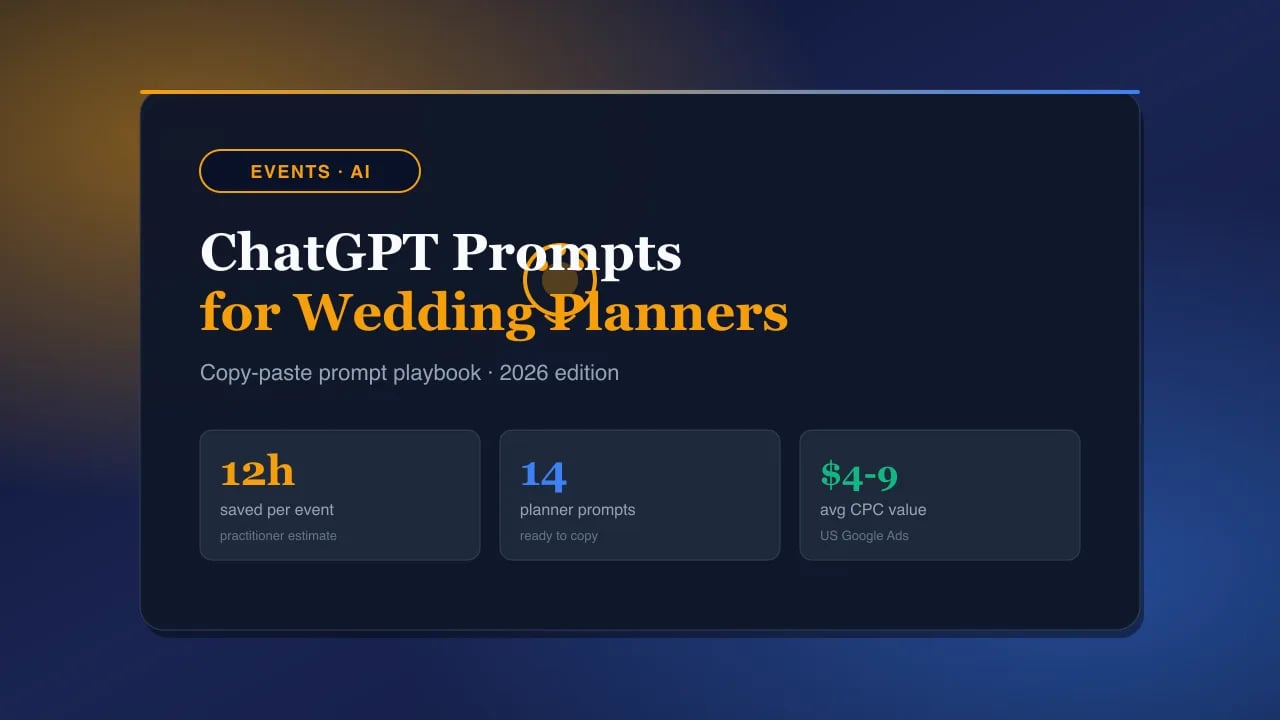
That is exactly the wedge ChatGPT fits into. Not the taste calls, not the vendor relationships, but the repeatable writing that eats a Tuesday afternoon. The 14 ChatGPT prompts for wedding planners in 2026 below are the ones our readers have flagged as the highest-leverage: intake intake calls, vendor RFPs across florist/venue/caterer/DJ, day-of timelines, tiered budgets at $15k/$30k/$60k, family dynamics scripts, RSVP wrangling, weather contingencies, and a full post-wedding thank-you sequence. Paste them, fill the brackets, ship.
What wedding planners can actually automate with ChatGPT
Start with what ChatGPT is good at: draft-quality writing with a house voice, first-pass logistics under constraints, and reformatting the same information for five different audiences. It is not good at picking your florist, negotiating a rain-date clause, or knowing whether your caterer is actually licensed. Keep the split clean and the tool earns its seat.
The tasks that reliably automate for planners in 2026:
- Intake call agendas and follow-up recaps
- Vendor RFPs and comparison summaries once quotes come back
- First-draft day-of timelines from a filled intake form
- Budget allocation frameworks by tier and region
- Difficult-conversation scripts (divorced parents, plus-one denials, cultural blends)
- Contract plain-English explainers for couples reading their first vendor agreement
- RSVP chase sequences (text, email, DM) with tone control
- Weather and force-majeure contingency plans
- Post-wedding thank-you sequences to couples, vendors, and referral sources
- Instagram content calendars pulled from a real event calendar
Feed ChatGPT the couple's intake form, the venue's known quirks, and your house style guide in the same session. Everything you generate afterward inherits that context. Skip this and every output sounds like a stock magazine article.
14 copy-paste prompts organized by wedding task
1. Initial consult intake call agenda
You are my senior associate at a full-service wedding planning firm based in [YOUR CITY]. Build a 45-minute discovery call agenda for a couple named [COUPLE NAMES] getting married on [WEDDING DATE] with an all-in budget of [BUDGET]. Their venue is [VENUE OR TBD], guest count target is [GUEST COUNT], and the vibe words they used on the inquiry form were [3-5 VIBE WORDS]. Structure the agenda in five sections: rapport (5 min), vision and non-negotiables (15 min), logistics and constraints (15 min), scope and pricing conversation (7 min), next steps (3 min). Under each section give me the exact questions to ask, plus one follow-up probe per question. End with a two-sentence recap I can send them by email within 24 hours. Voice: warm, specific, no wedding-industry cliches.
2. Post-consult follow-up recap email
Draft a follow-up email from [PLANNER NAME] to [COUPLE NAMES] after today's discovery call. Include: a one-line thank-you referencing something specific they said about [DETAIL FROM CALL], a bulleted recap of their three biggest priorities, a bulleted recap of the three constraints we agreed on, the two package options I proposed with pricing at [TIER 1 PRICE] and [TIER 2 PRICE], and a clear next step with a proposed decision date. Keep it under 220 words. Sign-off should feel like a real person, not a template.
3. Florist RFP email
Write an RFP email to [FLORIST NAME] for the [COUPLE LAST NAME] wedding on [DATE] at [VENUE]. Guest count is [NUMBER] across [NUMBER] tables. The couple's palette is [COLORS] and the vibe references are [2-3 REFERENCES OR PINTEREST BOARD LINK]. We need pricing on: bridal bouquet, [NUMBER] bridesmaid bouquets, [NUMBER] boutonnieres, ceremony arch florals (freestanding, no venue attachment), [NUMBER] centerpieces split between low and elevated, and one statement installation for the bar. Ask them to confirm setup and strike times, delivery fee, and their standard payment schedule. Include our decision date of [DATE] and mention we are comparing three vendors. Keep it professional and direct, five short paragraphs maximum.
4. Venue RFP email
Draft an RFP email to [VENUE CONTACT NAME] at [VENUE] for a [SEASON] wedding on [DATE OR DATE RANGE]. Ceremony and reception on-site, [GUEST COUNT] guests, [SEATED DINNER OR STATIONS]. Ask for: rental fee for the specific rooms we want ([ROOM NAMES]), included hours, overage rate per hour, in-house catering minimum or outside caterer policy, bar options and corkage, parking or shuttle logistics, and any preferred-vendor requirements. Request their most recent floor plans and load-in map. Mention we are a full-service planning firm and will be the primary point of contact through the contract. Ask for a hold if they can offer one. Six paragraphs, professional but not stiff.
5. Caterer RFP email
Compose an RFP to [CATERER NAME] for the [COUPLE LAST NAME] wedding on [DATE] at [VENUE]. Guest count [NUMBER], seated three-course dinner with two entree options, one vegetarian and one [DIETARY REQUIREMENT]. Cocktail hour: passed hors d'oeuvres, four selections, plus one stationary display. Bar: [BEER AND WINE OR FULL BAR] for [NUMBER OF HOURS]. Ask them for: per-person food pricing at three tiers, bar packages with brand tiers, staffing ratios and gratuity structure, rental inclusions vs add-ons (linens, china, glassware), and their standard cancellation and force-majeure language. Request one sample menu at each tier. Decision date [DATE]. Keep it tight.
6. DJ or band RFP email
Write an RFP email to [DJ OR BAND NAME] for a [DATE] wedding at [VENUE]. Guest count [NUMBER], vibe words are [VIBE WORDS], and the couple's must-play list leans [GENRE]. Coverage needed: ceremony (processional, recessional, prelude), cocktail hour (one hour), reception (four hours including intros, first dance, parent dances, cake cutting, open dancing). Ask for: pricing for the coverage window, overage rate, MC services, equipment provided (speakers, subs, wireless mics, uplighting), backup gear policy, and their do-not-play consultation process. Confirm they've worked at [VENUE] and ask about load-in access. Five paragraphs.
7. Day-of timeline first draft
Build a day-of timeline for [COUPLE NAMES] on [DATE] at [VENUE]. Ceremony start at [TIME], reception ends at [TIME]. Wedding party size [NUMBER], guest count [NUMBER]. Getting ready location is [ON-SITE OR OFF-SITE, ADDRESS]. Photographer coverage starts at [TIME]. First look [YES/NO]. Include vendor arrival times, hair and makeup schedule with buffer, first-look and family photo blocks, ceremony rehearsal check-in, cocktail hour, reception timeline down to five-minute increments for toasts, first dance, dinner service, cake, bouquet toss (or skip), last dance, and vendor strike. Add a right-hand column with the responsible party for each block: planner, photographer, DJ, venue. Output as a table.
8. Budget allocation across three tiers
Create three budget breakdowns for a wedding in [CITY, STATE] with [GUEST COUNT] guests: one at $15,000 total, one at $30,000 total, one at $60,000 total. For each tier, allocate by line item: venue and rentals, catering and bar, photography, videography, florals, music, attire, invitations and stationery, hair and makeup, transportation, planner fees, gratuities and taxes, and a 10% contingency. Give a percentage AND a dollar figure per line. After each tier, add a two-sentence note on what the couple realistically gets at that level (e.g., $15k = 60 guests brunch reception, DIY florals) and one line on the most common regret at that tier. Output as three side-by-side tables.9. Difficult family dynamics communication template
Draft a message the couple can send to [FAMILY MEMBER, e.g., FATHER OF THE BRIDE] about [SITUATION, e.g., his new partner being seated at the parents' table when the bride's mother has asked for distance]. The goal is to hold the boundary the couple has already decided on while acknowledging the family member's feelings. Do not negotiate the decision itself. Three paragraph options: one warm, one neutral, one firm. Each under 150 words. No apologizing for the decision, no over-explaining. Include a suggested delivery channel (text, call, in-person) and timing.
10. Contract plain-English explainer for nervous couples
The couple just received a [VENDOR TYPE] contract and is anxious about signing. Read the pasted contract below and produce a plain-English summary they can understand in five minutes. Cover: what they are paying and when, what happens if they cancel, what happens if the vendor cancels, force-majeure and weather language, liability and insurance requirements, any exclusivity or preferred-vendor clauses, and anything that is unusual for this vendor category. Flag any clause that would make me, as their planner, push back before they sign. End with three questions they should ask the vendor before signing. Do NOT give legal advice; recommend they run anything unusual past an attorney. Contract: [PASTE FULL CONTRACT TEXT].11. RSVP wrangling sequence (three touches)
Write a three-message RSVP chase sequence for guests who have not responded by [RSVP DEADLINE] for the [COUPLE NAMES] wedding on [DATE]. Message 1 (email, sent day after deadline): friendly, assumes they forgot, one-click RSVP link, 60 words max. Message 2 (text from couple, sent five days later): casual, direct, mentions the caterer needs a final count, 40 words max. Message 3 (phone or DM from a bridesmaid or groomsman, sent ten days later): warm but explicit that non-response will be counted as a decline. Give the exact script for each. No guilt-tripping. No passive aggression.
12. Weather contingency plan draft
Draft a weather contingency plan for an outdoor ceremony on [DATE] at [VENUE, ADDRESS]. The tent option seats [NUMBER] with a [SIZE] frame tent. Decision deadline for calling the tent is [HOURS] before ceremony. Include: three weather triggers (rain probability, wind speed, temperature) with specific thresholds; the exact call-tree order (planner to couple to venue to rental company to caterer); a communication template to send guests the morning of if we move indoors; and a same-day timeline shift showing what changes if we tent by 8am on wedding day. Also list what does NOT change (photography, catering flow) so the couple stays calm.13. Post-wedding thank-you sequence
Write a three-part post-wedding thank-you sequence to be sent by [PLANNER NAME]. Message 1 (to the couple, sent 48 hours after the wedding): personal, references one specific moment from the day, includes next steps on preserved florals or the gallery timeline, 180 words. Message 2 (to each key vendor: photographer, florist, caterer, DJ, venue): 90 words each, specific to what they did well that day, opens the door to future referrals. Message 3 (to the person who referred the couple to us): 100 words, warm, mentions the couple by first name, includes a small referral thank-you gesture. Do not use the words 'blessed' or 'humbled.'
14. Instagram content calendar from real events
Build a 30-day Instagram content calendar for [PLANNER STUDIO NAME] using the following upcoming and past events: [LIST 3-5 WEDDINGS WITH DATE, VENUE, SEASON, PALETTE]. Mix content types across: sneak peeks (day-of previews before the gallery drops), full feature carousels (once photographer delivers), vendor spotlights (tag partners), behind-the-scenes reels (setup, breakdown, timeline binder shots), educational posts (one budget tip, one timeline tip, one vendor question per week), and one Q&A story series per week. Assign each post a specific date, format (reel, carousel, single, story), and a first-line hook. Do not use hashtag lists over 8 tags. Do not schedule more than five posts per week.
Wedding planners who use AI for administrative drafting report 4-6 hours saved per event on average, based on informal 2025 surveys inside industry Facebook groups. The savings concentrate in vendor communication and post-event follow-up, not in creative design work.
ChatGPT vs Claude vs Gemini for wedding planning work
The three major models handle wedding-specific tasks differently. ChatGPT-5 is strong at structured outputs like timelines and budget tables. Claude Sonnet 4.5 tends to write more human vendor emails with fewer stock phrases. Gemini 2.5 wins on multimodal work: dropping in a venue floor plan PDF and asking for a floor layout is genuinely useful. Pick based on the specific task, not on loyalty to one platform.
| Task | ChatGPT-5 | Claude Sonnet 4.5 | Gemini 2.5 |
|---|---|---|---|
| Day-of timeline tables | Best | Good | Good |
| Vendor RFP emails | Good | Best | Good |
| Family conflict scripts | Good | Best | Fair |
| Budget spreadsheets | Best | Good | Good |
| Reading a contract PDF | Good | Best | Good |
| Floor plan and venue images | Good | Fair | Best |
| Instagram captions with brand voice | Good | Best | Fair |
| Long client questionnaires (200+ Qs) | Good | Best | Good |
For most planners running a solo or two-person studio, one paid ChatGPT seat plus a free Claude account covers 90% of what you need. Add Gemini when a venue sends you a PDF-only floor plan.
Save your house voice as a Custom GPT or a Claude Project. Paste in three real past emails you wrote, your booking process document, and a list of phrases you refuse to use. Every generation after that inherits your voice, and you stop editing every draft from scratch.
What ChatGPT cannot do for wedding planning
The failure modes are consistent and worth memorizing before a couple gets a wrong answer.
It cannot read a contract for legal risk. A plain-English summary is not the same as a legal review. Force-majeure and indemnification clauses have been rewritten across the industry after 2020, and a model trained on older templates will miss the new language. Recommend the couple use an attorney for anything over $10,000 in commitment.
It cannot verify vendor licensing or insurance. If ChatGPT tells you a caterer in your state needs a specific permit, verify with the actual state agency before you rely on it. Hallucinated regulatory citations are the single most common failure in this category.
It cannot negotiate for you. It can draft a counteroffer email. It cannot read the room, hear a florist's tone, or know that your venue's sales manager just lost her third booking this week and would take $2k off the site fee if you asked warmly.
It cannot check its own math. Budget outputs frequently misadd by 3-8%. Always run the totals through a calculator or spreadsheet before showing a couple.
It cannot replace on-site judgment. The rain call at 6am on wedding day is a human decision, not a model output.
Contract law, ethics, and insurance: The contract explainer prompt in this post is a translation tool, not legal advice. Every couple signing a vendor contract over a few thousand dollars should have an attorney review it, especially force-majeure and cancellation language. On vendor kickbacks: accepting undisclosed commissions from preferred vendors is a breach of fiduciary trust with your couples and, in some jurisdictions, a violation of consumer protection law. Disclose every referral fee in writing before the couple books, or refuse the commission. On insurance: recommend every couple carry a wedding-specific event insurance policy (typically $150-$400 for cancellation and liability coverage), and confirm your own planning business carries at minimum general liability and professional liability coverage. Do not rely on a venue's policy to cover your risk.
Workflow integration: how to embed these prompts
The prompts do not save time if you paste them from a blog post every Tuesday. Set up the workflow once and it runs itself.
Step 1: Build one master prompt library
Save all 14 prompts inside a single Notion page, an Airtable base, or the Custom GPT interface. Tag each by phase: inquiry, contracted, planning, week-of, post-wedding. Every planner and associate in your studio pulls from the same library.
Step 2: Feed context once, reuse everywhere
At the start of every couple's engagement, run a single ChatGPT session where you paste their signed intake form, their contract, their vendor list, and your studio style guide. Save that thread. Every prompt for that couple runs inside that thread so the model remembers everything.
Step 3: Edit for voice, always
Never send a raw ChatGPT output to a couple or vendor. Edit for 3-5 minutes minimum: cut one adjective per paragraph, add one specific detail only you know, replace one generic phrase with your studio's actual voice.
Step 4: Track what actually saves time
Log the tasks you delegate to AI for one month. Kill any prompt that does not clearly save at least 15 minutes per use. The library should shrink, not grow.
Ready to plug these into a broader system? The PromptSpace prompt library has 400+ vetted prompts across event and business categories, and our guides on ChatGPT for financial advisors and AI tools for CPA firms show the same workflow patterns applied to adjacent service businesses. For calendar and email automation on top of these prompts, PromptSpace Tools pairs well.
The underlying models change every few months. OpenAI publishes model updates at openai.com, and Anthropic ships Claude updates at anthropic.com. For wedding industry standards on contracts and ethics, the Association of Bridal Consultants and comparable regional bodies publish ethics guidelines worth reviewing annually.
Frequently asked questions
Will couples know I used ChatGPT to write their emails?
Only if you send raw output. Edit for voice, add one specific detail the model could not know (a reference to a call, a joke from the tasting), and the seams disappear. The tell is generic phrasing, not the tool itself.
Which ChatGPT plan do I need?
ChatGPT Plus ($20/month) handles everything in this post. The Team or Business plans matter if you have associates and want shared prompts and workspace-level data controls. Free tier works for testing but hits limits fast during a busy season.
Can I use ChatGPT to write the couple's vows?
Do not offer this as a service. Vows are the one piece of writing that has to be theirs. You can point couples to their own use of AI as a brainstorming tool, but keep your studio out of the drafting.
How do I keep client data private when using ChatGPT?
Turn off chat history in ChatGPT settings, or use the Team/Enterprise plan which excludes your data from training by default. Never paste social security numbers, full payment card data, or scanned IDs. Contract text, names, and addresses are lower-risk but still worth minimizing.
Does ChatGPT know current vendor pricing in my market?
No, and do not trust it if it offers one. Pricing data in the model is a rough national average at best and often 12-18 months stale. Always cross-check against real recent quotes from your own vendor network.
What is the biggest mistake planners make with AI?
Over-delegating the relational work. The intake call itself, the walk-through, the vendor phone call before signing. That is where the trust gets built. AI belongs in the writing that surrounds those moments, not inside them.
Can I use these prompts for corporate events or bar mitzvahs?
Most transfer with a few word swaps. The RFP structures, timelines, and post-event thank-you sequences map cleanly. Family dynamics scripts and RSVP wrangling need heavier rewriting for non-wedding contexts.
How often should I refresh my prompt library?
Twice a year, timed to your slow season. Model behavior changes, your studio voice drifts, and prompts written 18 months ago start generating outputs that feel dated. A one-hour audit every six months keeps the library sharp.
Do I need to disclose AI use to my couples in the contract?
Not legally required in most US states as of 2026, but disclosure builds trust. A one-line note in your services agreement (something like 'we use AI tools to draft administrative communications, which we edit and approve before sending') is clean and defensible.
What is the ROI on setting up this workflow?
Most planners recover the setup time (roughly 6-8 hours to build the library and context threads) inside the first two events. Sustained savings run 4-7 hours per wedding, or roughly $400-$700 in billable time reclaimed per event at typical planner rates.
Fourteen prompts, one voice, four hours back per event. Start with the RFP set this week, the timeline builder next week, and the thank-you sequence right after your next Saturday. The library compounds fast.