Krea 2 AI Image Generator: Best Prompts & Workflows (2026)
On July 7, 2026, a single post — "Tifa in Krea 2" — hit 625 upvotes on r/StableDiffusion and never left the top spot. Seven of the day's ten most-upvoted posts mention Krea 2. Another post, "Krea V2 Understands Camera Settings," gained 72 upvotes within hours of going live. And on HuggingFace, 1,503 community LoRAs for Krea 2 dropped on the same day. That's not hype — that's a community finding a model that actually does what it promises.
This guide covers everything worth knowing about Krea 2: what makes it different, the camera settings feature that's changing how artists prompt, 15 ready-to-use prompts across four style categories, how it compares to Midjourney V8 and ChatGPT image generation, how to run it free in ComfyUI, and where to find those 1,500+ LoRAs.
Table of Contents
What Is Krea 2 and Why Everyone's Switching
Krea 2 is a new open-source AI image generation model built with a fundamentally different architecture from the models that preceded it. Where SDXL relied on CLIP text encoders with limited language understanding and FLUX (Black Forest Labs) improved coherence through a rectified flow transformer, Krea 2 goes a step further — it uses Qwen3-VL as its text encoder.
That matters enormously. Qwen3-VL is a large vision-language model, not a narrow text encoder trained on image-caption pairs. It understands context, relationships, and nuance the way a language model does. The practical result: prompts that would confuse SDXL or produce generic outputs in FLUX are understood by Krea 2 with precision.
The difference compared to Z-Image Turbo and similar distilled fast-inference models is equally stark. Turbo-class models trade quality for speed. Krea 2 prioritizes fidelity — it generates at a pace closer to full FLUX inference, but the output quality in faces, hands, lighting, and complex compositions is noticeably higher. Early community benchmarks show Krea 2 matching or exceeding FLUX 1.1 Pro in portrait coherence while handling detailed multi-element scenes more cleanly.
The open-source release is significant. Unlike Midjourney — which remains closed and subscription-locked — Krea 2 weights are downloadable, runnable locally, and extendable via LoRAs. That's why the community adoption was instant.
Krea 2's Camera Settings Mode — The Feature That Changes Everything
The single most-discussed capability in Krea 2 right now is its native understanding of photography language. Not just the words — the actual technical relationships between camera parameters.
With SDXL or even FLUX, writing "f/1.4 aperture" in a prompt produces inconsistent results. The model treats it as decoration. Krea 2 treats it as instruction. The Qwen3-VL encoder has been trained on enough photography-specific text to understand that:
- f/1.4 means shallow depth of field — subject sharp, background blurred
- 85mm focal length means telephoto compression, flattering portrait perspective
- ISO 3200 means high-grain, low-light shooting conditions
- Rembrandt lighting means a specific triangular shadow pattern on the cheek
- Golden hour backlight means rim lighting, warm color cast, lens flare potential
You can now write prompts the way a photographer would brief a shoot. "Shot on a 50mm lens at f/2.8, overcast diffused light, eye-level perspective" produces images that genuinely reflect those constraints — not just aesthetically similar approximations.
The "Krea V2 Understands Camera Settings" post that went viral today demonstrated this with a side-by-side: the same subject prompted with identical camera parameters in FLUX vs. Krea 2. The difference in bokeh rendering, focal compression, and light quality was immediately visible to anyone who shoots photography.
For artists who have spent years trying to coax photographic realism out of AI models, this is the unlock they've been waiting for. See the cinematic AI image prompts guide for techniques that translate directly to Krea 2.
15 Proven Krea 2 Prompts by Style Category
These prompts are structured to take advantage of Krea 2's natural language and camera settings understanding. They work as starting points — adjust the subject, colors, and location to fit the project.
Portrait & Cinematic Photography
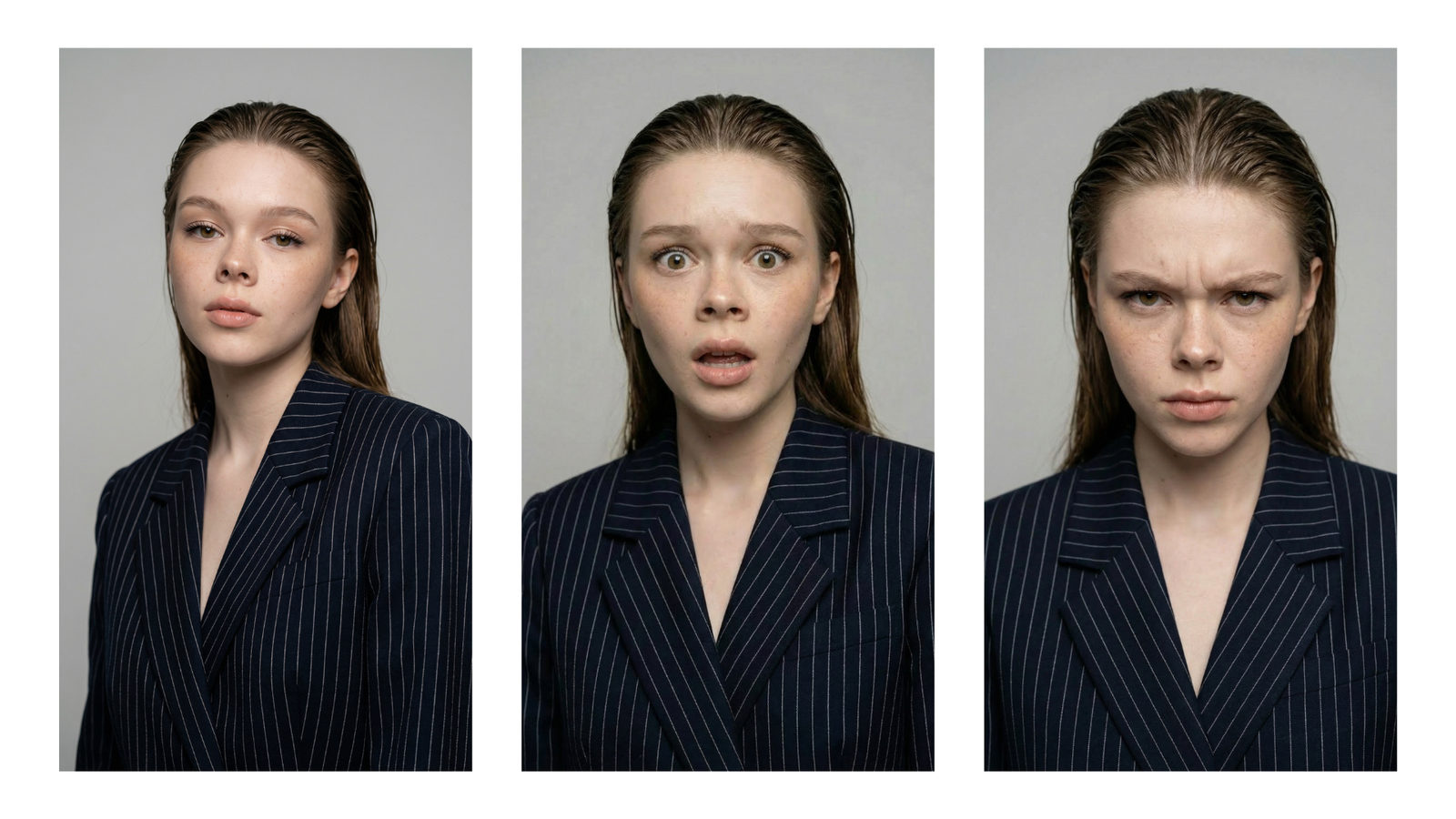
Krea 2 handles faces with exceptional consistency. The camera parameter awareness makes these prompts particularly powerful. For more starting points, browse the realistic portrait prompts collection.
Close-up portrait of a woman in her 40s, silver hair, weathered skin with character, shot on 85mm f/1.8 lens, Rembrandt lighting from camera left, deep shadows, film grain at ISO 800, neutral grey background, ultra-sharp eyes, soft shoulder falloff
Young man looking out rain-streaked window, neon city lights reflected, shot at 35mm f/2.0, natural blue-hour ambient light only, ISO 2400 grain, cinematic 2.39:1 crop, muted teal and orange color grade, shallow depth of field
Outdoor golden hour portrait, woman in linen dress, shot from low angle looking up, 50mm lens f/2.8, strong backlight creating rim lighting and hair glow, lens flare, warm amber tones, out-of-focus wildflower meadow background
Black and white street portrait, elderly man with deeply lined face, candid expression, 28mm wide angle close proximity, harsh midday sun creating strong shadows under brow, high contrast, slightly underexposed, photojournalism style
Product Photography & Commercial
Krea 2's precise lighting control makes it a serious tool for commercial product work. These prompts use specific lighting setups photographers use on actual shoots. See the full product photography prompts library for additional variations.
Luxury perfume bottle on dark marble surface, single overhead strip softbox, specular highlights along glass edges, shallow depth of field 100mm macro lens f/4, background fades to pure black, editorial cosmetics photography, 4K sharp
Artisan coffee cup with latte art on rough concrete countertop, natural window light from left, subtle steam wisps, shot at 60mm f/3.5, warm café atmosphere, shallow depth coffee beans blurred in background, Instagram-ready square crop
Minimalist sneaker product shot, white studio cyclorama, three-point lighting setup, 1/4 left angle view, crisp shadow on ground, 70mm lens f/8 for front-to-back sharpness, pure commercial photography aesthetic, color-accurate rendering
Fantasy & Character Art
Krea 2's expressive range extends well beyond photorealism. The Qwen3-VL encoder handles complex fictional descriptions with fewer hallucinations than previous models.
Female warrior in ornate silver armor, glowing magical runes etched into breastplate, dramatic underlighting from enchanted sword, dark forest background with mist, epic fantasy concept art style, hyper-detailed, cinematic scale, volumetric light shafts
Ancient dragon perched on gothic cathedral spire, moonlit storm clouds, scales iridescent oil-slick blue-black, 35mm wide establishing shot, sharp foreground architecture, soft-focus distant lightning, dark fantasy illustration, ultra-high detail wings
Cyberpunk street samurai, chrome prosthetic arm, neon-lit rain-soaked alley, shot at 24mm wide angle, low angle hero pose, red and blue neon signs reflecting off wet pavement, fog machine atmosphere, Blade Runner aesthetic, cinematic 2.35:1
Ethereal forest spirit, translucent glowing skin, surrounded by fireflies and floating cherry blossom petals, soft moonlight from above, Studio Ghibli-influenced painterly style, shallow depth of field, rich greens and midnight blues, magical realism
Architecture & Interior Design
Architectural photography prompts benefit greatly from Krea 2's focal length understanding — the difference between a 14mm ultra-wide and a 24mm standard wide dramatically changes perspective distortion and spatial compression.
Modernist living room interior, floor-to-ceiling windows overlooking pine forest, afternoon sun casting long shadows across polished concrete floor, shot at 24mm f/8, fully sharp front to back, neutral palette with warm wood accents, architectural photography
Brutalist concrete apartment building facade, overcast flat light eliminating shadows, geometric pattern of windows and balconies, 70mm telephoto compression, symmetrical composition, slight desaturation, architectural documentation aesthetic
Japanese minimalist tea room, tatami floor, paper shoji screens with diffused natural light, ikebana arrangement in foreground, 35mm lens f/5.6, warm late afternoon glow, extreme stillness and negative space, Wabi-sabi aesthetic
Futuristic skyscraper interior atrium, glass and steel soaring 40 stories, shot from ground level looking straight up with 14mm extreme wide angle, dramatic converging vertical lines, people tiny at base for scale, blue-white artificial light
Krea 2 vs Midjourney V8 vs ChatGPT: 2026 Comparison
Three models dominate conversations in July 2026. Here's how they actually stack up for practical use. For a deeper look at Midjourney specifically, the Midjourney V8 prompt guide covers that ecosystem in full.
| Feature | Krea 2 | Midjourney V8 | ChatGPT (GPT-4o Images) |
|---|---|---|---|
| Image Quality | Exceptional photorealism, strong on faces and hands, top-tier lighting fidelity | Outstanding aesthetic polish, consistent house style, strong at stylized outputs | Good for concepts and illustrations; less reliable at photographic realism |
| Technical Control | Native camera settings understanding (aperture, focal length, ISO, lighting) | Style references, aspect ratios, strong parameters — but no camera metadata parsing | Conversational editing; limited technical photography control |
| Cost | Free (open-source, run locally or via community tools) | $10–$60/month subscription; no free tier | Included in ChatGPT Plus ($20/month); usage caps apply |
| Best For | Photography-realism, technical art direction, LoRA style customization | Commercial creative work, brand visuals, stylized illustration | Rapid ideation, text-in-image, conversational iteration |
| Prompt Style | Natural language + photography terms; descriptive sentences work well | Tag-based with parameter flags (--ar, --style, --v); structured syntax | Conversational; edit via follow-up messages; less precise for technical specs |
The bottom line: Krea 2 wins on technical control and cost. Midjourney V8 wins on polish and production speed for commercial creative teams. ChatGPT wins on accessibility for non-technical users who need quick concepts.