Blender AI Agent 3D Workflow Automation: A 2026 Solo Dev Guide
3D is the creative discipline that resisted AI the longest, and for good reason — an image generator can't hand you a rigged, UV-unwrapped, game-ready asset. But the quiet shift in 2026 is that you no longer need a model to generate the mesh. You need an agent that can drive Blender. With the bpy API now well-mapped and agentic skills that actually understand Blender 5's Python surface, blender ai agent 3d workflow automation has gone from a tech demo to something I lean on every time I open a project. Here's what's working, what isn't, and the exact patterns I now use as a solo indie dev.
Table of Contents
Why 3D resisted AI longer than anything else
Image generation hit production quality in 2023. Code generation got real in 2024. Video crossed the line in 2025. 3D? 3D limped along with NeRFs and Gaussian splats and a steady stream of "text-to-mesh" demos that produced unusable spaghetti every time you tried to put one in a game engine.
The problem was never the geometry — it was everything around it. Topology. UV layout. PBR materials. Bones placed on actual joints. LODs. Collision meshes. Naming conventions your engine expects. A solo indie dev needs all of that in the right format by Friday. No diffusion model gives you that, because the work isn't artistic in the way the model thinks it is. It's technical art — mostly bookkeeping plus taste.
That's what flipped 3D for me last year. The hard part isn't making the asset. It's the forty-step pipeline that turns a sculpt into something a game engine will load. That pipeline has a name. It's called bpy.
The bpy + agent combination that actually works
Blender's Python API — bpy — has always been able to do everything the GUI can. Most 3D devs touched it once, wrote a janky script, and went back to clicking buttons because the docs are scattered and the call surface is enormous. That's the part agents fix.
An agent armed with a Blender-aware skill doesn't need to memorise the API. It needs to know which calls exist, how Blender 5 differs from 3.x, and which patterns are deprecated. With that context loaded, you describe the operation in plain English and it writes a working script. I run them headlessly with blender --background --python script.py and don't open the GUI for half the work I used to do by hand.
Concrete example. I had 47 environment props that needed: scale normalised to metres, origin moved to base centre, a second UV channel for lightmaps, exported as glTF with engine-specific naming. A 90-minute click-fest in the GUI, repeated 47 times. With an agent it's a 30-line script and I went to lunch. Same shift the solo dev skill stack made for code, but for 3D.
Here's roughly what that "normalise an asset folder" script looks like, trimmed to the core:
import bpy, os
for f in os.listdir("./props"):
    if not f.endswith(".blend"): continue
    bpy.ops.wm.open_mainfile(filepath=f"./props/{f}")
    obj = bpy.context.active_object
    obj.scale = (0.01, 0.01, 0.01)
    bpy.ops.object.transform_apply(scale=True)
    bpy.ops.export_scene.gltf(filepath=f"./out/{f[:-6]}.glb")
That's not glamorous. That's the point. The agent wrote it in one shot and 47 props became 47 glb files while I ate a sandwich. The job was always automatable — I just never sat down and learned the API well enough to write it myself.
Four blender ai agent 3d workflow automation patterns
After about six months of leaning on this setup, four patterns cover roughly 80% of what I use it for. Steal them.
Pattern 1: Batch scene processing
The thing the example above is doing. Anything you'd normally do once per file across a folder — re-origin, re-scale, decimate, bake AO, swap material slots, rename UV maps, export to a target format — is a one-script job. The agent reads your folder structure, asks what the target spec is, and produces a script that does the rounds.
The trick is keeping the script idempotent — running it twice shouldn't double-scale your meshes. Tell the agent: "make this safe to run twice." It adds a marker custom property and skips already-processed files. Without that, you'll wreck a folder eventually. Ask me how I know.
Pattern 2: UV unwrap fixes at scale
UVs are the most consistently broken thing in any asset pack you didn't make yourself. Overlapping islands, wasted space, lightmap channels that don't exist, channels named UVMap.001 because someone duplicated and never cleaned up. An agent can detect most of this and fix it: add a second channel, run smart UV project with sensible angle/island margin, pack islands tight, rename the channel to whatever your engine expects.
What I won't trust it on: anything where artistic UV layout matters. Characters, hero props, anything where seams are a creative choice. For background props and modular kits, it's fine. For a hero sword, I still unwrap by hand. Agents are great at "do the boring version correctly." They're not your senior environment artist.
Pattern 3: Procedural variations
This is the pattern that genuinely changed how I prototype. I model one barrel. I tell the agent: "generate 12 variations — vary height ±15%, vary radius ±10%, randomise the dent count between 0 and 3, rotate the wood-grain texture randomly per instance, output as 12 glb files." It writes a script that uses bpy modifiers, applies them with a seeded random, and exports the lot. I get 12 distinct-looking barrels for the price of one.
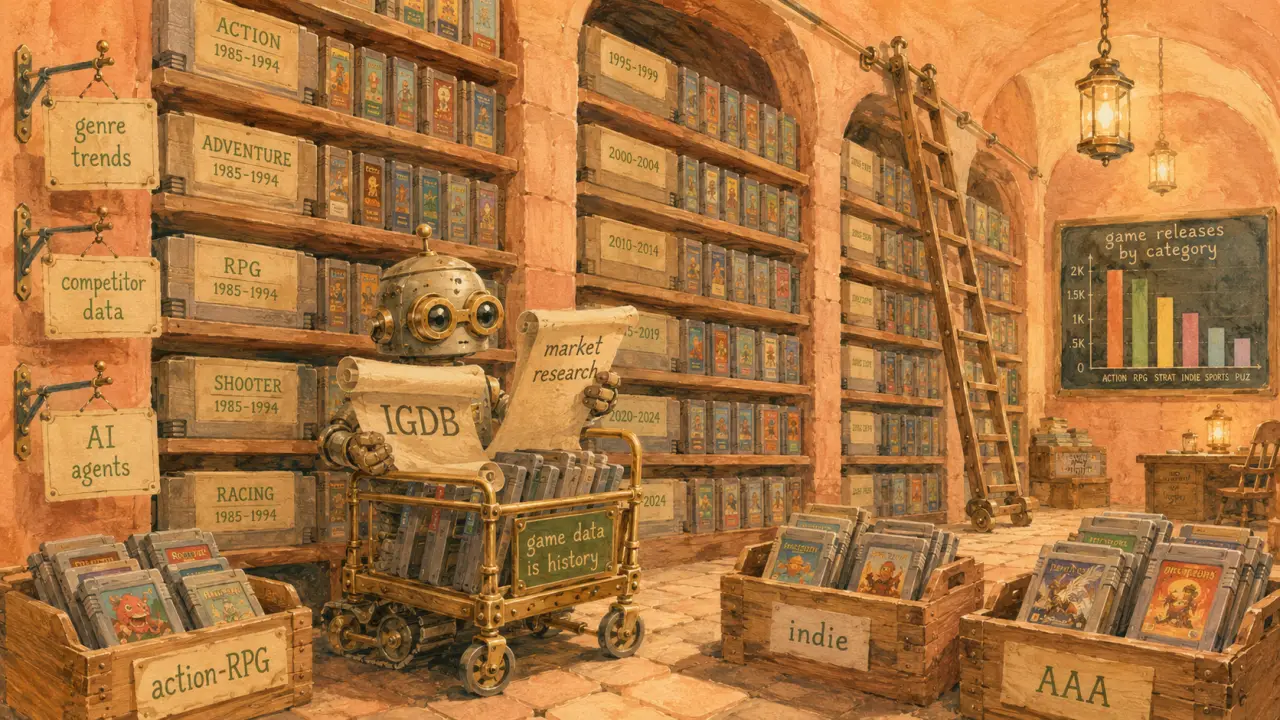
The technique compounds with the procedural-game-content angle I covered in the IGDB market research post. Once you know what genre conventions players expect, an agent can churn variations that hit those conventions without you hand-modelling each one. For a solo dev shipping in months not years, this is the difference between "looks indie" and "looks empty."
Pattern 4: Geometry Nodes scaffolding
Geometry Nodes is Blender's most powerful feature and its most intimidating. Building a scatter system, procedural fence, city-block generator — the node graphs get huge. Agents are surprisingly good at scaffolding these. Describe the desired behaviour, it writes a Python script that builds the node tree programmatically, and you open the result in Blender to tweak. A 70% scaffold beats a blank node editor every time.
Here's the shape of a script that builds a minimal Geometry Nodes setup — distribute points on the active mesh and instance a chosen object onto each one:
import bpy
mod = bpy.context.object.modifiers.new("Scatter", "NODES")
ng = bpy.data.node_groups.new("ScatterNG", "GeometryNodeTree")
mod.node_group = ng
dist = ng.nodes.new("GeometryNodeDistributePointsOnFaces")
inst = ng.nodes.new("GeometryNodeInstanceOnPoints")
ng.links.new(dist.outputs["Points"], inst.inputs["Points"])
That's six lines that would take a beginner half a day of YouTube tutorials. Once you see that the API is just nodes-as-Python, the whole feature opens up. The agent doesn't need to be a Geometry Nodes expert — it just needs to know the node names exist, and a good Blender skill provides exactly that.
The three skills doing the heavy lifting
I've tried about a dozen Blender-adjacent agent setups. Three skills consistently earn their keep. Install in this order.
1. blender5-code — the Blender 5 API specialist
What it does: teaches Claude the current bpy surface for Blender 5 — operator names, data API patterns, Geometry Nodes node identifiers, headless run conventions, and the breaking changes from 3.x and 4.x. Crucially, it knows what's deprecated, which is the failure mode of every general LLM trying to write Blender scripts.
Why solo 3D devs need it: Blender's API churns. A general-purpose model will confidently produce 4.x code that breaks on 5, or vice versa. blender5-code pins Claude to the version you're actually running so the script works on the first try instead of the third.
The first time I noticed it mattering: I asked vanilla Claude to write a UV pack script. It used bpy.ops.uv.pack_islands with the old argument signature, which silently no-ops on Blender 5. With blender5-code installed, it used the new shape_method parameter correctly.
2. agentic-workflow — for any multi-step pipeline
What it does: the same plan-checkpoint-execute loop that makes Claude useful for code work, applied to 3D pipelines. Reads your project, drafts a plan, asks for approval, executes in small steps with a summary at each.
Why solo 3D devs need it: a "process my asset folder" job has ten sub-decisions baked in. Naming convention? Export format? UV channel count? You don't want to discover halfway through that Claude assumed the wrong target engine. The agentic-workflow skill forces those decisions to the surface as checkpoints.
This is the same skill I leaned on heavily in the weekend MVP post. Same checkpoint discipline, different domain.
3. persistent-kb — your project's 3D memory
What it does: a project-scoped knowledge base Claude reads at the start of every session. For 3D work, you stuff it with what you'd otherwise re-explain every time: target engine, scale convention, naming pattern, UV channel layout, material slot order, the weird quirk where your character rig has an extra root bone for tooling reasons.
Why solo 3D devs need it: 3D projects accumulate more invisible conventions than code projects. If you don't capture them, every Blender script the agent writes will violate at least one. persistent-kb is how you stop re-typing "the engine expects Y-up, please convert on export" for the hundredth time.
Bonus: when you eventually hire a contractor or open-source the project, the KB is already a halfway-decent tech-art onboarding doc.
What this won't fix
Honest limitations, because the field is full of breathless 3D-AI claims that don't hold up.
- It won't replace modelling skill. Agents drive bpy. They don't sculpt. If you can't model a barrel, no amount of automation gives you a barrel — it just lets you process the one you bought from an asset store more efficiently.
- Rigging is still mostly manual. Auto-rig add-ons exist and agents can drive them, but for character-grade work you're still hand-tweaking weights. Don't believe demos that show otherwise — they're either toy meshes or they look like toy meshes after rigging.
- Shaders are case-by-case. Agents can wire up standard PBR materials and convert texture sets between conventions. They don't yet write nuanced procedural shaders that look art-directed. For hero materials, build by hand.
- Headless errors are cryptic. When a bpy script fails inside
blender --background, the stack trace is sometimes useless. Pair the agent with a debugging discipline — the same patterns that make root-cause debugging skills useful for code work apply here.
None of those are reasons to skip the setup. They're reasons to install it with realistic expectations.
FAQ
Does blender ai agent 3d workflow automation work on Blender 4.x or do I need 5?
Both work. The blender5-code skill is tuned for 5, but Claude can target 4.x if you tell it explicitly in the project KB. If you're starting fresh, install Blender 5 — the API stabilised meaningfully and agent suggestions are more reliable.
Can I run this on Blender's headless mode for CI?
Yes, that's where it shines. blender --background --python yourscript.py runs without a display, so you can wire it into GitHub Actions or a local watcher. I have a folder watcher that re-bakes lightmaps any time a level file changes. No GUI ever opens.
What about text-to-3D models like Meshy or Rodin?
Use them for blockouts, not finals. Pipe their output into Blender, then use an agent to clean topology, redo UVs, and re-export to your engine spec. The agent is the bridge between "AI mesh blob" and "actually shippable asset."
Will this work for character animation?
Partially. Bone constraints, baking actions, retargeting between rigs with matching bone names — agents handle that fine. Hand-keyed animation polish is still a human job.
How do I avoid the agent breaking my .blend files?
Two rules. Always run scripts on copies. Always make scripts idempotent — running twice produces the same result as running once. The agentic-workflow skill enforces both by default if you ask it to.
Is there a way to preview the script before running it?
Yes — the agent produces the script as text first. Read it. If it's calling bpy.ops.wm.save_as_mainfile on your only copy of the project, stop it. 95% of the time the script is fine. The 5% you catch by reading is the 5% that would've cost you a day.
The bottom line
3D is no longer the AI-resistant island it was two years ago — but the wins aren't where the hype said they'd be. Text-to-mesh still produces garbage. What works is the unglamorous middle of the pipeline: bookkeeping, batch processing, format conversion, procedural variation, Geometry Nodes scaffolding. That's where blender ai agent 3d workflow automation pays for itself within a week.
Start with one job that bores you. Mine was re-exporting prop folders to glb. Yours might be UV-checking an asset pack. Install blender5-code and agentic-workflow, write the script with Claude, run it once, and notice how much of your week just opened up.
→ Browse all 3D skills · Request a Blender skill that doesn't exist yet
If you're building game assets or reaction-time-training browser games alongside 3D work, our guide to the best free reaction time games is the companion piece on the player side of the same stack.