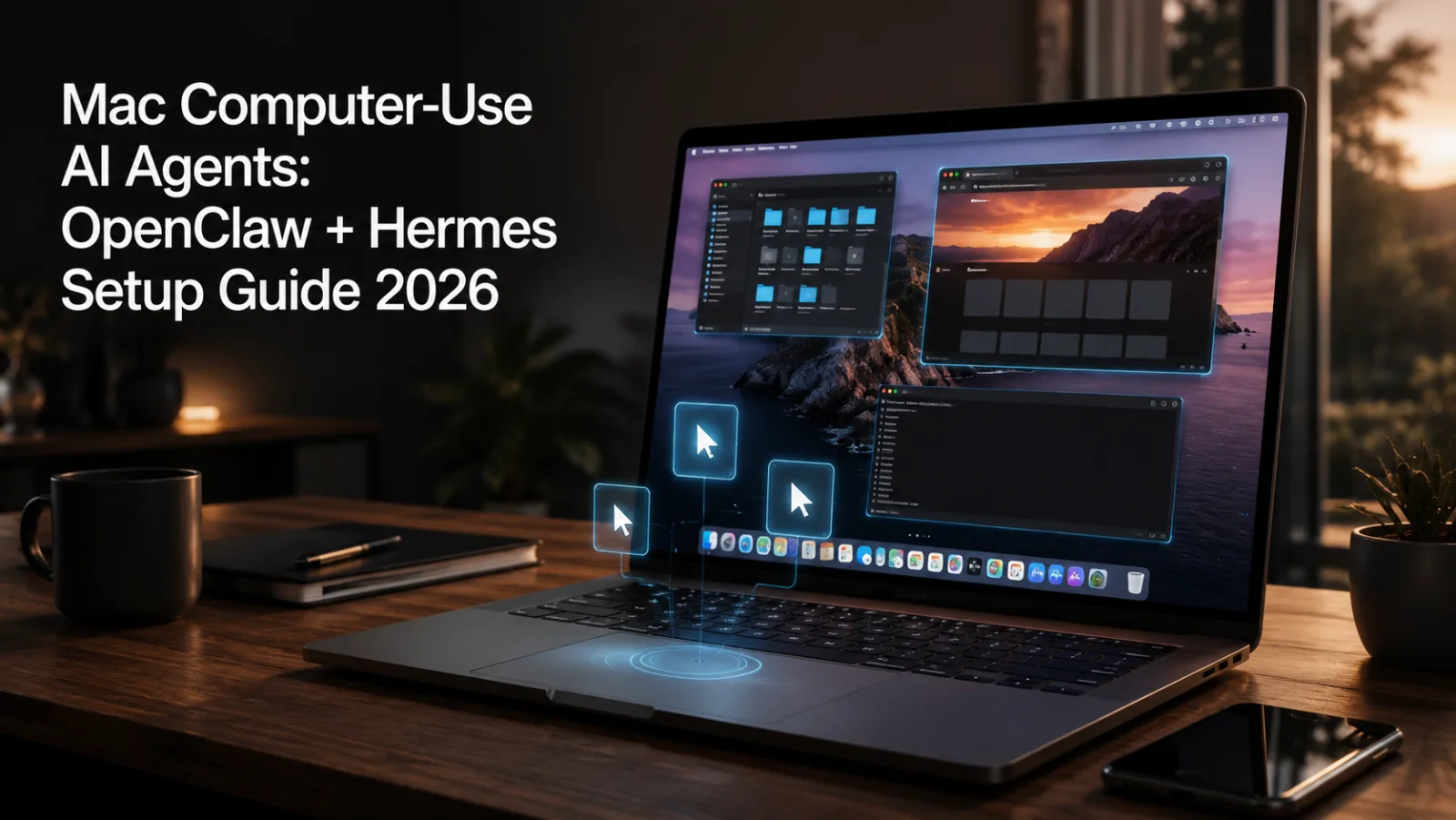
If you've been running OpenClaw for the last year, you already know the drill: a memory file, a SOUL persona, a Telegram bot that actually does work while you sleep. It's been a great tool. The team behind it has now shipped what's effectively the next chapter, called Hermes Agent, and the migration path is built right in.
This isn't a takedown. OpenClaw paved the road. Hermes is what happens when you take everything that worked, add a learning loop, more terminal backends, and a messaging gateway that hits 20+ platforms, and polish the rough edges. Here's an honest comparison so you can decide whether to switch, stay, or run both.
OpenClaw and Hermes Agent: a shared lineage
Both tools sit in the same family. OpenClaw was the original community-flavored agent CLI. It introduced the patterns a lot of us now take for granted: a markdown memory file, persona-driven behavior via SOUL.md, Telegram-first design, allowlists for shell commands.
Hermes Agent, built by Nous Research, picks up that thread and extends it. The CLI even ships a one-command migration: hermes claw migrate. That alone tells you the relationship. Hermes is engineered as a successor, not a competitor.
- OpenClaw: the community-driven original, simpler surface area
- Hermes Agent: the more ambitious follow-up, broader ecosystem
- Same DNA: SOUL.md, MEMORY.md, allowlists, Telegram bot patterns
OpenClaw vs Hermes Agent: feature comparison
Here's the side-by-side, kept honest. OpenClaw covers the basics well; Hermes adds the things you'd want next.
- Models supported: OpenClaw covers the major providers. Hermes adds Nous Portal, GitHub Copilot, NVIDIA NIM, AWS Bedrock, MiniMax, Kimi, GLM, DeepSeek, Hugging Face, and a long tail of others.
- Tool count: OpenClaw ships a solid core. Hermes ships around 70 tools across web, files, shell, vision, image gen, TTS, and code execution.
- Terminal backends: OpenClaw runs locally. Hermes runs across 7 backends: local, Docker, SSH, Singularity, Modal, Daytona, and Vercel Sandbox.
- Skills: OpenClaw has user-created skills. Hermes adds autonomous skill creation, in-use self-improvement, and the open agentskills.io standard.
- Messaging: OpenClaw centers on Telegram. Hermes runs 20+ platforms from a single gateway.
- Memory: Both have markdown memory. Hermes adds FTS5 session search and Honcho dialectic user modeling.
- Cron: Built-in on both. Hermes adds delivery to any messaging platform.
- MCP: Hermes adds first-class MCP support for plugging in any MCP server.
Performance and ergonomics in real use
I ran them side by side for two weeks on the same VPS. A few things stood out.
Startup and responsiveness: Hermes feels a touch heavier on cold start because it's loading more subsystems (memory index, Honcho profile, skills catalog). Once warm, the streaming is smooth and the TUI is noticeably nicer: slash-command autocomplete, multiline editing, interrupt-and-redirect in the middle of a tool call.
Long sessions: Hermes wins here. /compress handles long contexts gracefully, and the session search means I can ask "what was that Postgres trick from two weeks ago" and get a summarized recall instead of scrolling.
Setup friction: OpenClaw is simpler to grok on day one because it does less. Hermes has more knobs, but hermes setup walks you through them. It's the classic tradeoff: fewer features means a smaller learning curve.
Ecosystem, community, and skills hub
OpenClaw built a real community. Skills, persona files, and platform recipes are floating around in repos and Discords. None of that disappears when you move to Hermes. The migration tool imports user skills into ~/.hermes/skills/openclaw-imports/.
Hermes layers on top of that with the Skills Hub, an open standard for shareable procedural memory. Skills written for Hermes work in any compatible runtime, and the catalog grows weekly. There's also HermesClaw, a community WeChat bridge that lets you run both Hermes and OpenClaw on the same WeChat account if you want a slow, gradual transition.
The Discord is shared with the broader Nous Research community, which means you're talking to people who actually train models, not just app developers.
When OpenClaw is still the right call
OpenClaw isn't going anywhere. There are real cases where I'd keep using it:
- You only need Telegram and you've already invested in a clean OpenClaw config. Don't fix what isn't broken.
- You're on resource-constrained hardware (a Raspberry Pi, a tiny VPS) and the smaller surface area helps.
- You've got a custom fork with patches you don't want to redo.
- You want minimum moving parts for a single-purpose bot, say a daily news digest with no skills system or subagents.
For those use cases, OpenClaw is still a great answer. The agent ecosystem benefits from having multiple shapes of tool, not one.
When Hermes Agent is the upgrade you want
The flip side: pick Hermes if any of these match your day:
- You use more than one model provider. Hermes makes switching trivial; OpenClaw is fine but more limited.
- You want to run remotely. Daytona and Modal serverless backends mean your agent hibernates when idle and costs almost nothing between sessions.
- You message from more than Telegram. Discord, Slack, WhatsApp, Signal, SMS, Email: one gateway process for all of it.
- You want skills that improve themselves. Hermes' learning loop genuinely compounds over weeks of use.
- You need MCP support to plug in external tool servers.
- You want voice memo transcription baked into the messaging gateway.
- You care about parallel work: subagents and Programmatic Tool Calling are real productivity wins.
Migration tips: moving from OpenClaw to Hermes Agent
The good news: this is the most painless tool migration I've done in a while. Hermes' setup wizard auto-detects ~/.openclaw and offers to import everything. If you skip that step, run it later:
hermes claw migrate # interactive, full preset hermes claw migrate --dry-run # preview without writing hermes claw migrate --preset user-data # skip API keys hermes claw migrate --overwrite # force on conflicts
What gets pulled across:
- SOUL.md: your persona, copied as-is
- MEMORY.md and USER.md: long-term memory entries
- Skills: moved into
~/.hermes/skills/openclaw-imports/ - Command allowlist: your approval patterns
- Messaging settings: platform configs, allowed users, working dir
- API keys: Telegram, OpenRouter, OpenAI, Anthropic, ElevenLabs (allowlisted)
- TTS assets and workspace AGENTS.md
I'd recommend running --dry-run first, then a real migration, then keeping OpenClaw installed for a week so you can fall back if something feels off. After two weeks I'd never gone back.
Running both: a gentle migration strategy
You don't have to commit on day one. A few patterns I've seen work:
- Different chats, different agents. Keep OpenClaw on your existing Telegram bot, point Hermes at a new bot, run them in parallel for a couple of weeks.
- HermesClaw bridge. The community HermesClaw project lets both run on a single WeChat account if that's your platform.
- Same memory file, two agents. Symlink
~/.openclaw/MEMORY.mdinto Hermes' workspace and let both read it while you decide. - Migrate skills last. Bring memory and config first, then port skills one at a time as you actually use them.
The point is to test Hermes against your real workflow without burning your existing setup. After a week the answer usually becomes obvious.
The honest verdict in 2026
OpenClaw is a great tool. It made a lot of us comfortable with the idea that an AI agent could live on a server and quietly do real work. If it fits your workflow today, keep it.
Hermes Agent is what happens when that idea gets a bigger budget, a learning loop, and a research lab behind it. It's more capable, more flexible, and built to grow. For most developers I talk to in 2026, it's the answer to "which open-source AI CLI should I run?"
The migration is one command. The downside risk is small. And both tools sharing DNA means your investment in OpenClaw (the SOUL, the memories, the skills) comes with you.
FAQ: OpenClaw vs Hermes Agent
Is OpenClaw deprecated?
No. It's still maintained and runs fine. Hermes is the spiritual successor with broader scope, but OpenClaw remains a valid choice for simpler setups.
Will my OpenClaw skills work in Hermes?
Yes. hermes claw migrate imports them into ~/.hermes/skills/openclaw-imports/. Most run as-is; a few may need light tweaks for the new tool API.
Can I run both at the same time?
Yes. They use separate config directories (~/.openclaw vs ~/.hermes) and can talk to different bot tokens. The HermesClaw bridge handles the WeChat case specifically.
Which one is faster?
OpenClaw is lighter on cold start. Hermes has a richer feature set so it does more on launch, but warm-state responsiveness is comparable.
Does the migration tool handle API keys?
Yes, with an allowlist. Use --preset user-data if you'd rather move keys yourself.
Which one should I pick for a brand new project?
Hermes Agent. The 70-tool suite, multi-platform gateway, and learning loop give you more headroom. Pick OpenClaw only if you've got a specific reason to keep things minimal.
What's next after the switch
Whichever side of the OpenClaw vs Hermes Agent line you land on, the bottleneck eventually becomes prompt quality, not the agent. We curate tested prompts for AI coding assistants, agent automations, and prompt-engineering workflows over at promptspace.in. Handy if you want a head start on the next ten things you'd build.
If you're migrating, run the dry-run first, keep OpenClaw warm in the background for a week, and let your future self thank you for not deleting ~/.openclaw on day one.