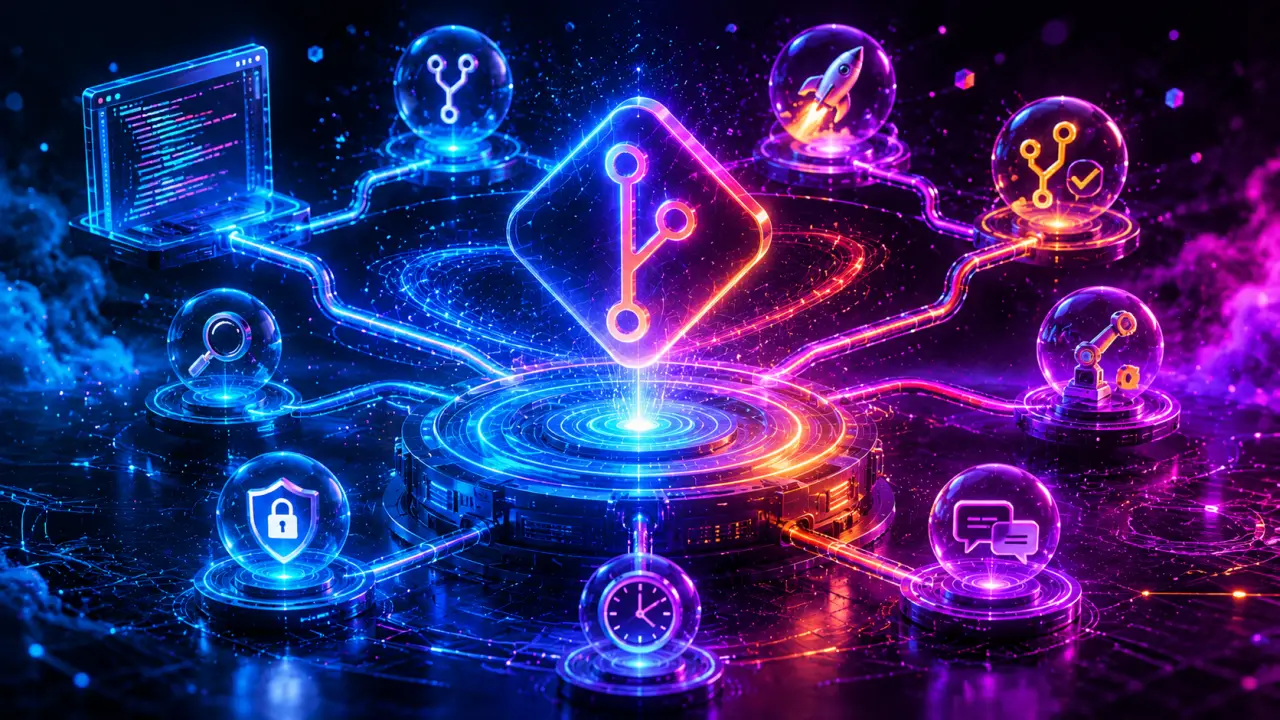
In 2026, AI coding agents have become indispensable tools for developers, especially when it comes to managing Git workflows. One of the most impactful ways these agents save time is through Git automation skills. These skills are defined in SKILL.md files, which provide the agent with detailed instructions on how to perform specific Git-related tasks. By automating repetitive and error-prone Git operations, developers can focus more on writing code and less on managing version control details. Git automation skills cover a broad range of tasks including writing commit messages, generating pull request descriptions, creating changelogs, naming branches, and resolving merge conflicts. Each of these tasks, when automated, can significantly reduce the cognitive load on developers and improve consistency across projects. For example, consistent commit messages help maintain a clean project history, which is crucial for debugging and collaboration. One of the best Git automation skills in 2026 is the git-commit-writer skill. This skill uses conventional commit standards to generate clear, concise, and meaningful commit messages automatically. Developers can customize this skill to include ticket numbers, scope, and detailed descriptions, ensuring that every commit is informative and standardized. This not only improves readability but also integrates seamlessly with CI/CD pipelines that rely on commit message conventions. Another essential skill is the PR-description-generator. This skill helps AI agents draft detailed pull request descriptions by summarizing code changes, highlighting key modifications, and suggesting reviewers. By automating this process, teams can reduce the back-and-forth often required to clarify PR content, speeding up code reviews and merges. Developers can provide templates in the SKILL.md file to tailor descriptions to their project’s needs. Changelog-generator skills have also evolved to become more intelligent and context-aware. These skills analyze merged pull requests and commits to create comprehensive changelogs that categorize changes by type, such as features, fixes, and performance improvements. Automated changelogs keep end-users and stakeholders informed about new releases without manual effort, which is especially valuable in fast-paced development environments. Branch-naming conventions are another area where AI agents excel with automation skills. The branch-namer skill can generate branch names based on issue trackers, feature descriptions, or sprint goals. This ensures that branches are named consistently, making it easier to identify the purpose of each branch at a glance. For example, a branch name like feature/login-authentication-1234 clearly indicates the feature and the associated ticket number. Merge conflict resolution remains one of the most challenging aspects of Git workflows. AI agents equipped with merge-conflict-resolver skills can automatically detect and resolve common conflicts by understanding the context of changes. These skills can suggest resolutions or even apply them directly, reducing the time developers spend manually fixing conflicts. However, it is important to configure these skills carefully to avoid incorrect merges. To get the most out of Git automation skills, developers should invest time in customizing the SKILL.md files. This customization allows the AI agent to align with project-specific workflows, coding standards, and team preferences. For instance, teams can define how detailed commit messages should be or specify the format for pull request templates. The more tailored the instructions, the more effective the automation becomes. Practical tips for developers include integrating Git automation skills into their existing development environment. Many AI coding agents now support plugins or extensions for popular IDEs like VS Code and JetBrains products. This integration allows developers to invoke Git automation commands directly from their editor, streamlining the workflow and reducing context switching. Another useful practice is to combine multiple Git automation skills into a cohesive pipeline. For example, after a developer pushes code, the AI agent can automatically generate a commit message, create a pull request with a detailed description, and update the changelog. This end-to-end automation minimizes manual intervention and ensures that all Git-related documentation is up to date. Developers should also monitor the performance and accuracy of their AI agents’ Git automation skills. Regularly reviewing generated commit messages, PR descriptions, and changelogs helps identify areas where the AI might need retraining or updated instructions. Feedback loops are essential to maintain high-quality automation that adapts to evolving project requirements. Security considerations are critical when automating Git workflows. Developers must ensure that AI agents do not inadvertently expose sensitive information in commit messages or pull request descriptions. Configuring filters and validation rules within the SKILL.md files can prevent such leaks and maintain compliance with organizational policies. In addition to automation, Git skills can assist with education and onboarding. New team members can learn best practices by reviewing AI-generated commit messages and pull request descriptions. This passive learning helps maintain consistency across the team and accelerates the onboarding process by providing clear examples of expected Git usage. Looking ahead, AI coding agents will likely incorporate more advanced natural language understanding to interpret complex code changes and generate even more insightful Git documentation. Skills that combine code analysis with project management data will enable smarter branch naming, changelog generation, and conflict resolution tailored to the context of the entire project. For developers interested in building their own Git automation skills, starting with simple tasks like commit message generation is advisable. Gradually adding complexity, such as PR description templates and merge conflict heuristics, allows for iterative improvement and easier debugging. The modular nature of SKILL.md files supports this incremental approach. Community sharing of Git automation skills is another trend gaining traction. Developers can publish their SKILL.md files on platforms like PromptSpace to share best practices and learn from others. This collaborative environment accelerates the development of robust skills and fosters innovation in AI-assisted Git workflows. In conclusion, mastering Git automation skills is essential for developers working with AI coding agents in 2026. These skills not only save time but also improve the quality and consistency of version control practices. By leveraging skills like git-commit-writer, PR-description-generator, changelog-generator, branch-namer, and merge-conflict-resolver, teams can streamline their workflows and focus on delivering high-quality software. Embracing Git automation skills today prepares developers for the future of AI-assisted coding, where intelligent agents handle routine tasks and enable humans to tackle more creative and complex challenges. Investing in these skills is an investment in productivity, collaboration, and software excellence.
Frequently Asked Questions
What AI tools do developers use most in 2026? Claude Code, GitHub Copilot, and Cursor AI dominate developer workflows. See our Developer Prompts collection.Are AI coding tools worth it? Yes — developers consistently report 20–40% productivity gains on repetitive tasks. Most subscriptions pay for themselves within the first week.
Copilot vs Cursor — which is better? Cursor handles complex multi-file edits better. Copilot integrates into more editors. Most developers who try Cursor prefer it for complex projects.
Is AI-generated code production-ready? AI produces solid starting points, not final code. Always review, test, and refine AI-generated code before deploying to production.