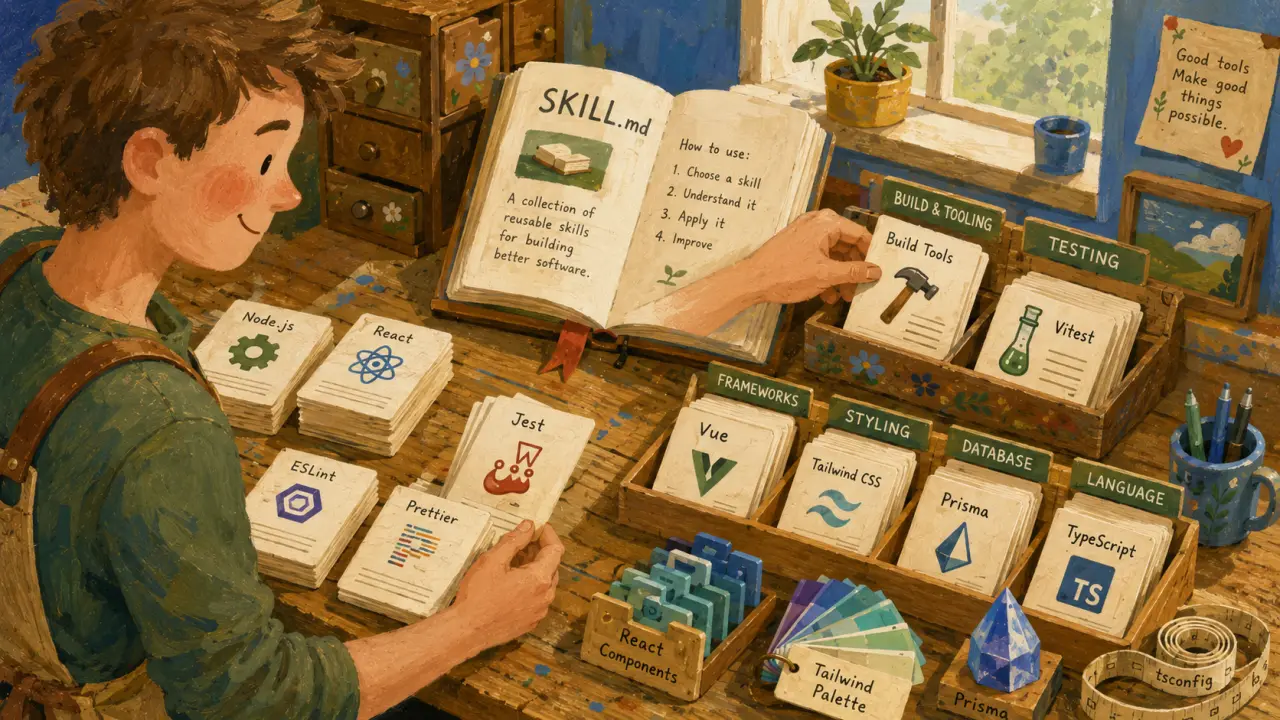
Documentation is the highest-leverage use case for AI coding skills. Writing docs is time-consuming, follows predictable patterns, and most developers skip it. A documentation skill doesn't just save time — it ensures docs actually get written, improving code maintainability and collaboration across teams.
Why Documentation Skills Matter
Good documentation bridges the gap between development and user understanding. It reduces onboarding time for new developers, minimizes support requests, and ensures your project can evolve smoothly. Claude code skills designed for documentation automate repetitive writing tasks, freeing developers to focus on building features rather than explaining them.Best Claude Code Skills for Documentation
The best Claude code skills for documentation cover key areas: README generation, API documentation, inline code comments including JSDoc, changelog generation, and architecture documentation. Each skill addresses a specific documentation pain point and collectively they create comprehensive project transparency.1. README Generation
README files are often the first interaction users and developers have with a project. Claude’s README generation skills scan your project structure and generate a complete, customized README file. They detect your programming language, framework, and tooling automatically, then produce well-structured sections such as installation, usage, configuration, contributing guidelines, and licensing.How It Works
Good README generation skills parse your project files like package.json, Dockerfile, and CI/CD configs. For instance, if your package.json specifies dependencies, the skill includes an installation command like npm install. If a Dockerfile is present, it adds a section on containerization. This approach eliminates generic placeholders and ensures the README reflects your actual setup.Practical Example
Suppose you have a Node.js project with Express and MongoDB. The skill reads your package.json, detects express and mongoose dependencies, sees your Dockerfile, and generates a README with sections on setting up Node.js, running the server, connecting to MongoDB, and using Docker for deployment.Step-by-Step Usage
1. Upload or point the Claude skill to your project repository. 2. The skill analyzes your files and dependencies. 3. It generates a draft README with relevant sections. 4. Review and customize the draft as needed. 5. Save and commit the README to your repo.Tips
- Keep your package.json and config files up to date for the best results. - Use the generated README as a starting point and add project-specific details manually. - Regularly regenerate the README after major changes to keep documentation current.2. API Documentation
API docs are essential for developers consuming your interfaces. Claude code skills can auto-generate REST or GraphQL API documentation by analyzing routes, controllers, or schema files. These skills produce clear endpoint descriptions, request/response examples, and error codes.Real-World Use Case
Imagine you maintain a RESTful API for a fintech app. The Claude skill parses your Express routes and JSDoc comments, then creates a comprehensive API document with all endpoints categorized, parameters listed, and sample payloads included. This documentation can be exported as Markdown or integrated with tools like Swagger.Steps to Generate API Docs
1. Ensure your API routes are well-structured and optionally annotated with comments. 2. Run the Claude API documentation skill on your codebase. 3. Review the generated docs for completeness. 4. Publish the docs alongside your project or on a developer portal.Tips
- Use consistent naming conventions and comment styles to improve doc generation accuracy. - Combine with automated testing to verify your API docs reflect actual behavior. - Update docs automatically on code changes using CI pipelines integrated with Claude skills.3. Inline Code Comments and JSDoc
Inline comments and JSDoc annotations improve code readability and facilitate better tooling support. Claude code skills can scan your source files and generate meaningful comments explaining complex logic, function purposes, parameter descriptions, and return types.Practical Example
In a complex algorithm or utility function, Claude can generate descriptive comments that outline what the function does, its inputs, outputs, and possible side effects. This is especially useful when onboarding new team members or maintaining legacy code.How to Use
1. Run the Claude commenting skill on your source code files. 2. Review the generated inline comments and JSDoc blocks. 3. Edit or add extra context where needed. 4. Commit the updated code with enhanced documentation.Tips
- Use clear, concise language in comments. - Avoid redundant comments that state the obvious. - Encourage team members to regularly run commenting skills as part of code reviews.4. Changelog Generation
Keeping a changelog up to date is vital for transparency in software development. Claude code skills can automate changelog creation by analyzing commit messages, pull request titles, and issue trackers to summarize new features, bug fixes, and breaking changes.Real-World Application
In an open-source project, automatically generated changelogs help users quickly understand what’s new or different in each release. Claude skills can format changelogs according to popular standards like Keep a Changelog or Semantic Versioning.Steps to Automate Changelogs
1. Structure your commit messages using conventional commits (e.g., feat:, fix:, docs:). 2. Integrate the Claude changelog skill with your version control system. 3. On release, run the skill to generate or update the CHANGELOG.md. 4. Review and publish the changelog alongside your release notes.Tips
- Enforce commit message conventions via Git hooks. - Combine changelog generation with CI/CD pipelines for seamless releases. - Encourage detailed commit messages to improve changelog quality.5. Architecture Documentation
Documenting your project’s architecture helps teams understand system design, dependencies, and data flow. Claude code skills can generate architecture overviews by analyzing project structure, module relationships, and configuration files.Example Use Case
For a microservices application, the skill can create diagrams and textual summaries describing each service’s responsibilities, communication patterns, and deployment strategies. This documentation supports onboarding and system audits.How to Generate Architecture Docs
1. Provide the Claude skill access to your entire codebase and relevant config files. 2. The skill identifies modules, interconnections, and external dependencies. 3. It produces high-level summaries and optionally visual diagrams. 4. Use the generated docs as part of your project wiki or technical documentation.Tips
- Maintain a modular and well-organized project structure. - Use descriptive names for services and modules. - Regularly update architecture docs as your system evolves.Conclusion
In 2026, leveraging Claude code skills for documentation is a game-changer. These skills not only save time but ensure high-quality, up-to-date documentation that enhances collaboration, onboarding, and project success. By automating README generation, API docs, inline comments, changelogs, and architecture overviews, teams can focus more on coding and less on writing repetitive documentation. Explore and integrate these documentation skills into your workflow to unlock the full potential of AI-assisted development in your projects.Frequently Asked Questions
Are these prompts free? Yes — all PromptSpace prompts are free to copy and use. Browse our ChatGPT Prompts library for hundreds more.Do these work on the free tier? Most work on free tiers. Complex prompts may perform better on paid versions (ChatGPT Plus, Claude Pro) with larger context windows.
How do I get better AI results? Be specific: include your role, desired format, target audience, and any constraints. More context always improves output.
Can I modify these prompts for my use case? Absolutely — treat every prompt as a starting template. Customize the role, topic, tone, and format to match your needs.