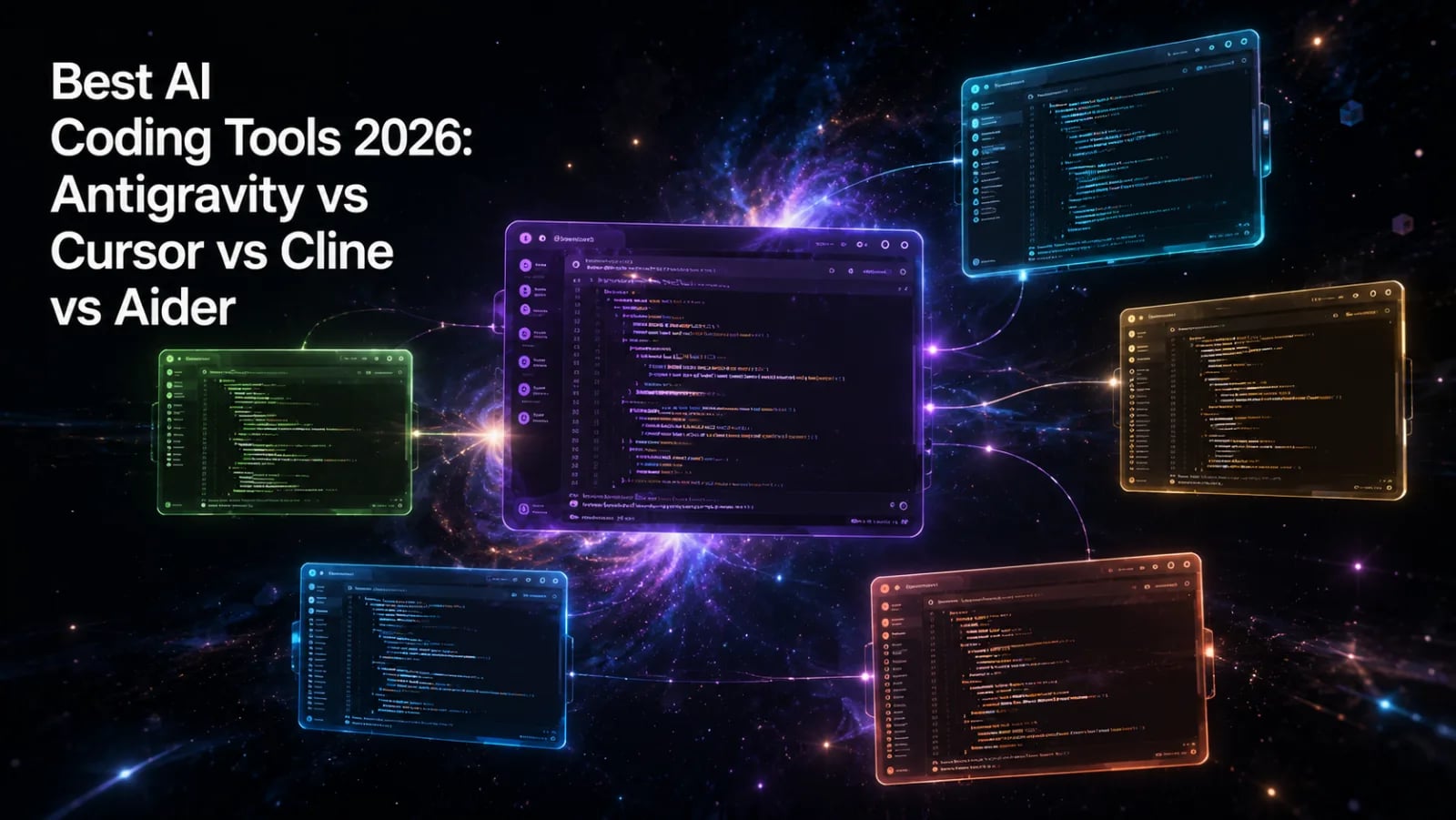
The AI coding tool space looked different a year ago. Cursor was the obvious pick, Copilot the safe pick, Claude Code had just shown up. Then late 2025 happened. Google dropped Antigravity, a full agentic IDE. Cline crossed a million installs. Roo Code forked Cline and started shipping faster than the original.
The question isn't "which autocomplete is best" anymore. It's "which agent do I trust to actually do the work while I review." This post compares the next-gen tools, gives blunt opinions on when each one wins, and skips the marketing fluff.
What's new in agentic IDEs (and why it matters)
Three shifts pushed AI coding past the autocomplete era:
- Multi-agent workflows. One agent plans, another writes, a third reviews. Antigravity ships this by default. Roo Code added "modes" that act like specialized agents.
- Autonomous task completion. You describe the feature, the agent reads the codebase, edits files, runs tests, and reports back. Cline calls this "Plan and Act." It works for medium-sized tasks now.
- Browser and terminal control. Antigravity drives a real Chrome instance. Cline runs shell commands and reads output. Aider has had terminal access forever.
The implication: less typing, more reviewing diffs. If you hate code review, you'll hate this era. If you're fine being the senior reviewing a fast junior, it's a real productivity jump.
TL;DR comparison: agentic IDE comparison at a glance
Skim this, then jump to the tool you care about.
- Antigravity: free during public preview. Best for developers who want a polished agentic IDE with browser control.
- Cursor: $20/mo Pro, $40/mo Business. Best for people who want the most polished editor experience.
- Cline: free (open source), pay model API costs. Best for VS Code users who want control and transparency.
- Aider: free (open source), pay model API. Best for terminal-first developers and git workflows.
- Continue: free, $20/user/mo team plan. Best for teams wanting open-source Copilot replacement.
- Roo Code: free (open source), pay model costs. Best for Cline users who want more modes and faster releases.
1. Google Antigravity: the new agentic IDE on the block
Antigravity launched in public preview in November 2025. It's Google's answer to Cursor, built around agents from day one. The pitch: you don't open files, you assign tasks. The agent picks the files.
What's good
- Multi-agent by default. A planner breaks down your request, a coder edits, a verifier checks the result.
- Built-in browser. The agent opens a Chrome window, clicks through your app, and confirms the feature works.
- Free during preview. Gemini 3 Pro and Claude Sonnet 4.5 access without a separate API bill.
- Good at frontend work. The browser loop catches visual bugs autocomplete tools miss.
What's annoying
- It's a separate app, not a VS Code extension. If you have a tuned setup, you're starting over.
- Rate limits exist on the free preview. Heavy days hit walls.
- Your code goes to Google servers. Read the terms before pointing it at proprietary repos.
Pick Antigravity if you're starting fresh, doing UI work, or curious about where agentic IDEs are headed.
2. Cursor: still the polished default
Cursor isn't new in 2026, but it didn't sit still. The Composer agent matured, background agents landed, and the editor still feels like the smoothest experience of the bunch.
- Pricing: $20/mo Pro, $40/mo Business, free tier with limited fast requests.
- Strengths: best UX, fastest tab autocomplete, solid agent mode, multi-file edits that just work.
- Weaknesses: closed source, pricing changes annoy long-time users, free tier got tighter in 2025.
If you've already paid for Cursor and it's working, you don't need to switch. The new tools aren't strictly better, they're different bets. Cursor's bet is polish, and that bet's holding up.
3. Cline: the open-source VS Code agent that won the year
Cline is a VS Code extension. Install it, paste an API key (Anthropic, OpenAI, OpenRouter, Ollama), and you get an agent inside your existing editor. No new app to learn.
Why it took off
- Open source. You can read the code, audit the prompts, and trust what's happening.
- Plan and Act mode. The agent shows you a plan first, you approve, then it executes.
- Model agnostic. Use Claude Sonnet 4.5 for hard tasks, Haiku for cheap ones, or run Qwen locally.
- Terminal and browser tools built in.
The catch
- You pay model costs directly. A heavy day on Sonnet 4.5 can hit $10 to $20.
- The UI is fine, not great. After Antigravity or Cursor, it feels utilitarian.
- Context management is on you. Long sessions can get expensive if you don't reset.
Cline is what I recommend to most working developers right now. Transparent, works in the editor you already use, no vendor lock-in.
4. Aider: terminal-based pair programmer that refuses to die
Aider has been around since 2023 and keeps getting better. It's a Python CLI. Run aider in your repo, tell it what to change, and it edits files and commits to git automatically.
- Pricing: free, open source. You pay model API costs.
- Killer feature: automatic git commits per change. Every edit is a clean commit you can revert.
- Repo map: Aider builds a smart map of your codebase so the model gets relevant context without dumping everything.
- Voice mode: yes, you can dictate. Surprisingly useful for ideation.
Aider beats everyone for refactors and surgical edits. Hate the change? git reset. Done.
No GUI, no browser control. If you want an agent that clicks around your app, Aider isn't it. Pick Aider if you live in tmux or care about clean git history.
5. Continue: open-source autocomplete plus agent
Continue is the open-source answer to GitHub Copilot, and it grew an agent in 2025. VS Code and JetBrains extension. Configure your own models for autocomplete, chat, and agent tasks.
- Pricing: free for individuals. Team plan around $20/user/mo.
- Strength: the only tool here with first-class JetBrains support. Kotlin or Java devs on IntelliJ, this is your option.
- Custom models per task: Codestral for fast autocomplete, Claude for agent work, all in one config.
- Weakness: the agent is decent but not best in class. For pure agent work, Cline or Roo Code feel sharper.
Continue makes sense if you want a Copilot replacement that's open source, or if you're on JetBrains.
6. Roo Code: the Cline fork that ships faster
Roo Code (originally "Roo Cline") forked from Cline in early 2025 and now has its own identity. Same idea, more aggressive feature pace.
- Custom modes. Beyond Plan and Act, define modes like Architect, Debug, or Test. Each has its own prompt and tool permissions.
- Better multi-file edits. Roo handles large refactors more reliably in my experience.
- More experimental features. MCP server support and multi-model orchestration land in Roo before Cline.
Roo moves fast, which means more bugs. Want stability? Cline is calmer. Want the bleeding edge? Roo. I run both: Cline for client work, Roo for personal projects.
When to pick each tool: a real decision matrix
Skip the "it depends" answer. Here's what to actually pick based on how you work.
- Most powerful agent, don't care about lock-in: Antigravity.
- Smoothest editor, willing to pay for polish: Cursor.
- Open source, transparency, already love VS Code: Cline.
- Terminal life, git hygiene matters: Aider.
- JetBrains user, want a Copilot replacement: Continue.
- Want Cline with more features: Roo Code.
- Sensitive code that can't leave your machine: Cline or Aider with a local model like Qwen 2.5 Coder or DeepSeek V3.
Most working devs should run two tools. A polished one for daily flow (Cursor or Antigravity) and an open-source one for sensitive work or when the polished one breaks.
Pricing summary: what you'll actually pay in 2026
Sticker prices lie. Here's the real monthly cost for a developer using each tool seriously, including model API spend.
- Antigravity: $0 during preview. Expect $20 to $30/mo when paid tier launches.
- Cursor Pro: $20/mo flat. Add $20/mo if you hit fast request limits.
- Cline + Claude Sonnet 4.5: $30 to $80/mo for a heavy user. Less with cheaper models.
- Cline + local Qwen or DeepSeek: $0/mo plus your hardware.
- Aider + Claude or GPT-4o: $20 to $60/mo. Aider's prompt efficiency keeps costs down.
- Continue: $0 personal. $20/user/mo for teams.
- Roo Code: same as Cline.
BYO key often costs more than Cursor's flat fee for heavy users. You're paying for control, not savings.
Best free AI coding tools 2026: the free tier breakdown
If you're broke, a student, or just testing, here's what you can do for $0.
- Antigravity: fully free during preview. Best free experience right now.
- Cursor free tier: limited fast requests, a few hundred slow requests per month.
- Cline + Gemini free tier: Gemini 2.5 Flash is free up to a daily limit through Google AI Studio.
- Continue + local Ollama: truly free if you have a decent GPU. Qwen 2.5 Coder 14B runs on a 16GB card and is genuinely usable.
- Roo Code: same free options as Cline.
Best totally free stack for 2026: Cline or Roo Code in VS Code, pointed at Gemini 2.5 Flash via Google AI Studio. Costs nothing, works for most tasks.
Real workflow examples (not marketing demos)
Building a new feature
I open Antigravity, describe the feature in two paragraphs, and let the planner break it down. Review the plan, tweak it, approve. Twenty minutes later I'm reviewing a working implementation.
Refactoring a 5,000 line module
Aider wins this. Run aider --model sonnet, point at the files, ask for the refactor in chunks. Each chunk becomes a git commit. If chunk 4 broke something, revert just that one.
Debugging a weird production bug
Cline's Plan and Act mode. Paste the stack trace, the agent reads relevant files, proposes hypotheses, tests them. The transparent plan step matters because debugging is where overconfident agents waste hours.
Daily small edits
Cursor tab autocomplete still wins. None of the agentic tools beat Cursor for the "type three letters, hit tab, get the right line" loop.
Sensitive client code
Cline plus a local Qwen 2.5 Coder model. Nothing leaves the machine. Slower than Sonnet, but free and private.
Why open-source AI coding agents are gaining ground
Three reasons:
- Trust. When Cursor changed pricing in 2024 and 2025, devs got mad. With Cline you can read the code.
- Model choice. Closed tools pick the model. Open tools let you swap. When DeepSeek V3 dropped at 90% of Sonnet's quality for 5% of the cost, Cline users switched in an afternoon. Cursor users waited.
- Local models got real. Qwen 2.5 Coder, DeepSeek V3, and GLM 4.6 are good enough for daily work on a single GPU.
Closed tools lead on polish, open tools catch up on capability, then teams switch. We're at the catching-up phase.
Get more out of any of these tools
AI coding tools are only as good as the prompts you give them. The agents are smart, but they need clear instructions. Promptspace.in has coding prompts for refactoring, code review, and debugging. Drop them into any of the tools above.
FAQ: AI coding tools 2026
Is Antigravity better than Cursor?
For agent work and frontend tasks, yes. For daily editing flow and tab autocomplete, no. They're aimed at different things.
Can I use Cline for free?
The extension is free. You pay for the model API. With Gemini 2.5 Flash's free tier, you can use Cline for $0 if your usage is light.
What's the difference between Cline and Roo Code?
Roo Code forked from Cline and ships features faster. Custom modes, more experimental options. Cline is more stable. Same core idea.
Is Aider still relevant in 2026?
Yes. For refactors, git-driven workflows, and terminal-first developers, Aider is still the best option. Not flashy, but reliable.
Which tool is best for working with local models?
Cline, Roo Code, or Aider. All three support Ollama and other local backends out of the box.
Do I need to pay for Claude or GPT to use these tools?
For Cline, Aider, Continue, and Roo Code, you provide the API key. For Antigravity and Cursor, the subscription includes model access. For free options, use Gemini's free tier or run a local model.
Which AI coding tool is best for beginners?
Cursor or Antigravity. Both have polished UIs and don't require API key setup. Cline is great too but the BYO key step trips up some new users.
Is GitHub Copilot still worth it in 2026?
If you're already on it through work, sure. If you're picking fresh, the tools above offer more agent capability per dollar.
The honest take for 2026
The best AI coding tool isn't a single answer anymore. It's a stack. Most developers I respect run two or three depending on the task.
If I had to pick one tool for a new developer in 2026, it'd be Cline. Open source, works in VS Code, transparent, swap models as the landscape shifts. Safest bet against vendor changes.
Want the most ambitious experience? Try Antigravity while it's free. Terminal native? Aider is still the cleanest tool here.
Spend a weekend with two or three. The right tool is the one that disappears into your workflow.