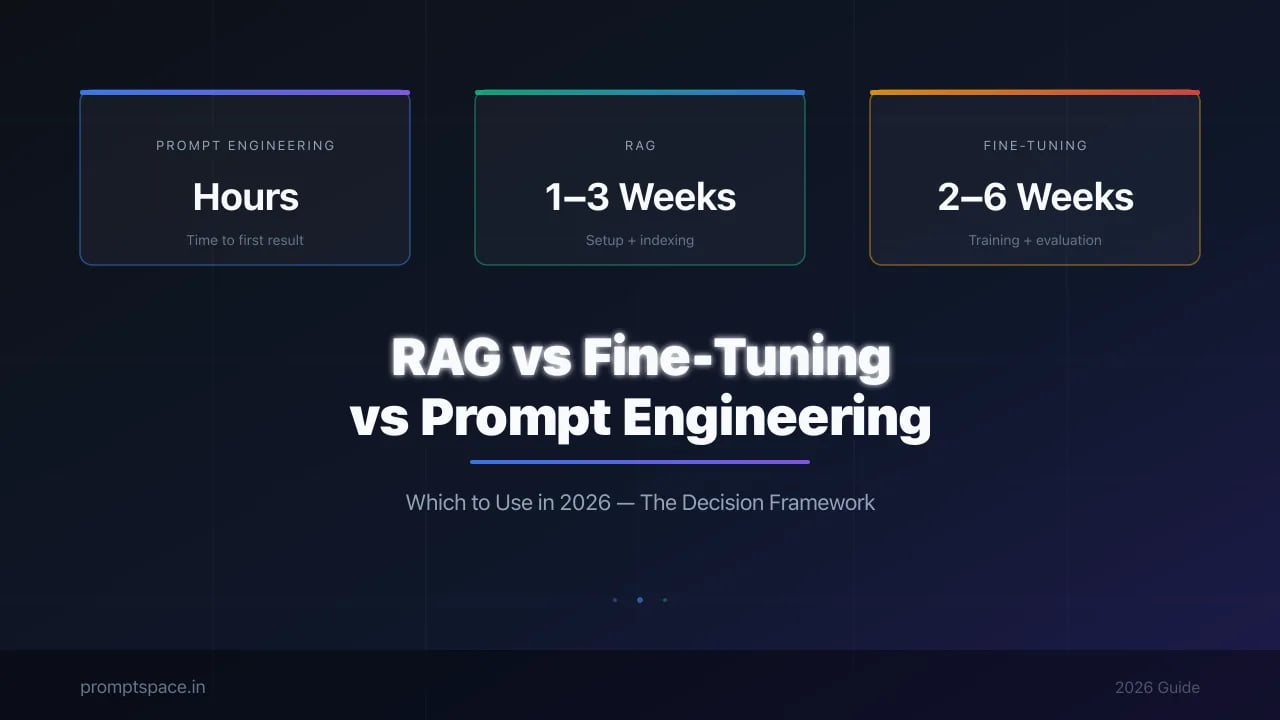
RAG vs Fine-Tuning vs Prompt Engineering: Which to Use in 2026
Three months after your team chose fine-tuning, you're back at the drawing board because the model still hallucinates product specs that changed last quarter. Another team picked RAG and now they're debugging retrieval noise at 11 PM. Meanwhile someone on Slack is insisting the whole thing could have been solved with a better system prompt.
They might be right. Or they might be about to waste six weeks finding out they weren't. The frustrating truth is that RAG, fine-tuning, and prompt engineering are not competing solutions — they solve genuinely different problems. Mixing them up at the architecture decision stage is one of the most expensive mistakes an AI team makes in 2026.
This guide gives you a concrete decision framework, a cost model, and the failure cases each approach handles badly. By the end, you'll know which technique to reach for first — and when to combine them.
Table of Contents
- TL;DR — The 60-Second Decision
- What Each Approach Actually Does
- Prompt Engineering: When It's Enough
- RAG: When Your Data Changes Faster Than You Can Train
- Fine-Tuning: When Behavior Is the Problem, Not Knowledge
- The Decision Framework (Printable)
- Cost Comparison: Time, Money, and Maintenance
- Combining Approaches: When 1+1 = 3
- Where MCP and Tool-Use Fit In
- Honest Limitations of Each Approach
- Frequently Asked Questions
TL;DR — The 60-Second Decision
Use prompt engineering when the base model already knows what it needs to know and you just need it to behave a certain way — format, tone, persona, task framing. Zero infrastructure. Iterate in minutes.
Use RAG when your domain knowledge changes frequently, is too large to fit in a context window, or is proprietary enough that you can't fine-tune on it. RAG keeps knowledge retrieval-time fresh; fine-tuning bakes stale snapshots into weights.
Use fine-tuning when you need the model to reliably produce a specific output format, adopt a specialized vocabulary, or consistently follow complex multi-step reasoning patterns — and prompt engineering alone keeps failing. Fine-tuning changes behavior, not just knowledge.
What Each Approach Actually Does
Before the decision framework, you need a crisp mental model of what each technique actually changes at inference time.
Prompt Engineering
Prompt engineering modifies the input to the model. You're writing instructions, examples, and context that steer the model's output without touching its weights or adding retrieval infrastructure. The model's world-knowledge is frozen as of its training cutoff. What changes is how it applies that knowledge.
Think of it like giving a very smart consultant a detailed brief before a meeting versus letting them walk in cold. Same consultant. Better output from the same person, with no retraining required.
Retrieval-Augmented Generation (RAG)
RAG adds a retrieval step before generation. At query time, a retriever searches a vector database (or a keyword index, or a hybrid of both) and injects relevant documents into the prompt. The model then generates its answer using both its trained knowledge and the retrieved context.
This means the model's effective knowledge can be updated just by updating the vector index — no retraining. But it also means every generation now depends on retrieval quality. A retriever that returns the wrong chunk can confidently mislead the model.
Fine-Tuning
Fine-tuning updates the model's weights using examples of the task you want it to perform. After fine-tuning, the behavior change is baked in — you don't need to prompt for it every time. The model's base knowledge shifts slightly too, but that's usually a side effect, not the goal.
Full fine-tuning trains every weight; Parameter-Efficient Fine-Tuning (PEFT) methods like LoRA and QLoRA update only a small adapter layer, making this practical on much smaller GPU budgets in 2026 than it was two years ago.
Prompt Engineering: When It's Enough
Prompt engineering is dramatically underestimated by teams who jump straight to infrastructure. There are real categories of problems where a well-crafted system prompt outperforms both RAG and fine-tuning — and costs orders of magnitude less.
Where Prompt Engineering Wins
- Format and structure tasks. Getting GPT-4o or Claude Opus to output JSON, Markdown tables, or YAML — reliably and consistently — is a prompt engineering problem. Few-shot examples in the system prompt solve this without any training infrastructure.
- Persona and tone adoption. Building a customer-facing agent that sounds like your brand is a system prompt problem. Fine-tuning for this is usually overkill.
- Multi-step reasoning chains. Chain-of-thought prompting ("think step by step") is a prompt engineering technique that dramatically improves accuracy on reasoning tasks. It works well on modern frontier models without any tuning.
- Safety and refusals. Guardrails against certain topics or output types are often faster to implement via system prompt constraints than via RLHF-style fine-tuning.
- Rapid iteration. When requirements are still changing weekly, a prompt can be versioned in a text file and deployed in seconds. A fine-tuning job cannot.
Where Prompt Engineering Fails
- Tasks that require domain-specific knowledge not in the training data (use RAG)
- Consistent low-latency behavior with a shorter context window (use fine-tuning)
- When the base model's output quality just isn't good enough for the task (evaluate fine-tuning)
- Highly confidential data you can't paste into a prompt (use fine-tuning on-premise)
⭐ Pro Tip: Before reaching for RAG or fine-tuning, spend a focused 4-hour session pushing the current model with structured prompts, few-shot examples, and a well-designed system prompt. In a surprising number of cases, the "we need RAG" conclusion was actually a "we need a better prompt" conclusion in disguise.
RAG: When Your Data Changes Faster Than You Can Train
RAG is the dominant pattern for enterprise AI in 2026 for one straightforward reason: most enterprise knowledge is dynamic. Product catalogs update. Policies change. Legal documents get amended. Retraining a model every time your documentation changes is impractical — RAG solves this by separating knowledge storage from model weights.
Where RAG Wins
- Frequently-updated knowledge bases. Support bots that need to answer questions about the current version of your product, not a snapshot from three months ago. The vector index updates; the model doesn't need to.
- Large private document corpora. When you have thousands of PDFs, contracts, or internal wikis that would never fit in a context window, RAG is the only practical option.
- Traceability requirements. RAG retrieves specific source chunks, making it possible to cite which document an answer came from. This is increasingly important for compliance in regulated industries.
- Multi-tenant knowledge separation. Namespace your vector index by customer and retrieve only the relevant tenant's data at query time. This is extremely difficult to achieve cleanly with fine-tuning.
RAG's Real Failure Modes (the ones no one talks about in tutorials)
- Retrieval noise. The retriever returns a chunk that's topically similar but semantically wrong for the specific query. The model incorporates it anyway. This is the "RAG hallucination" problem — it's actually a retrieval problem, not a generation problem.
- Chunking strategy debt. A wrong chunk size set in week 1 haunts you for months. Too large: context gets diluted. Too small: important context splits across two chunks, neither of which triggers a retrieval hit.
- Embedding model drift. If you re-embed your corpus with a newer model but forget to re-embed the query side (or vice versa), your retrieval quietly degrades for weeks before someone notices.
- Latency at scale. Each RAG call adds a retrieval round-trip. At 100 req/sec, this becomes a real architecture problem. Plan your caching strategy early.
⭐ Pro Tip: The single most impactful improvement to most RAG pipelines isn't a better model — it's better chunking and a hybrid retrieval strategy (BM25 keyword + semantic vector search). Test this before switching to a more expensive retrieval approach.
Fine-Tuning: When Behavior Is the Problem, Not Knowledge
Fine-tuning has a reputation as the expensive, slow option that you only reach for when everything else fails. That reputation was fair in 2022. In 2026, LoRA and QLoRA make fine-tuning a 4-6 hour job on commodity GPU infrastructure for most task-specific use cases. The cost bar has dropped dramatically. But the decision criteria haven't changed.
Where Fine-Tuning Wins
- Consistent output format. If the model needs to output structured JSON with a specific schema — reliably, across thousands of requests, without prompt-stuffing examples every time — fine-tuning is significantly more reliable than prompt engineering at scale. Fewer tokens per request means lower cost too.
- Domain-specific vocabulary. Medical billing codes, legal citations, industrial part numbers. The base model will generalize badly here. Fine-tuning on 1,000-5,000 domain-specific examples changes this.
- Task specialization at the edge. Running a 7B model on-device or at the edge with fine-tuning often outperforms a 70B general model via RAG, at a fraction of the inference cost and latency.
- Highly sensitive data. When the data can't leave your infrastructure — medical records, attorney-client privileged documents, classified material — fine-tuning a model you run on-premise is often the only legally viable option.
Fine-Tuning's Real Failure Modes
- Catastrophic forgetting. Fine-tune too aggressively on a narrow domain and the model loses its general reasoning ability. Use low learning rates and small datasets unless you've tested extensively.
- Knowledge staleness. Fine-tuned weights are frozen. If your domain knowledge changes (and it usually does), you need to either re-fine-tune or add a RAG layer on top — at which point you're doing both.
- Evaluation gap. Fine-tuning can produce a model that scores well on your evaluation set while failing silently on real-world edge cases. Your eval set is almost always narrower than production traffic.
- Tooling overhead. Even with LoRA, you need a training pipeline, versioned datasets, evaluation harness, and deployment infrastructure. This is 2-4 engineering weeks of setup for a first implementation.
The Decision Framework (Printable)
Use this flowchart before committing to any architecture. It's deliberately conservative — defaulting to the simpler approach until a concrete failure case forces the upgrade.
| Question | Yes → | No → |
|---|---|---|
| Does the base model already know everything it needs for this task? | Try prompt engineering first | Continue ↓ |
| Is the missing knowledge dynamic (changes weekly/monthly)? | Use RAG | Continue ↓ |
| Is the missing knowledge static and proprietary (can't use cloud API)? | Use fine-tuning on-premise | Continue ↓ |
| Is the problem about output behavior, not knowledge? | Use fine-tuning | Revisit prompt engineering |
| Do you need to cite source documents in the output? | RAG (or RAG + fine-tuning) | Either works |
| Does latency matter at >100 req/sec? | Fine-tuning (no retrieval overhead) | RAG is fine |
The Quick-Start Rule
If you're starting a new project: begin with prompt engineering alone. Run it in production for two weeks. Collect real failure cases. Then decide whether those failures point to a knowledge gap (use RAG) or a behavior gap (use fine-tuning). Most teams would save 4-8 weeks of engineering time if they followed this rule.
Cost Comparison: Time, Money, and Maintenance
| Dimension | Prompt Engineering | RAG | Fine-Tuning |
|---|---|---|---|
| Setup time | Hours | 1-3 weeks | 2-6 weeks |
| Initial cost | Near zero | $500-5,000 (infra + embedding) | $200-2,000 (GPU time, LoRA) |
| Ongoing cost | API tokens only | Vector DB hosting + retrieval API | Re-training cadence + inference hosting |
| Maintenance load | Low (prompt versioning) | Medium (index freshness, chunk strategy) | High (eval harness, re-training pipeline) |
| Time-to-iterate | Minutes | Hours (re-index) | Days (re-train) |
| Knowledge freshness | Training cutoff | Real-time (when indexed) | Training cutoff (stale by default) |
| Latency (p99) | Lowest | Medium (retrieval overhead) | Low (no retrieval step) |
The cost numbers above assume standard frontier model API costs (GPT-4o, Claude) for inference. For self-hosted open-source models, fine-tuning changes the calculus because per-token inference costs drop to near zero once the model is deployed — making the one-time training cost more attractive.
⭐ Pro Tip: The hidden cost everyone underestimates is the evaluation harness. You can't confidently iterate on RAG or fine-tuning without a test set that covers real failure cases from production. Budget one engineering week to build this before starting any optimization work.
Combining Approaches: When 1+1 = 3
The most robust production AI systems in 2026 use all three techniques in combination. The trick is knowing which combination makes sense for your specific problem.
RAG + Prompt Engineering (most common)
This is the default pattern for knowledge-intensive applications. The retriever finds relevant context; the prompt tells the model how to use that context. Your prompt engineering controls citation format, refusal behavior when context is insufficient, and output structure. This is where most enterprise chatbot and search projects land.
Fine-Tuning + RAG (for specialized domains)
Fine-tune the model on domain vocabulary and output format, then add RAG for current knowledge. A legal AI assistant might be fine-tuned on legal reasoning patterns (behavior) while retrieving from a current case law index (knowledge). The fine-tuning makes it reliably produce properly-formatted legal memos; the RAG keeps the case citations current.
Fine-Tuning + Prompt Engineering (for edge deployment)
Deploy a small fine-tuned model (7B-13B) at the edge or on-device with a minimal system prompt. The fine-tuning handles the heavy lifting of domain behavior; the system prompt handles session-specific context. This pattern is growing rapidly in industrial IoT, healthcare wearables, and on-device assistants where RAG's retrieval overhead is impractical.
All Three (for complex enterprise agents)
A customer service agent might: (1) start with a fine-tuned base that understands company tone and output format, (2) retrieve the customer's account history and recent policy changes via RAG, and (3) use a detailed system prompt to stitch these together into a specific response strategy for the current ticket category. Overkill for most applications — right-sized for high-volume, high-stakes customer interactions.
Where MCP and Tool-Use Fit In
Model Context Protocol (MCP) started showing up in Google autocomplete alongside RAG vs fine-tuning searches in mid-2026 — a signal that practitioners are trying to understand where it fits in this stack.
MCP is a runtime protocol for connecting models to external tools and data sources. It's closer to RAG in the sense that it extends what a model can access at inference time, but the mechanism is different: instead of vector search, MCP provides structured tool calls (APIs, database queries, file reads) that the model orchestrates.
MCP vs RAG
- RAG is passive retrieval: you search for text chunks and inject them. Best for unstructured document corpora.
- MCP is active tool-use: the model calls a function, gets back structured data, and incorporates it. Best for transactional data, live API integrations, and deterministic queries.
The practical difference: use RAG when you're searching over text ("find me relevant policy clauses"). Use MCP when you're querying structured systems ("look up this customer's current subscription tier in the CRM").
Neither replaces fine-tuning for behavior problems. Neither replaces prompt engineering for basic instruction-following. MCP adds a new column to the decision matrix — it doesn't collapse the existing ones.
Honest Limitations (What This Guide Won't Fix)
No framework eliminates the need for experimentation. The decision tree above gives you a starting point — but the right approach for your specific use case depends on your data quality, your team's skills, your latency requirements, and a dozen other variables that a blog post can't fully account for.
What this guide can't tell you:
- Whether your specific base model is capable enough of the task even with the right technique applied
- The actual chunking strategy and embedding model that will work for your specific document corpus
- Whether your fine-tuning dataset is large enough and high-quality enough to achieve your target accuracy
- How your production traffic distribution will differ from your test set
The real failure mode to avoid: choosing a technique based on what sounds impressive to stakeholders rather than what matches the problem. RAG pipelines are visually impressive in demos. Fine-tuning makes for better conference talks. Neither of these is a reason to pick one over a well-crafted system prompt that gets the job done.
Frequently Asked Questions
Is RAG better than fine-tuning for most applications?
For applications where knowledge changes frequently, yes — RAG is almost always the right starting point. But if the problem is about making the model behave a certain way reliably (specific output format, domain-specific reasoning patterns), fine-tuning addresses what RAG cannot. Most production systems eventually combine both rather than choosing one.
Can I use RAG and fine-tuning together?
Yes, and this combination is increasingly common in 2026. Fine-tune the model on domain-specific behavior and output format. Add RAG for current-knowledge retrieval. The fine-tuned model will use the retrieved context more reliably and in the expected format. This is the architecture underlying most serious enterprise AI deployments.
How much training data do I need for fine-tuning?
For task-specific fine-tuning with LoRA, as few as 500-1,000 high-quality examples often produce measurable improvement. For output-format consistency tasks, 200-500 examples is frequently sufficient. For domain-vocabulary adaptation, plan for 2,000-10,000+ depending on vocabulary breadth. Quality matters far more than quantity.
Is prompt engineering still worth learning in 2026?
More than ever. Frontier models are more capable, meaning a well-structured prompt can accomplish tasks that used to require fine-tuning. Prompt engineering is also the fastest iteration loop — critical for any application still in discovery or with changing requirements. Every engineer shipping AI-powered features needs these skills, regardless of what infrastructure they build on top.
Where does MCP fit in the RAG vs fine-tuning decision?
MCP is a tool-use layer, not a direct alternative to RAG. Use RAG when you're searching unstructured text corpora. Use MCP when you need the model to query structured data systems (APIs, databases, CRMs) at inference time. In complex agentic pipelines you may use both: MCP for transactional lookups, RAG for document search. Neither replaces fine-tuning for behavior-change tasks.
What's the cheapest way to get started with fine-tuning in 2026?
LoRA on a small open-source model (Llama 3 8B, Mistral 7B) via RunPod or Modal is the most cost-effective entry point — typically $20-80 for a complete fine-tuning run on 1,000-5,000 examples. QLoRA reduces VRAM requirements further, making a single consumer-grade GPU (A100 40GB) viable for most task-specific jobs. Hugging Face's PEFT library and torchtune are the standard toolchains.
Can prompt engineering alone replace RAG for my internal knowledge base?
Only if your entire knowledge base fits within the model's context window and the content is static. Modern frontier models support 128K-1M token context windows, making this more viable than it was — but for most enterprise knowledge bases spanning thousands of documents, this approach is impractical, and the cost of stuffing full documents into every prompt becomes prohibitive at scale.
What's the best evaluation metric for a RAG pipeline?
Evaluate retrieval quality and generation quality separately. For retrieval: precision@k and recall@k against a labeled query set. For generation: hallucination rate (answers that contradict retrieved context), faithfulness (answers that only use retrieved content), and answer relevancy. RAGAS is the standard open-source evaluation framework for this in 2026, covering all these dimensions in a single evaluation run.
What To Do Next
The highest-leverage thing you can do today is audit your current AI stack against this decision framework. For each component: is it solving a knowledge problem, a behavior problem, or an instruction problem? If the technique doesn't match the problem type, you've found your bottleneck.. For prompt templates specifically designed for RAG pipelines, the RAG prompt collection is a useful starting point.
If you're building prompts for RAG pipelines or fine-tuned models and want a library of tested, production-grade prompts to work from, explore PromptSpace's prompt library — organized by use case, with a growing section on RAG-specific prompting patterns and system prompt templates for instruction-tuned models.
For practitioners going deeper on the architecture side: the deep research agent stack post covers how RAG and tool-use compose in a production research workflow. The production MCP server guide is the practical starting point for the MCP tool-use layer.
Finally: the 300-line eval harness post shows the evaluation infrastructure you need before optimizing any of the three techniques described here. Build the evaluation layer first. Everything else follows from that.